Peng Xinjian, Li Wenping, Johnson William D, Torres Karen E O, McCormick David L
Life Sciences Group, IIT Research Institute, Chicago, Illinois, 60616, United States of America.
GenUs Biosystems, Northbrook, Illinois, 60062, United States of America.
PLoS One. 2015 Jan 30;10(1):e0116285. doi: 10.1371/journal.pone.0116285. eCollection 2015.
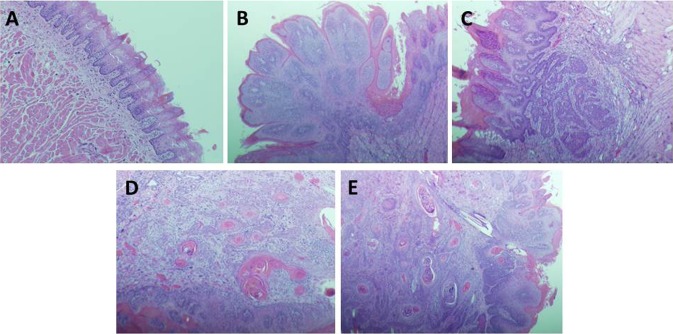
Oral squamous cell carcinomas (OSCC) induced in F344 rats by 4-nitroquinoline-1-oxide (4-NQO) demonstrate considerable phenotypic similarity to human oral cancers. Gene expression studies (microarray and PCR) were coupled with methylation analysis of selected genes to identify molecular markers of carcinogenesis in this model and potential biochemical and molecular targets for oral cancer chemoprevention. Microarray analysis of 11 pairs of OSCC and site-matched phenotypically normal oral tissues from 4-NQO-treated rats identified more than 3500 differentially expressed genes; 1735 genes were up-regulated in rat OSCC versus non-malignant tissues, while 1803 genes were down-regulated. In addition to several genes involved in normal digestion, genes demonstrating the largest fold increases in expression in 4-NQO-induced OSCC include three lipocalins (VEGP1, VEGP2, LCN2) and three chemokines (CCL, CXCL2, CXCL3); both classes are potentially druggable targets for oral cancer chemoprevention and/or therapy. Down-regulated genes in 4-NQO-induced OSCC include numerous keratins and keratin-associated proteins, suggesting that alterations in keratin expression profiles may provide a useful biomarker of oral cancer in F344 rats treated with 4-NQO. Confirming and extending our previous results, PTGS2 (cyclooxygenase-2) and several cyclooxygenase-related genes were significantly up-regulated in 4-NQO-induced oral cancers; up-regulation of PTGS2 was associated with promoter hypomethylation. Rat OSCC also demonstrated increased methylation of the first exon of APC2; the increased methylation was correlated with down-regulation of this tumor suppressor gene. Overexpression of pro-inflammatory chemokines, hypomethylation of PTGS2, and hypermethylation of APC2 may be causally linked to the etiology of oral cancer in this model.
4-硝基喹啉-1-氧化物(4-NQO)诱导F344大鼠产生的口腔鳞状细胞癌(OSCC)与人类口腔癌表现出相当大的表型相似性。基因表达研究(微阵列和聚合酶链反应)与选定基因的甲基化分析相结合,以鉴定该模型中致癌作用的分子标志物以及口腔癌化学预防的潜在生化和分子靶点。对11对来自4-NQO处理大鼠的OSCC和位点匹配的表型正常口腔组织进行微阵列分析,鉴定出3500多个差异表达基因;与非恶性组织相比,1735个基因在大鼠OSCC中上调,而1803个基因下调。除了几个参与正常消化的基因外,在4-NQO诱导的OSCC中表达增加倍数最大的基因包括三种脂质运载蛋白(VEGP1、VEGP2、LCN2)和三种趋化因子(CCL、CXCL2、CXCL3);这两类基因都是口腔癌化学预防和/或治疗的潜在可药物作用靶点。4-NQO诱导的OSCC中下调的基因包括许多角蛋白和角蛋白相关蛋白,这表明角蛋白表达谱的改变可能为用4-NQO处理的F344大鼠口腔癌提供有用的生物标志物。证实并扩展我们之前的结果,PTGS2(环氧化酶-2)和几个环氧化酶相关基因在由4-NQO诱导的口腔癌中显著上调;PTGS2的上调与启动子低甲基化有关。大鼠OSCC还表现出APC2第一外显子甲基化增加;甲基化增加与该肿瘤抑制基因的下调相关。促炎趋化因子的过表达、PTGS2的低甲基化和APC2的高甲基化可能与该模型中口腔癌的病因有因果关系。