Feng Rentian, Tong Qin, Xie Zhaojun, Cheng Haizi, Wang Lirong, Lentzsch Suzanne, Roodman G David, Xie Xiang-Qun
Department of Pharmaceutical Sciences and Drug Discovery Institute, Computational Chemical Genomics Screening Center, School of Pharmacy, and NIH NIDA Center of Excellence for Computational Drug Abuse Research, University of Pittsburgh, Pittsburgh, Pennsylvania.
Department of Computational Biology, Joint Pitt/CMU Computational Biology Program, University of Pittsburgh, Pittsburgh, Pennsylvania.
Mol Carcinog. 2015 Dec;54(12):1796-806. doi: 10.1002/mc.22251. Epub 2015 Jan 16.
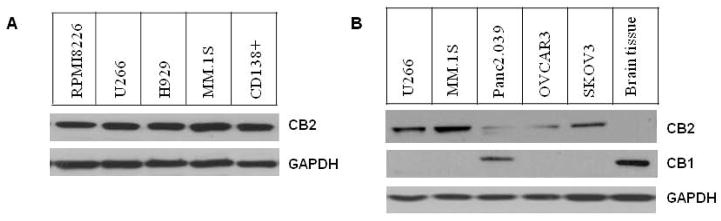
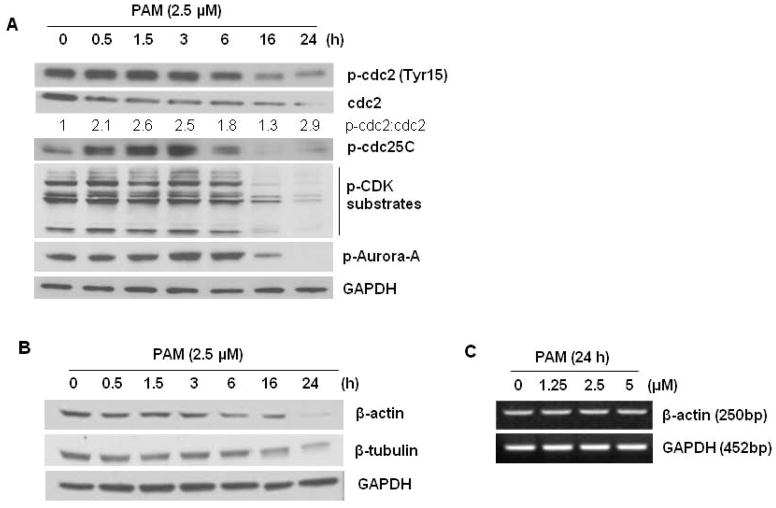
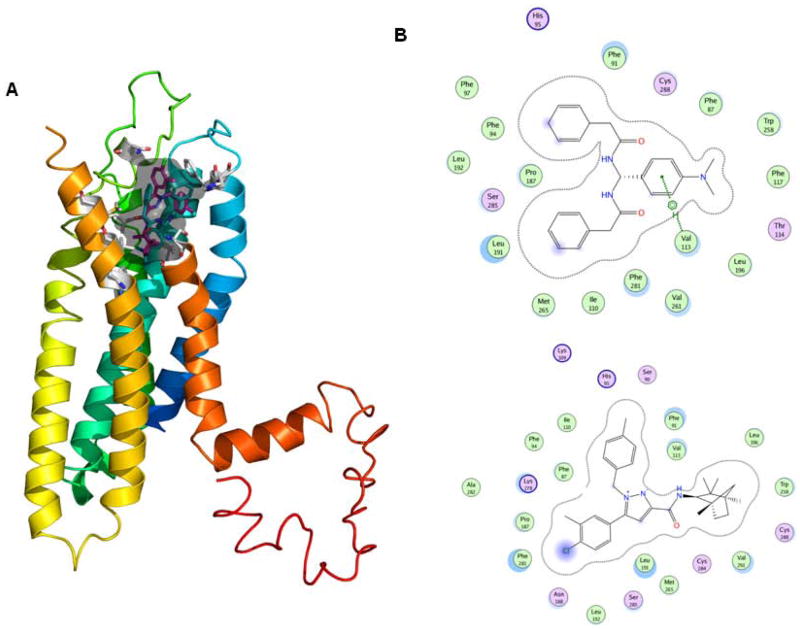
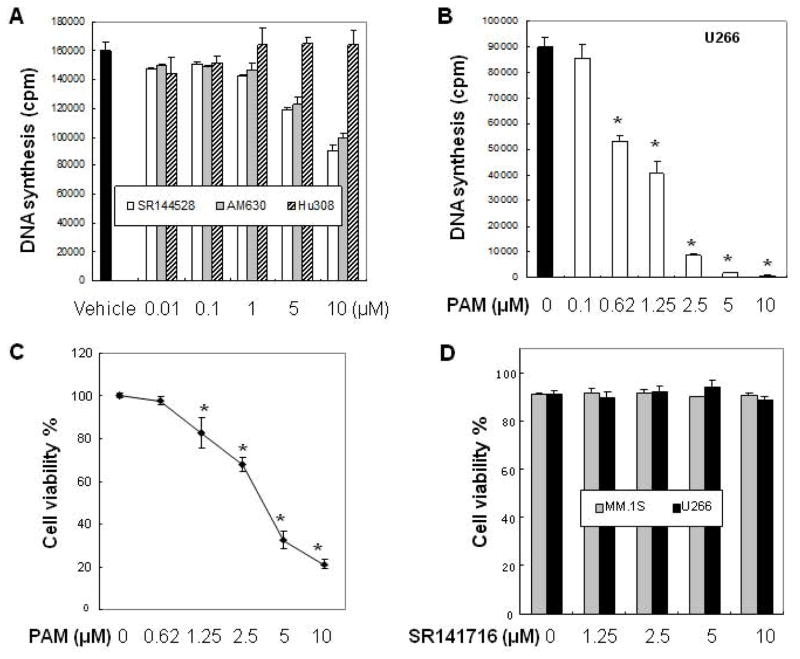
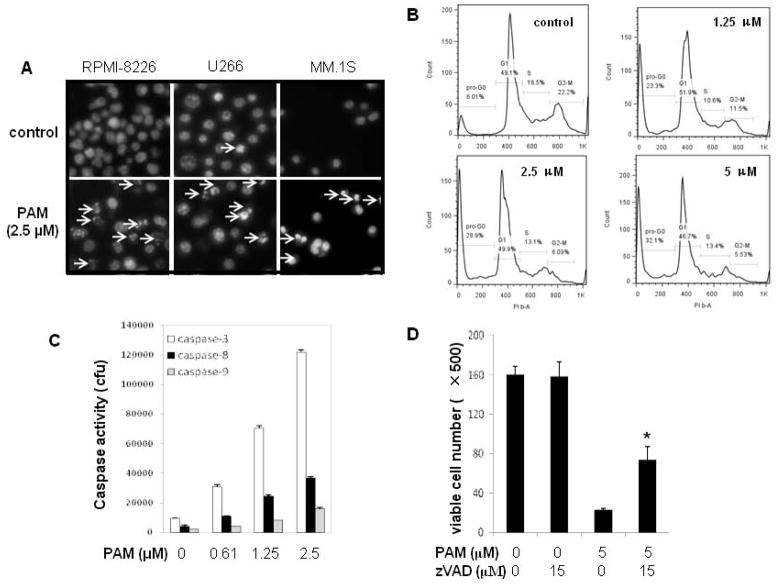
Cannabinoid receptor-2 (CB2) is expressed dominantly in the immune system, especially on plasma cells. Cannabinergic ligands with CB2 selectivity emerge as a class of promising agents to treat CB2-expressing malignancies without psychotropic concerns. In this study, we found that CB2 but not CB1 was highly expressed in human multiple myeloma (MM) and primary CD138+ cells. A novel inverse agonist of CB2, phenylacetylamide but not CB1 inverse agonist SR141716, inhibited the proliferation of human MM cells (IC50 : 0.62 ∼ 2.5 μM) mediated by apoptosis induction, but exhibited minor cytotoxic effects on human normal mononuclear cells. CB2 gene silencing or pharmacological antagonism markedly attenuated phenylacetylamide's anti-MM effects. Phenylacetylamide triggered the expression of C/EBP homologous protein at the early treatment stage, followed by death receptor-5 upregulation, caspase activation, and β-actin/tubulin degradation. Cell cycle related protein cdc25C and mitotic regulator Aurora A kinase were inactivated by phenylacetylamide treatment, leading to an increase in the ratio inactive/active cdc2 kinase. As a result, phosphorylation of CDK substrates was decreased, and the MM cell mitotic division was largely blocked by treatment. Importantly, phenylacetylamide could overcome the chemoresistance of MM cells against dexamethasone or melphalan. Thus, targeting CB2 may represent an attractive approach to treat cancers of immune origin.
大麻素受体-2(CB2)主要在免疫系统中表达,尤其是在浆细胞上。具有CB2选择性的大麻素能配体成为一类有前景的药物,可用于治疗表达CB2的恶性肿瘤而无精神方面的顾虑。在本研究中,我们发现CB2而非CB1在人多发性骨髓瘤(MM)和原代CD138+细胞中高表达。一种新型的CB2反向激动剂苯乙酰酰胺而非CB1反向激动剂SR141716,通过诱导凋亡抑制人MM细胞的增殖(IC50:0.62~2.5μM),但对人正常单核细胞表现出轻微的细胞毒性作用。CB2基因沉默或药理学拮抗显著减弱苯乙酰酰胺的抗MM作用。苯乙酰酰胺在治疗早期触发C/EBP同源蛋白的表达,随后死亡受体-5上调、半胱天冬酶激活以及β-肌动蛋白/微管蛋白降解。细胞周期相关蛋白cdc25C和有丝分裂调节因子极光激酶A被苯乙酰酰胺处理失活,导致无活性/活性cdc2激酶比值增加。结果,CDK底物的磷酸化减少,MM细胞的有丝分裂被处理在很大程度上阻断。重要的是,苯乙酰酰胺可以克服MM细胞对地塞米松或美法仑的耐药性。因此,靶向CB2可能是治疗免疫源性癌症的一种有吸引力的方法。