Berland Aurore, Gaillard Pascal, Guidetti Michèle, Barone Pascal
Unité de Recherche Interdisciplinaire Octogone, EA4156, Laboratoire Cognition, Communication et Développement, Université de Toulouse Jean-Jaurès, Toulouse, France; Centre de Recherche Cerveau et Cognition, Université de Toulouse UPS, CNRS-UMR 5549, Toulouse, France.
Unité de Recherche Interdisciplinaire Octogone, EA4156, Laboratoire Cognition, Communication et Développement, Université de Toulouse Jean-Jaurès, Toulouse, France.
PLoS One. 2015 Feb 2;10(2):e0115557. doi: 10.1371/journal.pone.0115557. eCollection 2015.
The analysis of categorization of everyday sounds is a crucial aspect of the perception of our surrounding world. However, it constitutes a poorly explored domain in developmental studies. The aim of our study was to understand the nature and the logic of the construction of auditory cognitive categories for natural sounds during development. We have developed an original approach based on a free sorting task (FST). Indeed, categorization is fundamental for structuring the world and cognitive skills related to, without having any need of the use of language. Our project explored the ability of children to structure their acoustic world, and to investigate how such structuration matures during normal development. We hypothesized that age affects the listening strategy and the category decision, as well as the number and the content of individual categories.
Eighty-two French children (6-9 years), 20 teenagers (12-13 years), and 24 young adults participated in the study. Perception and categorization of everyday sounds was assessed based on a FST composed of 18 different sounds belonging to three a priori categories: non-linguistic human vocalizations, environmental sounds, and musical instruments.
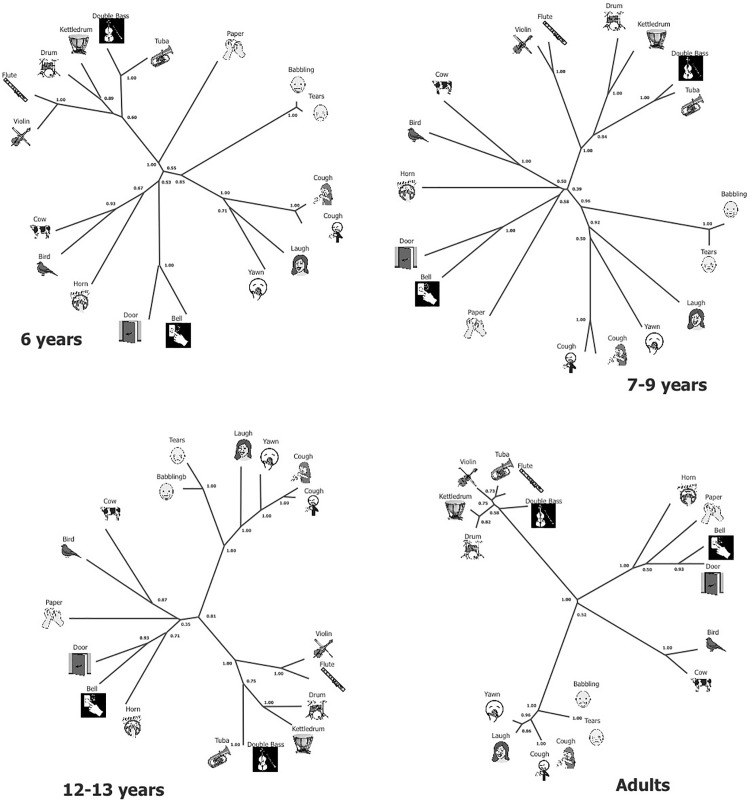
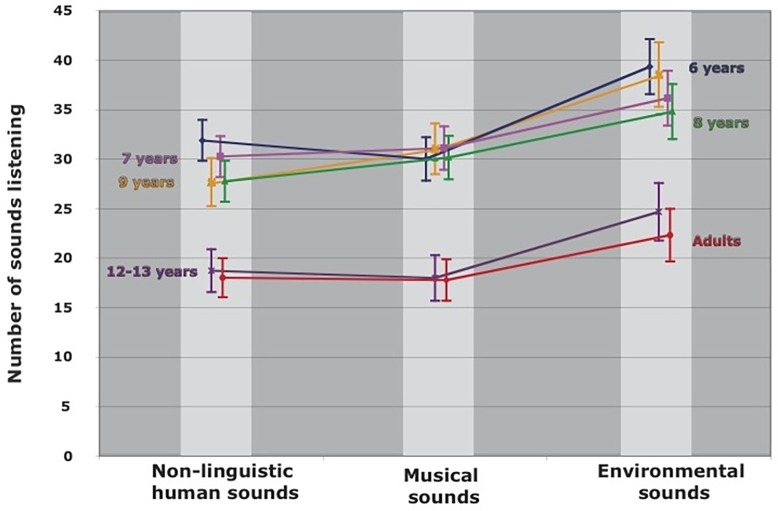
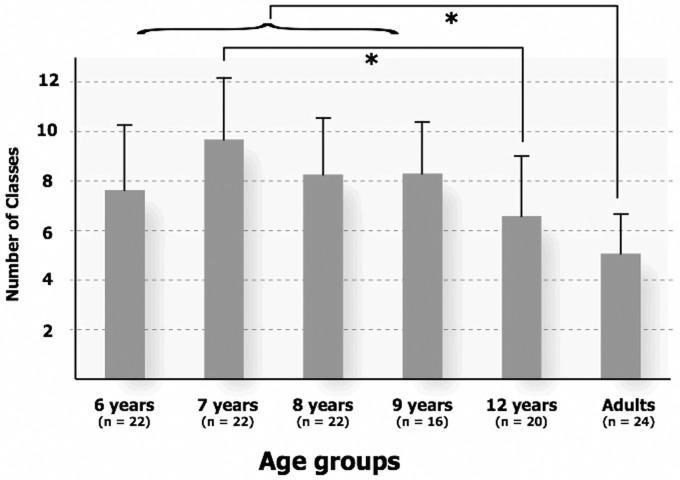
Children listened to the sounds more times than older participants, built significantly more classes than adults, and used a different strategy of classification. We can thus conclude that there is an age effect on how the participants accomplished the task. Analysis of the auditory categorization performed by 6-year-old children showed that this age constitutes a pivotal stage, in agreement with the progressive change from a non-logical reasoning based mainly on perceptive representations to the logical reasoning used by older children. In conclusion, our results suggest that the processing of auditory object categorization develops through different stages, while the intrinsic basis of the classification of sounds is already present in childhood.
对日常声音进行分类分析是我们感知周围世界的一个关键方面。然而,在发展研究中,这是一个尚未得到充分探索的领域。我们研究的目的是了解在发育过程中自然声音听觉认知类别的构建本质和逻辑。我们基于自由分类任务(FST)开发了一种原创方法。事实上,分类对于构建世界以及与之相关的认知技能至关重要,而无需使用语言。我们的项目探讨了儿童构建其声学世界的能力,并研究这种构建在正常发育过程中是如何成熟的。我们假设年龄会影响听力策略和类别决策,以及各个类别的数量和内容。
82名法国儿童(6 - 9岁)、20名青少年(12 - 13岁)和24名年轻人参与了这项研究。基于由18种不同声音组成的自由分类任务对日常声音的感知和分类进行评估,这些声音属于三个先验类别:非语言人类发声、环境声音和乐器声音。
儿童比年龄较大的参与者听声音的次数更多,构建的类别明显比成年人多,并且使用了不同的分类策略。因此,我们可以得出结论,参与者完成任务的方式存在年龄效应。对6岁儿童进行的听觉分类分析表明,这个年龄构成了一个关键阶段,这与从主要基于感知表征的非逻辑推理到年龄较大儿童使用的逻辑推理的渐进变化相一致。总之,我们的结果表明,听觉对象分类的处理是通过不同阶段发展的,而声音分类的内在基础在儿童时期就已经存在。