• 文献检索
  • 文档翻译
  • 深度研究
  • 学术资讯
  • Suppr Zotero 插件Zotero 插件
  • 邀请有礼
  • 套餐&价格
  • 历史记录
应用&插件
Suppr Zotero 插件Zotero 插件浏览器插件Mac 客户端Windows 客户端微信小程序
定价
高级版会员购买积分包购买API积分包
服务
文献检索文档翻译深度研究API 文档MCP 服务
关于我们
关于 Suppr公司介绍联系我们用户协议隐私条款
关注我们

Suppr 超能文献

核心技术专利:CN118964589B侵权必究
粤ICP备2023148730 号-1Suppr @ 2026

文献检索

告别复杂PubMed语法,用中文像聊天一样搜索,搜遍4000万医学文献。AI智能推荐,让科研检索更轻松。

立即免费搜索

文件翻译

保留排版,准确专业,支持PDF/Word/PPT等文件格式,支持 12+语言互译。

免费翻译文档

深度研究

AI帮你快速写综述,25分钟生成高质量综述,智能提取关键信息,辅助科研写作。

立即免费体验

人工耳蜗植入儿童对日常声音的分类。

Categorization of everyday sounds by cochlear implanted children.

机构信息

UMR 5549, Faculté de Médecine Purpan, Centre National de la Recherche Scientifique, Toulouse, France.

Centre de Recherche Cerveau et Cognition, Université de Toulouse, Université Paul Sabatier, Toulouse, France.

出版信息

Sci Rep. 2019 Mar 5;9(1):3532. doi: 10.1038/s41598-019-39991-9.

DOI:10.1038/s41598-019-39991-9
PMID:30837546
原文链接:https://pmc.ncbi.nlm.nih.gov/articles/PMC6401047/
Abstract

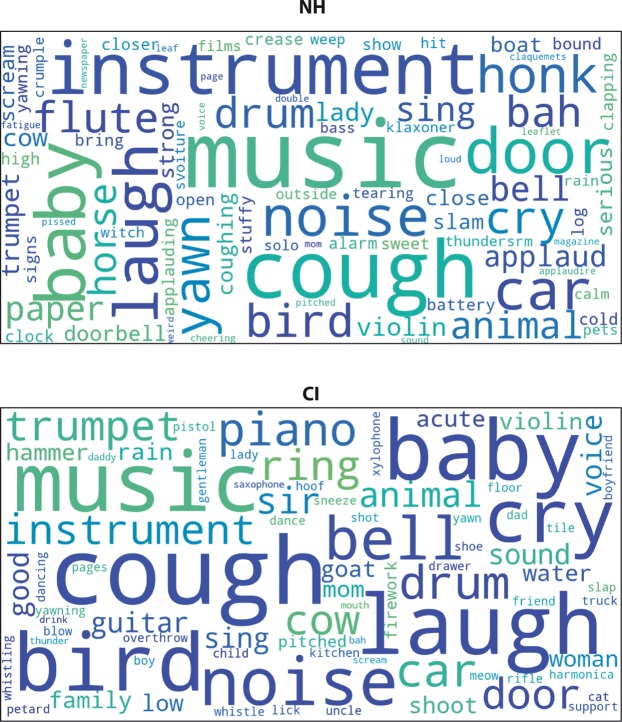
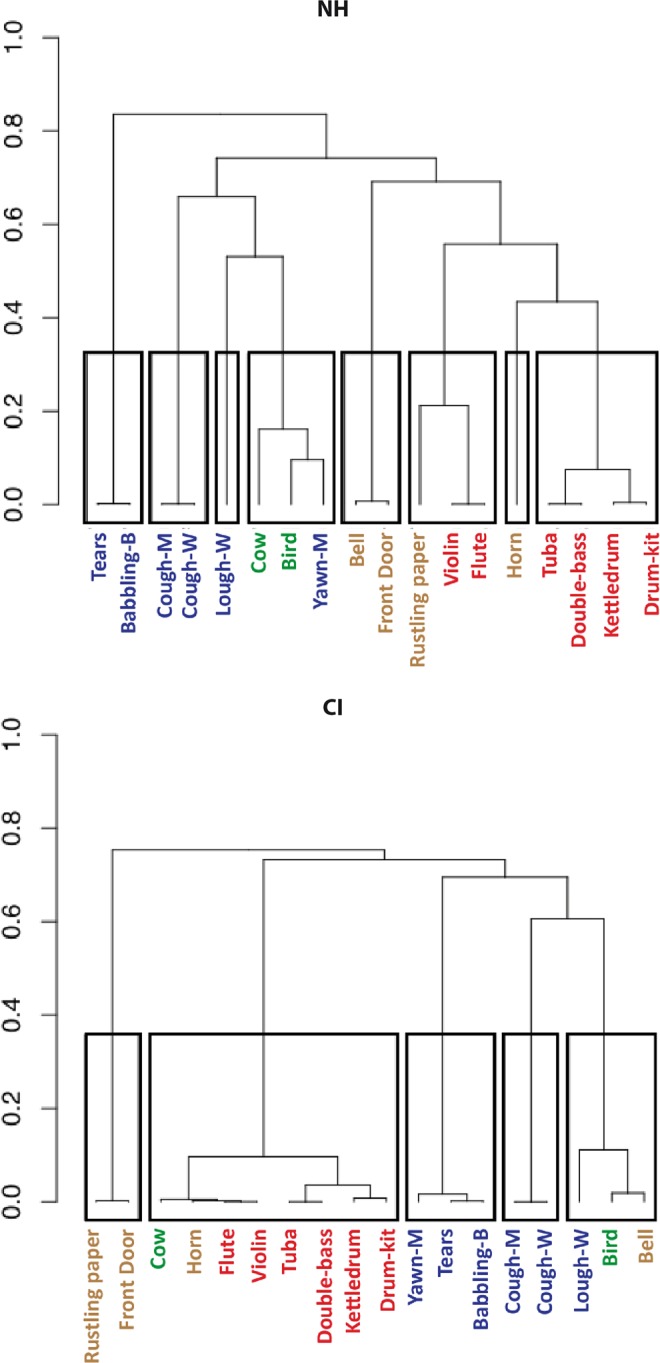
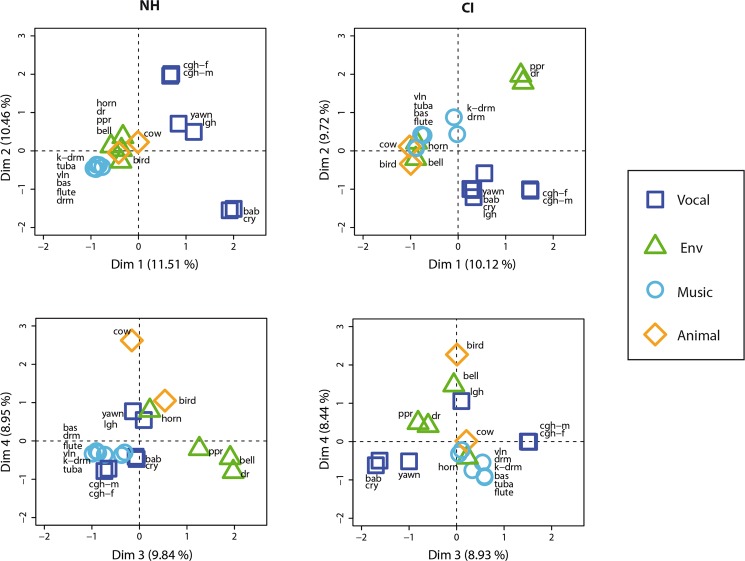
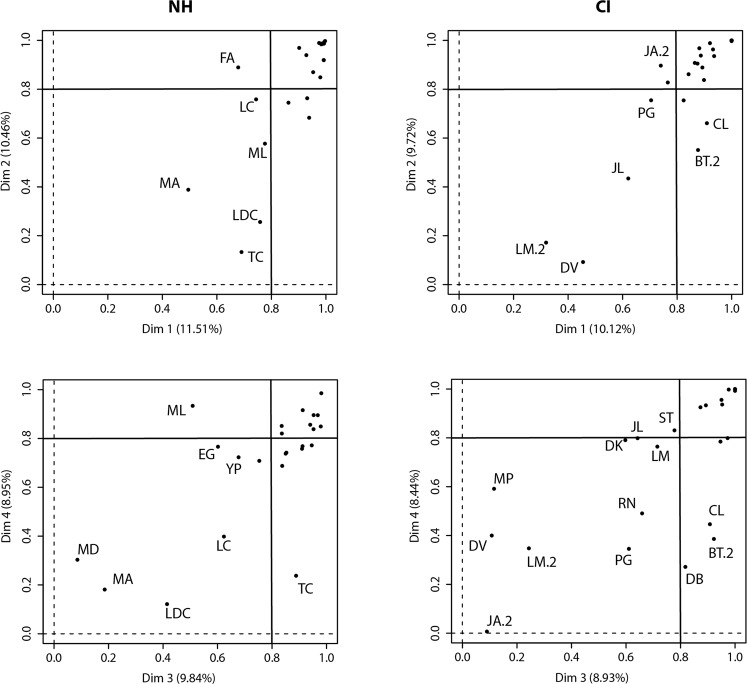
Auditory categorization is an important process in the perception and understanding of everyday sounds. The use of cochlear implants (CIs) may affect auditory categorization and result in poor abilities. The current study was designed to compare how children with normal hearing (NH) and children with CIs categorize a set of everyday sounds. We tested 24 NH children and 24 children with CI on a free-sorting task of 18 everyday sounds corresponding to four a priori categories: nonlinguistic human vocalizations, environmental sounds, musical sounds, and animal vocalizations. Multiple correspondence analysis revealed considerable variation within both groups of child listeners, although the human vocalizations and musical sounds were similarly categorized. In contrast to NH children, children with CIs categorized some sounds according to their acoustic content rather than their associated semantic information. These results show that despite identification deficits, children with CIs are able to categorize environmental and vocal sounds in a similar way to NH children, and are able to use categorization as an adaptive process when dealing with everyday sounds.

摘要

听觉分类是感知和理解日常声音的一个重要过程。使用人工耳蜗(CI)可能会影响听觉分类,并导致分类能力较差。本研究旨在比较正常听力(NH)儿童和 CI 儿童对一组日常声音的分类。我们对 24 名 NH 儿童和 24 名 CI 儿童进行了 18 种日常声音的自由分类任务测试,这些声音对应于四个先验类别:非语言人声、环境声音、音乐声音和动物声音。多元对应分析显示,尽管人类声音和音乐声音的分类相似,但两组儿童听众内部都存在相当大的差异。与 NH 儿童不同的是,CI 儿童根据声音的声学内容而不是其相关的语义信息对一些声音进行分类。这些结果表明,尽管存在识别缺陷,但 CI 儿童能够以类似于 NH 儿童的方式对环境和人声进行分类,并且能够在处理日常声音时将分类作为一种自适应过程。
https://cdn.ncbi.nlm.nih.gov/pmc/blobs/fb69/6401047/f874ba37db10/41598_2019_39991_Fig5_HTML.jpg
https://cdn.ncbi.nlm.nih.gov/pmc/blobs/fb69/6401047/82e0f8d39ced/41598_2019_39991_Fig1_HTML.jpg
https://cdn.ncbi.nlm.nih.gov/pmc/blobs/fb69/6401047/f3b48d094e06/41598_2019_39991_Fig2_HTML.jpg
https://cdn.ncbi.nlm.nih.gov/pmc/blobs/fb69/6401047/5a752fceffd5/41598_2019_39991_Fig3_HTML.jpg
https://cdn.ncbi.nlm.nih.gov/pmc/blobs/fb69/6401047/854c4c51635c/41598_2019_39991_Fig4_HTML.jpg
https://cdn.ncbi.nlm.nih.gov/pmc/blobs/fb69/6401047/f874ba37db10/41598_2019_39991_Fig5_HTML.jpg
https://cdn.ncbi.nlm.nih.gov/pmc/blobs/fb69/6401047/82e0f8d39ced/41598_2019_39991_Fig1_HTML.jpg
https://cdn.ncbi.nlm.nih.gov/pmc/blobs/fb69/6401047/f3b48d094e06/41598_2019_39991_Fig2_HTML.jpg
https://cdn.ncbi.nlm.nih.gov/pmc/blobs/fb69/6401047/5a752fceffd5/41598_2019_39991_Fig3_HTML.jpg
https://cdn.ncbi.nlm.nih.gov/pmc/blobs/fb69/6401047/854c4c51635c/41598_2019_39991_Fig4_HTML.jpg
https://cdn.ncbi.nlm.nih.gov/pmc/blobs/fb69/6401047/f874ba37db10/41598_2019_39991_Fig5_HTML.jpg

相似文献

1
Categorization of everyday sounds by cochlear implanted children.人工耳蜗植入儿童对日常声音的分类。
Sci Rep. 2019 Mar 5;9(1):3532. doi: 10.1038/s41598-019-39991-9.
2
Categorization of common sounds by cochlear implanted and normal hearing adults.人工耳蜗植入者和听力正常的成年人对常见声音的分类。
Hear Res. 2016 May;335:207-219. doi: 10.1016/j.heares.2016.03.007. Epub 2016 Apr 2.
3
Categorisation of natural sounds at different stages of auditory recovery in cochlear implant adult deaf patients.人工耳蜗植入成年聋人患者听觉恢复不同阶段自然声音的分类
Hear Res. 2018 Sep;367:182-194. doi: 10.1016/j.heares.2018.06.006. Epub 2018 Jun 12.
4
Perception of musical timbre by cochlear implant listeners: a multidimensional scaling study.人工耳蜗使用者对音乐音色的感知:多维标度研究。
Ear Hear. 2013 Jul-Aug;34(4):426-36. doi: 10.1097/AUD.0b013e31827535f8.
5
Cochlear implant-mediated perception of nonlinguistic sounds.人工耳蜗介导的非语言声音感知。
Ear Hear. 2010 Aug;31(4):505-14. doi: 10.1097/AUD.0b013e3181d99a52.
6
Cortical Processing of Vocal and Nonvocal Sounds in Cochlear-Implanted Children: An Electrophysiological Study.人工耳蜗植入儿童对声音和非声音的皮层处理:一项电生理研究。
Ear Hear. 2018 Jan/Feb;39(1):150-160. doi: 10.1097/AUD.0000000000000475.
7
Assessment of Spectral and Temporal Resolution in Cochlear Implant Users Using Psychoacoustic Discrimination and Speech Cue Categorization.使用心理声学辨别和语音线索分类评估人工耳蜗使用者的频谱和时间分辨率
Ear Hear. 2016 Nov/Dec;37(6):e377-e390. doi: 10.1097/AUD.0000000000000328.
8
Acoustic, aerodynamic, and perceptual analyses of the voice of cochlear-implanted children.人工耳蜗植入儿童嗓音的声学、空气动力学和感知分析。
J Voice. 2013 Jul;27(4):523.e1-17. doi: 10.1016/j.jvoice.2013.03.005.
9
Music perception with cochlear implants: a review.人工耳蜗植入的音乐感知:综述
Trends Amplif. 2004;8(2):49-82. doi: 10.1177/108471380400800203.
10
Perception of everyday sounds: a developmental study of a free sorting task.日常声音的感知:一项关于自由分类任务的发展性研究。
PLoS One. 2015 Feb 2;10(2):e0115557. doi: 10.1371/journal.pone.0115557. eCollection 2015.

引用本文的文献

1
Auditory sequence learning with degraded input: children with cochlear implants ('nature effect') compared to children from low and high socio-economic backgrounds ('nurture effect').输入退化时的听觉序列学习:与来自低社会经济背景和高社会经济背景的儿童(“后天培养效应”)相比,接受人工耳蜗植入的儿童(“先天效应”)。
Sci Rep. 2025 Mar 6;15(1):7872. doi: 10.1038/s41598-025-92454-2.
2
Recognizing Voices Through a Cochlear Implant: A Systematic Review of Voice Perception, Talker Discrimination, and Talker Identification.通过人工耳蜗识别声音:对声音感知、说话人辨别和说话人识别的系统评价。
J Speech Lang Hear Res. 2022 Aug 17;65(8):3165-3194. doi: 10.1044/2022_JSLHR-21-00209. Epub 2022 Aug 4.
3

本文引用的文献

1
Categorisation of natural sounds at different stages of auditory recovery in cochlear implant adult deaf patients.人工耳蜗植入成年聋人患者听觉恢复不同阶段自然声音的分类
Hear Res. 2018 Sep;367:182-194. doi: 10.1016/j.heares.2018.06.006. Epub 2018 Jun 12.
2
Higher-order auditory areas in congenital deafness: Top-down interactions and corticocortical decoupling.先天性耳聋中的高阶听觉区域:自上而下的相互作用和皮质-皮质解耦
Hear Res. 2017 Jan;343:50-63. doi: 10.1016/j.heares.2016.08.017. Epub 2016 Sep 13.
3
Categorization of common sounds by cochlear implanted and normal hearing adults.
Perception of Environmental Sounds in Cochlear Implant Users: A Systematic Review.
人工耳蜗使用者对环境声音的感知:一项系统综述。
Front Neurosci. 2022 Jan 10;15:788899. doi: 10.3389/fnins.2021.788899. eCollection 2021.
人工耳蜗植入者和听力正常的成年人对常见声音的分类。
Hear Res. 2016 May;335:207-219. doi: 10.1016/j.heares.2016.03.007. Epub 2016 Apr 2.
4
Cochlear implant assessment and candidacy for children with partial hearing.部分听力儿童的人工耳蜗评估及适应证
Cochlear Implants Int. 2016 Apr;17 Suppl 1:66-9. doi: 10.1080/14670100.2016.1152014.
5
Perception of everyday sounds: a developmental study of a free sorting task.日常声音的感知:一项关于自由分类任务的发展性研究。
PLoS One. 2015 Feb 2;10(2):e0115557. doi: 10.1371/journal.pone.0115557. eCollection 2015.
6
Speech prosody perception in cochlear implant users with and without residual hearing.有残余听力和无残余听力的人工耳蜗使用者的言语韵律感知
Ear Hear. 2015 Mar-Apr;36(2):239-48. doi: 10.1097/AUD.0000000000000105.
7
Gender categorization in cochlear implant users.人工耳蜗使用者的性别分类。
J Speech Lang Hear Res. 2013 Oct;56(5):1389-401. doi: 10.1044/1092-4388(2013/12-0132). Epub 2013 Sep 10.
8
Environmental sounds recognition in children with cochlear implants.人工耳蜗植入儿童的环境声音识别。
PLoS One. 2013 Jun 20;8(6):e66100. doi: 10.1371/journal.pone.0066100. Print 2013.
9
Auditory object salience: human cortical processing of non-biological action sounds and their acoustic signal attributes.听觉对象显著性:人类对非生物动作声音及其声学信号属性的皮质处理。
Front Syst Neurosci. 2012 May 9;6:27. doi: 10.3389/fnsys.2012.00027. eCollection 2012.
10
Auditory perception of material is fragile while action is strikingly robust.材料的听觉感知很脆弱,而动作则非常稳健。
J Acoust Soc Am. 2012 Feb;131(2):1337-48. doi: 10.1121/1.3675946.