Lorenz Aaron J, Beissinger Timothy M, Silva Renato Rodrigues, de Leon Natalia
Department of Agronomy and Horticulture, University of Nebraska, Lincoln, Nebraska 68583
Department of Plant Sciences, University of California, Davis, California 95616.
G3 (Bethesda). 2015 Feb 2;5(4):541-9. doi: 10.1534/g3.114.015263.
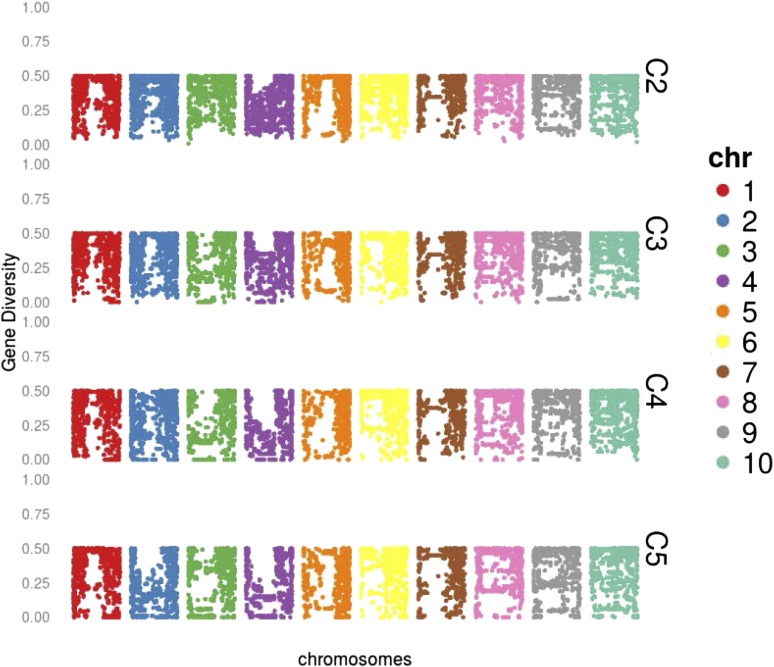
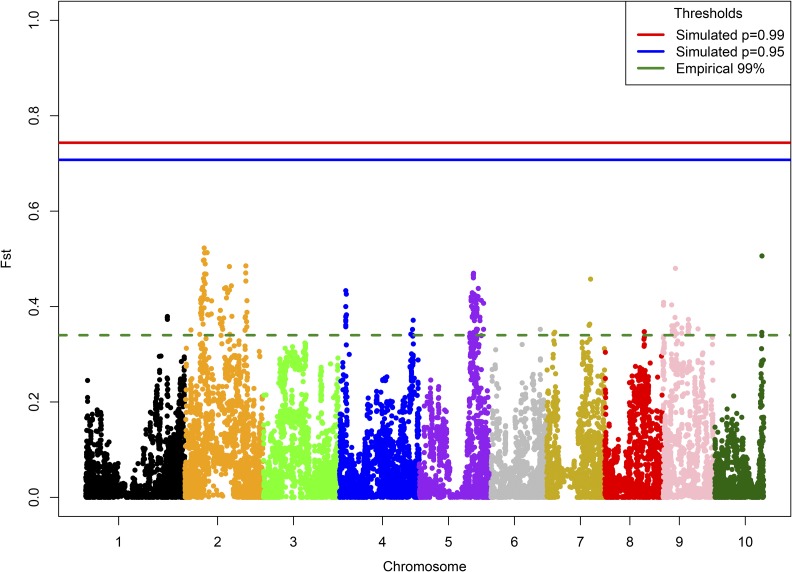
Maize silage is forage of high quality and yield, and represents the second most important use of maize in the United States. The Wisconsin Quality Synthetic (WQS) maize population has undergone five cycles of recurrent selection for silage yield and composition, resulting in a genetically improved population. The application of high-density molecular markers allows breeders and geneticists to identify important loci through association analysis and selection mapping, as well as to monitor changes in the distribution of genetic diversity across the genome. The objectives of this study were to identify loci controlling variation for maize silage traits through association analysis and the assessment of selection signatures and to describe changes in the genomic distribution of gene diversity through selection and genetic drift in the WQS recurrent selection program. We failed to find any significant marker-trait associations using the historical phenotypic data from WQS breeding trials combined with 17,719 high-quality, informative single nucleotide polymorphisms. Likewise, no strong genomic signatures were left by selection on silage yield and quality in the WQS despite genetic gain for these traits. These results could be due to the genetic complexity underlying these traits, or the role of selection on standing genetic variation. Variation in loss of diversity through drift was observed across the genome. Some large regions experienced much greater loss in diversity than what is expected, suggesting limited recombination combined with small populations in recurrent selection programs could easily lead to fixation of large swaths of the genome.
玉米青贮饲料是一种优质高产的饲料,是美国玉米的第二大重要用途。威斯康星优质合成(WQS)玉米群体已经历了五个轮回选择周期,以提高青贮饲料产量和品质,从而形成了一个遗传改良群体。高密度分子标记的应用使育种者和遗传学家能够通过关联分析和选择作图来识别重要基因座,并监测全基因组遗传多样性分布的变化。本研究的目的是通过关联分析和选择标记评估来识别控制玉米青贮饲料性状变异的基因座,并描述WQS轮回选择计划中通过选择和遗传漂变引起的基因多样性基因组分布变化。我们未能利用WQS育种试验的历史表型数据与17719个高质量、信息丰富的单核苷酸多态性找到任何显著的标记-性状关联。同样,尽管在青贮饲料产量和品质方面有遗传增益,但WQS群体在这些性状的选择上没有留下强烈的基因组标记。这些结果可能是由于这些性状背后的遗传复杂性,或者是选择对现存遗传变异的作用。全基因组范围内观察到了因遗传漂变导致的多样性丧失的差异。一些大的区域经历的多样性丧失比预期的要大得多,这表明轮回选择计划中有限的重组和小群体容易导致大片基因组的固定。