Department of Medical Microbiology and Infection Control, VU University Medical Centre, Amsterdam, 1007 MB, The Netherlands ; Department of Intensive Care, VU University Medical Centre, Amsterdam, 1007 MB, The Netherlands.
Department of Intensive Care, VU University Medical Centre, Amsterdam, 1007 MB, The Netherlands.
Ann Intensive Care. 2014 Dec 21;4:40. doi: 10.1186/s13613-014-0040-x. eCollection 2014.
Availability of a patient data management system (PDMS) has created the opportunity to develop trigger-based electronic surveillance systems (ESSs). The aim was to evaluate a semi-automated trigger-based ESS for the detection of ventilator-associated pneumonia (VAP) and central line-associated blood stream infections (CLABSIs) in the intensive care.
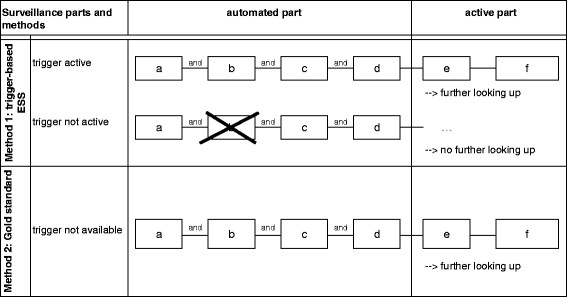
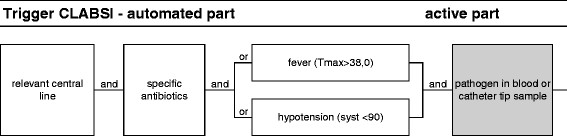
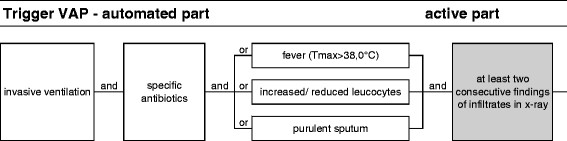
Prospective comparison of surveillance was based on a semi-automated ESS with and without trigger. Components of the VAP/CLABSI definition served as triggers. These included the use of VAP/CLABSI-related antibiotics, the presence of mechanical ventilation or an intravenous central line, and the presence of specific clinical symptoms. Triggers were automatically fired by the PDMS. Chest X-rays and microbiology culture results were checked only on patient days with a positive trigger signal from the ESS. In traditional screening, no triggers were used; therefore, chest X-rays and culture results had to be screened for all patient days of all included patients. Patients with pneumonia at admission were excluded.
A total of 553 patients were screened for VAP and CLABSI. The incidence of VAP was 3.3/1,000 ventilation days (13 VAP/3,927 mechanical ventilation days), and the incidence of CLABSI was 1.7/1,000 central line days (24 CLABSI/13.887 central line days). For VAP, the trigger-based screening had a sensitivity of 92.3%, a specificity of 100%, and a negative predictive value of 99.8% compared to traditional screening of all patients. For CLABSI, sensitivity was 91.3%, specificity 100%, and negative predictive value 99.6%.
Pre-selection of patients to be checked for signs and symptoms of VAP and CLABSI by a computer-generated automated trigger system was time saving but slightly less accurate than conventional surveillance. However, this after-the-fact surveillance was mainly designed as a quality indicator over time rather than for precise determination of infection rates. Therefore, surveillance of VAP and CLABSI with a trigger-based ESS is feasible and effective.
患者数据管理系统(PDMS)的出现为开发基于触发的电子监测系统(ESS)提供了机会。目的是评估一种用于重症监护中呼吸机相关性肺炎(VAP)和中心静脉相关血流感染(CLABSI)的半自动基于触发的 ESS。
前瞻性监测比较是基于具有和不具有触发的半自动 ESS。VAP/CLABSI 定义的组成部分用作触发。这些包括使用 VAP/CLABSI 相关抗生素、存在机械通气或静脉内中央导管以及存在特定临床症状。触发由 PDMS 自动触发。只有在 ESS 发出阳性触发信号的患者日,才会检查胸部 X 光片和微生物培养结果。在传统筛查中,不使用触发;因此,必须对所有纳入患者的所有患者日进行胸部 X 光片和培养结果筛查。入院时患有肺炎的患者被排除在外。
共对 553 例患者进行了 VAP 和 CLABSI 筛查。VAP 的发病率为 3.3/1000 通气日(13 例 VAP/3927 机械通气日),CLABSI 的发病率为 1.7/1000 中央线日(24 例 CLABSI/13887 中央线日)。对于 VAP,与对所有患者进行传统筛查相比,基于触发的筛查具有 92.3%的敏感性、100%的特异性和 99.8%的阴性预测值。对于 CLABSI,敏感性为 91.3%,特异性为 100%,阴性预测值为 99.6%。
通过计算机生成的自动触发系统对 VAP 和 CLABSI 的体征和症状进行预筛选可节省时间,但准确性略低于传统监测。然而,这种事后监测主要是作为随时间推移的质量指标设计的,而不是用于精确确定感染率。因此,基于触发的 ESS 对 VAP 和 CLABSI 的监测是可行且有效的。