Paravicini G, Mösch H U, Schmidheini T, Braus G
Institute of Microbiology, Swiss Federal Institute of Technology, Zurich.
Mol Cell Biol. 1989 Jan;9(1):144-51. doi: 10.1128/mcb.9.1.144-151.1989.
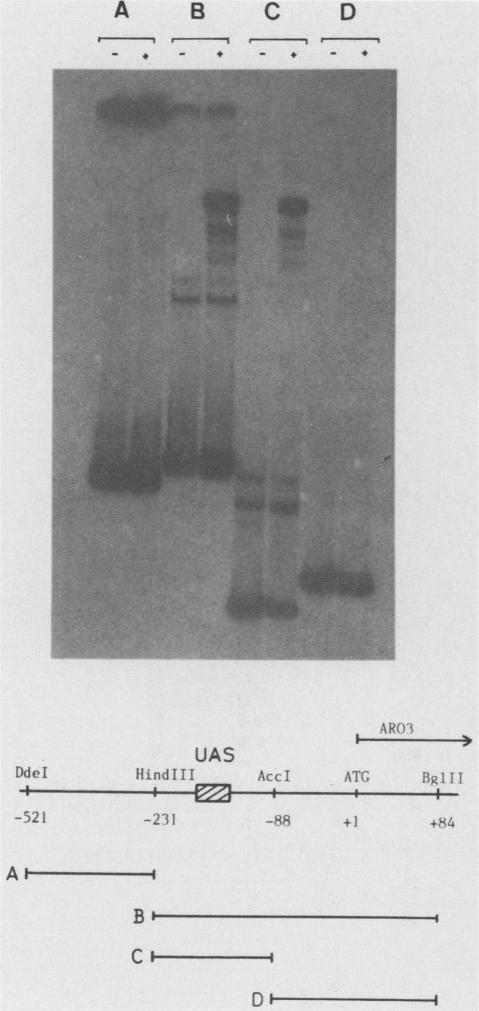
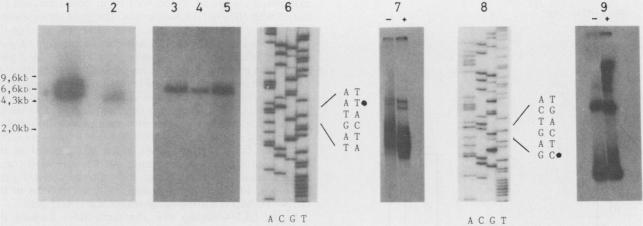
The ARO3 gene encodes one of two 3-deoxy-D-arabino-heptulosonate-7-phosphate isoenzymes in Saccharomyces cerevisiae catalyzing the first step in the biosynthesis of aromatic amino acids. The ARO3-encoded 3-deoxy-D-arabino-heptulosonate-7-phosphate synthase (EC 4.1.2.15) is feedback inhibited by phenylalanine; its isoenzyme, the ARO4 gene product, is inhibited by tyrosine. Both genes ARO3 and ARO4 are strongly regulated under the general control regulatory system. Cells carrying only one intact isogene are phenotypically indistinguishable from a wild-type strain when grown on minimal medium. The complete functional ARO3 promoter comprises 231 base pairs and contains only one TGACTA binding site for the general control activator protein GCN4. Mutating this element to TTACTA inhibits binding of GCN4 and results in a decreased basal level of ARO3 gene product and slow growth of a strain defective in its isogene ARO4. In addition, ARO3 gene expression cannot be elevated under amino acid starvation conditions. An ARO3 aro4 strain with gcn4 genetic background has the same phenotype of low ARO3 gene expression and slow growth. The amount of GCN4 protein present in repressed wild-type cells therefore seems to contribute to a basal level of ARO3 gene expression. The general control activator GCN4 has thus two functions: (i) to maintain a basal level of ARO3 transcription (basal control) in the presence of amino acids and (ii) to derepress the ARO3 gene to a higher transcription rate under amino acid starvation (general control).
ARO3基因编码酿酒酵母中两种3-脱氧-D-阿拉伯庚酮糖-7-磷酸同工酶之一,催化芳香族氨基酸生物合成的第一步。ARO3编码的3-脱氧-D-阿拉伯庚酮糖-7-磷酸合酶(EC 4.1.2.15)受苯丙氨酸的反馈抑制;其同工酶,即ARO4基因产物,受酪氨酸抑制。ARO3和ARO4这两个基因在一般控制调节系统下受到强烈调控。当在基本培养基上生长时,仅携带一个完整同基因的细胞在表型上与野生型菌株无法区分。完整的功能性ARO3启动子由231个碱基对组成,仅包含一个用于一般控制激活蛋白GCN4的TGACTA结合位点。将该元件突变为TTACTA会抑制GCN4的结合,并导致ARO3基因产物的基础水平降低,以及其同基因ARO4有缺陷的菌株生长缓慢。此外,在氨基酸饥饿条件下,ARO3基因的表达无法升高。具有gcn4遗传背景的ARO3 aro4菌株具有相同的低ARO3基因表达和生长缓慢的表型。因此,在受抑制的野生型细胞中存在的GCN4蛋白量似乎有助于ARO3基因表达的基础水平。一般控制激活剂GCN4因此具有两个功能:(i)在有氨基酸存在的情况下维持ARO3转录的基础水平(基础控制),以及(ii)在氨基酸饥饿时将ARO3基因去抑制至更高的转录速率(一般控制)。