Di Gioia D, Stieber P, Schmidt G P, Nagel D, Heinemann V, Baur-Melnyk A
Department of Internal Medicine III, University Hospital Munich-Grosshadern, 81377 Munich, Germany.
Institute of Clinical Chemistry, University Hospital Munich-Grosshadern, 81377 Munich, Germany.
Br J Cancer. 2015 Mar 3;112(5):809-18. doi: 10.1038/bjc.2015.8. Epub 2015 Feb 3.
Follow-up care in breast cancer is still an issue of debate. Diagnostic methods are more sensitive, and more effective therapeutic options are now available. The risk of recurrence is not only influenced by tumour stage but also by the different molecular subtypes. This study was performed to evaluate the use of whole-body imaging combined with tumour marker monitoring for the early detection of asymptomatic metastatic breast cancer (MBC).
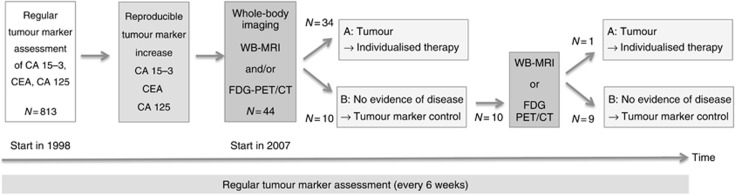
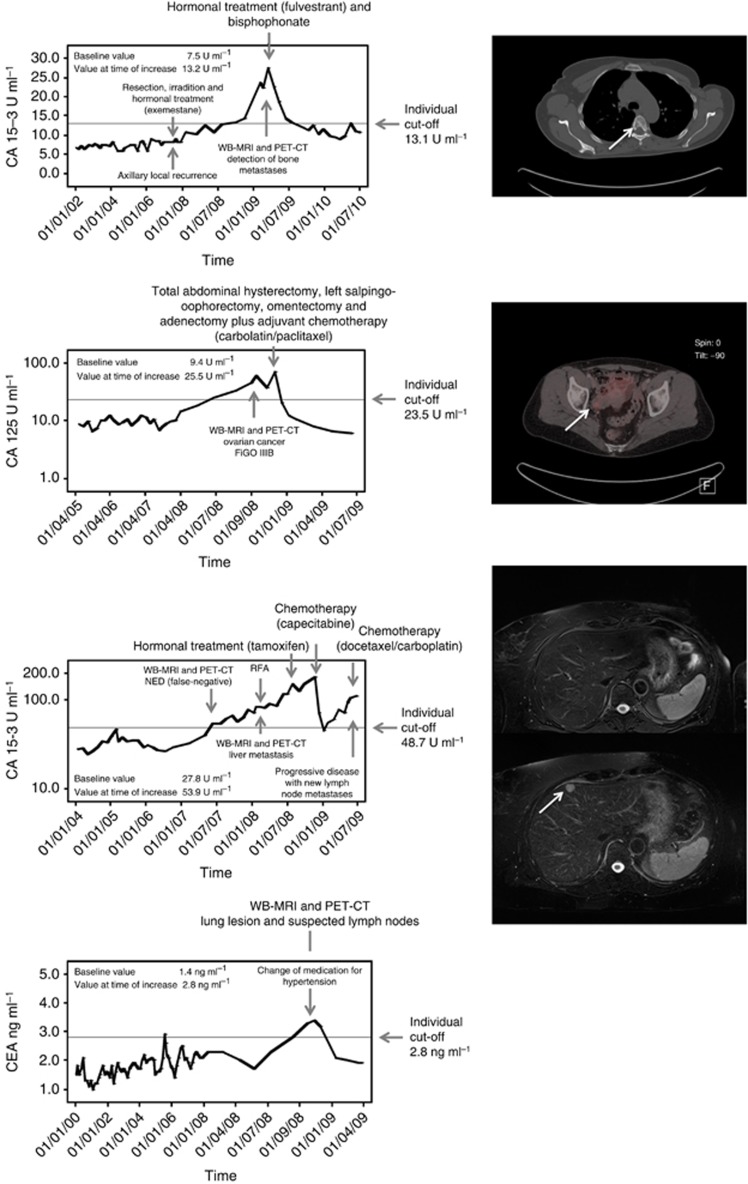
This analysis was performed as part of a follow-up study evaluating 813 patients with a median follow-up of 63 months. After primary therapy, all patients underwent tumour marker monitoring for CEA, CA 15-3 and CA 125 at 6-week intervals within an intensified diagnostic aftercare algorithm. A reproducible previously defined increase was considered as a strong indicator of MBC. From 2007 to 2010, 44 patients with tumour marker increase underwent whole-body magnetic resonance imaging and/or an FDG-PET/CT scan. Histological clarification and/or imaging follow-up were done.
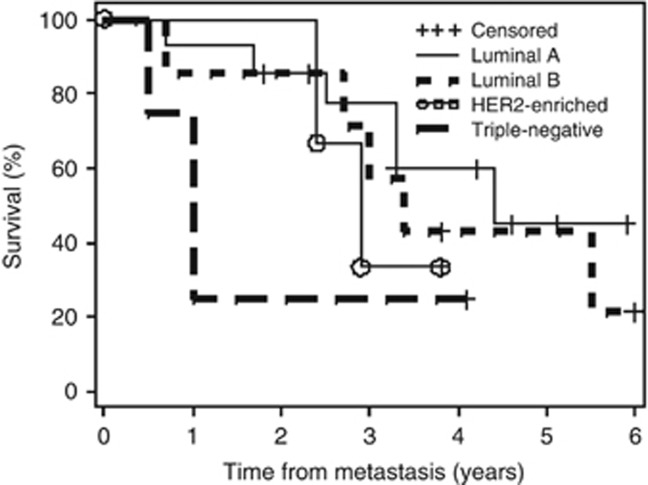
Metastases were detected in 65.9% (29/44) of patients, 13.6% (6/44) had secondary malignancies besides breast cancer and 20.5% (9/44) had no detectable malignancy. Limited disease was found in 24.1% (7/29) of patients. Median progression-free survival of MBC was 9.2 months and median overall survival was 41.1 months. The 3- and 5-year survival rates were 64.2% and 40.0%, respectively.
A reproducible tumour marker increase followed by whole-body imaging is highly effective for early detection. By consequence, patients might benefit from earlier detection and improved therapeutic options with a prolonged survival.
乳腺癌的后续护理仍是一个有争议的问题。诊断方法更加灵敏,现在也有了更有效的治疗选择。复发风险不仅受肿瘤分期影响,还受不同分子亚型的影响。本研究旨在评估全身成像联合肿瘤标志物监测用于早期检测无症状转移性乳腺癌(MBC)的效果。
本分析是一项随访研究的一部分,该研究评估了813例患者,中位随访时间为63个月。在初始治疗后,所有患者在强化诊断后续护理方案中每隔6周接受癌胚抗原(CEA)、糖类抗原15-3(CA 15-3)和糖类抗原125(CA 125)的肿瘤标志物监测。先前定义的可重复性升高被视为MBC的有力指标。2007年至2010年,44例肿瘤标志物升高的患者接受了全身磁共振成像和/或氟代脱氧葡萄糖正电子发射断层显像/计算机断层扫描(FDG-PET/CT)检查。进行了组织学确诊和/或影像学随访。
65.9%(29/44)的患者检测到转移,13.6%(6/44)除乳腺癌外还有继发性恶性肿瘤,20.5%(9/44)未检测到恶性肿瘤。24.1%(7/29)的患者发现疾病局限。MBC的中位无进展生存期为9.2个月,中位总生存期为41.1个月。3年和5年生存率分别为64.2%和40.0%。
肿瘤标志物出现可重复性升高后进行全身成像对早期检测非常有效。因此,患者可能会从更早的检测和改善的治疗选择中获益,生存期延长。