Kobayashi Noritoshi, Watanabe Seitaro, Hosono Kunihiro, Kubota Kensuke, Nakajima Atsushi, Kaneko Takashi, Sugimori Kazuya, Tokuhisa Motohiko, Goto Ayumu, Mori Ryutaro, Taniguchi Koichi, Matsuyama Ryusei, Endo Itaru, Maeda Shin, Ichikawa Yasushi
Medical Oncology Division, Yokohama City University School of Medicine, 3-9, Fuku-ura, Kanazawa-ku, Yokohama, 236-0004, Japan.
Gastroenterology Division, Yokohama City University School of Medicine, 3-9, Fuku-ura, Kanazawa-ku, Yokohama, 236-0004, Japan.
BMC Gastroenterol. 2015 Feb 5;15:8. doi: 10.1186/s12876-015-0233-2.
Endoscopic biliary stenting (EBS) is one of the most important palliative treatments for biliary tract cancer. However, reflux cholangitis arising from bacterial adherence to the inner wall of the stent must be avoided. We evaluated the use of EBS above the sphincter of Oddi to determine whether reflux cholangitis could be prevented in preoperative cases.
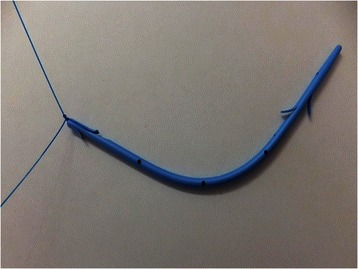
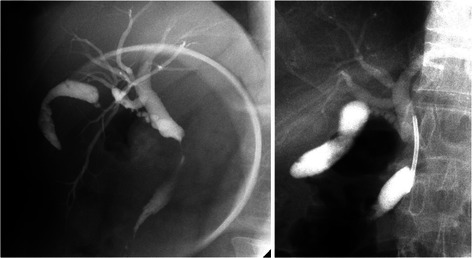
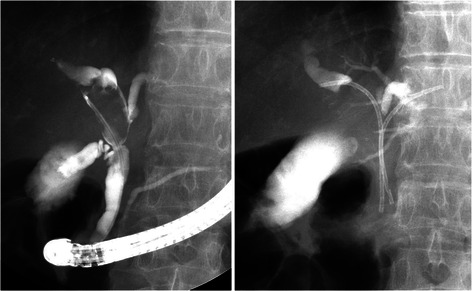
Fifty-seven patients with primary biliary tract cancer were retrospectively recruited for the evaluation of stent placement either above (n = 25; inside stent group) or across (n = 32; conventional stent group) the sphincter of Oddi. We compared the stent patency periods prior to the time of surgical resection.
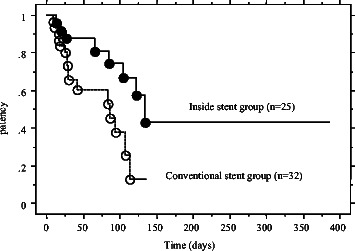
The preoperative periods were 96.3 days in the conventional stent group and 96.8 days in the inside stent group (P = 0.979). Obstructive jaundice and/or acute cholangitis occurred in 7 patients (28.0%) in the inside stent group and in 15 patients (46.9%) in the conventional stent group during the preoperative period (P = 0.150). The average patency periods of the stents were 85.2 days (range, 13-387 days) for the inside stent group and 49.1 days (range, 9-136 days) for the conventional stent group (log-rank test: P = 0.009). The mean numbers of re-interventions because of stent occlusion were 0.32 for the inside stent group and 1.03 for the conventional stent group (P = 0.026). Post-endoscopic retrograde cholangiopancreatography complications occurred in 2 patients in the inside stent group and 4 patients in the conventional stent group (P = 0.516). Postoperative liver abscess occurred in 1 patient in the inside stent group and 5 patients in the conventional stent group (P = 0.968). Inside stent placement was the only significant preventative factor associated with stent obstruction based on univariate (hazard ratio [HR], 0.286; 95% confidence interval [CI], 0.114-0.719; P = 0.008) and multivariate (HR, 0.292; 95% CI, 0.114-0.750; P = 0.011) analyses.
Temporary plastic stent placement above the sphincter of Oddi is a better bridging treatment than conventional stent placement in preoperative primary biliary tract cancer.
内镜下胆道支架置入术(EBS)是胆道癌最重要的姑息治疗方法之一。然而,必须避免因细菌附着于支架内壁而引发的反流性胆管炎。我们评估了在Oddi括约肌上方使用EBS,以确定术前病例中是否可以预防反流性胆管炎。
回顾性招募了57例原发性胆道癌患者,以评估在Oddi括约肌上方(n = 25;内置支架组)或穿过(n = 32;传统支架组)放置支架的情况。我们比较了手术切除前支架的通畅期。
传统支架组的术前时间为96.3天,内置支架组为96.8天(P = 0.979)。术前期间,内置支架组7例患者(28.0%)发生梗阻性黄疸和/或急性胆管炎,传统支架组15例患者(46.9%)发生(P = 0.150)。内置支架组支架的平均通畅期为85.2天(范围13 - 387天),传统支架组为49.1天(范围9 - 136天)(对数秩检验:P = 0.009)。因支架堵塞进行再次干预的平均次数,内置支架组为0.32次,传统支架组为1.03次(P = 0.026)。内置支架组2例患者发生内镜逆行胰胆管造影术后并发症,传统支架组4例患者发生(P = 0.516)。内置支架组1例患者发生术后肝脓肿,传统支架组5例患者发生(P = 0.968)。基于单因素(风险比[HR],0.286;95%置信区间[CI],0.114 - 0.719;P = 0.008)和多因素(HR,0.292;95% CI,0.114 - 0.750;P = 0.011)分析,内置支架放置是与支架堵塞相关的唯一显著预防因素。
在术前原发性胆道癌中,在Oddi括约肌上方临时放置塑料支架是比传统支架放置更好的桥接治疗方法。