Kerlin Douglas H, Gatton Michelle L
Infectious Diseases Programme, QIMR Berghofer Medical Research Institute, Brisbane, QLD, Australia.
School of Public Health and Social Work, Queensland University of Technology, GPO Box 2434, Brisbane, QLD 4001, Australia.
Malar J. 2015 Feb 5;14:51. doi: 10.1186/s12936-015-0580-z.
The benign reputation of Plasmodium vivax is at odds with the burden and severity of the disease. This reputation, combined with restricted in vitro techniques, has slowed efforts to gain an understanding of the parasite biology and interaction with its human host.
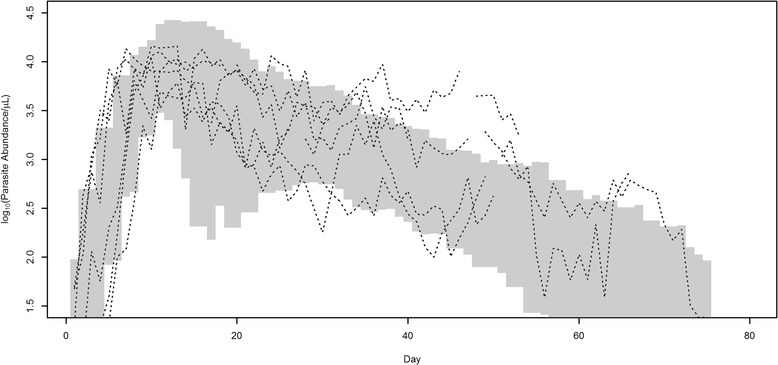
A simulation model of the within-host dynamics of P. vivax infection is described, incorporating distinctive characteristics of the parasite such as the preferential invasion of reticulocytes and hypnozoite production. The developed model is fitted using digitized time-series' from historic neurosyphilis studies, and subsequently validated against summary statistics from a larger study of the same population. The Chesson relapse pattern was used to demonstrate the impact of released hypnozoites.
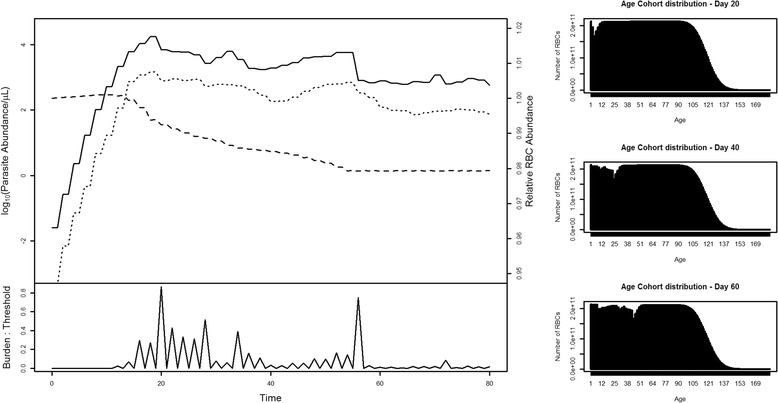
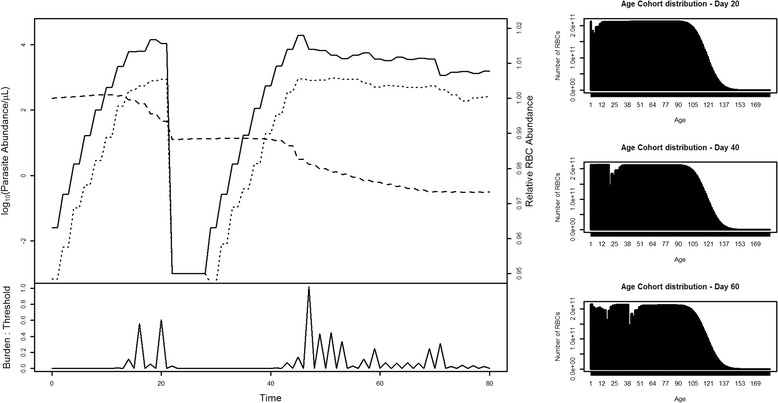
The typical pattern for dynamics of the parasite population is a rapid exponential increase in the first 10 days, followed by a gradual decline. Gametocyte counts follow a similar trend, but are approximately two orders of magnitude lower. The model predicts that, on average, an infected naïve host in the absence of treatment becomes infectious 7.9 days post patency and is infectious for a mean of 34.4 days. In the absence of treatment, the effect of hypnozoite release was not apparent as newly released parasites were obscured by the existing infection.
The results from the model provides useful insights into the dynamics of P. vivax infection in human hosts, in particular the timing of host infectiousness and the role of the hypnozoite in perpetuating infection.
间日疟原虫的良性声誉与其疾病负担和严重程度不符。这种声誉,再加上体外技术的限制,减缓了人们对该寄生虫生物学及其与人类宿主相互作用的理解。
描述了间日疟原虫感染宿主内动态的模拟模型,纳入了该寄生虫的独特特征,如对网织红细胞的优先侵袭和休眠子产生。使用历史神经梅毒研究中的数字化时间序列对开发的模型进行拟合,随后根据对同一人群的更大规模研究的汇总统计数据进行验证。使用切森复发模式来证明释放的休眠子的影响。
寄生虫种群动态的典型模式是在最初10天内快速指数增长,随后逐渐下降。配子体计数遵循类似趋势,但大约低两个数量级。该模型预测,在没有治疗的情况下,平均而言,初次感染的宿主在出现症状后7.9天具有传染性,传染性平均持续34.4天。在没有治疗的情况下,休眠子释放的影响并不明显,因为新释放的寄生虫被现有的感染所掩盖。
该模型的结果为人类宿主中间日疟原虫感染的动态提供了有用的见解,特别是宿主传染性的时间以及休眠子在持续感染中的作用。