Speich Benjamin, Ali Said M, Ame Shaali M, Albonico Marco, Utzinger Jürg, Keiser Jennifer
Department of Medical Parasitology and Infection Biology, Swiss Tropical and Public Health Institute, Basel, Switzerland.
University of Basel, Basel, Switzerland.
Parasit Vectors. 2015 Feb 5;8:82. doi: 10.1186/s13071-015-0702-z.
An accurate diagnosis of soil-transmitted helminthiasis is important for individual patient management, for drug efficacy evaluation and for monitoring control programmes. The Kato-Katz technique is the most widely used method detecting soil-transmitted helminth eggs in faecal samples. However, detailed analyses of quality control, including false-positive and faecal egg count (FEC) estimates, have received little attention.
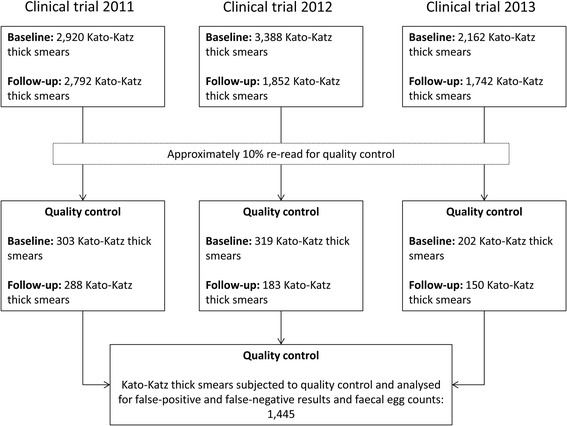
Over a 3-year period, within the frame of a series of randomised controlled trials conducted in Pemba, United Republic of Tanzania, 10% of randomly selected Kato-Katz thick smears were re-read for Trichuris trichiura and Ascaris lumbricoides eggs. In case of discordant result (i.e. positive versus negative) the slides were re-examined a third time. A result was assumed to be false-positive or false-negative if the result from the initial reading did not agree with the quality control as well as the third reading. We also evaluated the general agreement in FECs between the first and second reading, according to internal and World Health Organization (WHO) guidelines.
From the 1,445 Kato-Katz thick smears subjected to quality control, 1,181 (81.7%) were positive for T. trichiura and 290 (20.1%) were positive for A. lumbricoides. During quality control, very low rates of false-positive results were observed; 0.35% (n = 5) for T. trichiura and 0.28% (n = 4) for A. lumbricoides. False-negative readings of Kato-Katz thick smears were obtained in 28 (1.94%) and 6 (0.42%) instances for T. trichiura and A. lumbricoides, respectively. A high frequency of discordant results in FECs was observed (i.e. 10.0-23.9% for T. trichiura, and 9.0-11.4% for A. lumbricoides).
Our analyses show that the rate of false-positive diagnoses of soil-transmitted helminths is low. As the probability of false-positive results increases after examination of multiple stool samples from a single individual, the potential influence of false-positive results on epidemiological studies and anthelminthic drug efficacy studies should be determined. Existing WHO guidelines for quality control might be overambitious and might have to be revised, specifically with regard to handling disagreements in FECs.
准确诊断土源性蠕虫病对于个体患者管理、药物疗效评估以及监测控制项目而言至关重要。改良加藤厚涂片法是检测粪便样本中土源性蠕虫卵最广泛使用的方法。然而,包括假阳性和粪便虫卵计数(FEC)估计在内的质量控制详细分析却很少受到关注。
在坦桑尼亚联合共和国奔巴岛进行的一系列随机对照试验框架内,历时3年,对随机选取的10%改良加藤厚涂片进行复查,以检测鞭虫和蛔虫卵。如果结果不一致(即阳性与阴性),则对玻片进行第三次复查。如果初始读数结果与质量控制以及第三次读数不一致,则该结果被认定为假阳性或假阴性。我们还根据内部和世界卫生组织(WHO)指南,评估了第一次和第二次读数之间FEC的总体一致性。
在接受质量控制的1445份改良加藤厚涂片中,1181份(81.7%)鞭虫检测呈阳性,290份(20.1%)蛔虫检测呈阳性。在质量控制过程中,观察到假阳性结果的发生率非常低;鞭虫为0.35%(n = 5),蛔虫为0.28%(n = 4)。改良加藤厚涂片的假阴性读数在鞭虫和蛔虫检测中分别有28例(1.94%)和6例(0.42%)。观察到FEC结果存在较高频率的不一致情况(即鞭虫为10.0 - 23.9%,蛔虫为9.0 - 11.4%)。
我们的分析表明,土源性蠕虫病的假阳性诊断率较低。由于从单个个体采集多个粪便样本进行检测后,假阳性结果的概率会增加,因此应确定假阳性结果对流行病学研究和驱虫药物疗效研究的潜在影响。现有的WHO质量控制指南可能过于严格,可能需要修订,特别是在处理FEC不一致的问题上。