The Fourth Clinical Medical College of Nanjing Medical University, Nanjing, Jiangsu, People's Republic of China.
Department of Radiation Oncology, The Affiliated Jiangsu Cancer Hospital of Nanjing Medical University, Nanjing, Jiangsu, People's Republic of China.
Onco Targets Ther. 2015 Jan 17;8:169-76. doi: 10.2147/OTT.S74397. eCollection 2015.
High-mobility group protein 2 (HMGA2) and epithelial-mesenchymal transition (EMT)-associated proteins play key roles in cancer progression and metastasis. However, the clinical significance of HMGA2 and its relationship with EMT markers in nasopharyngeal carcinoma (NPC) is unclear. This study aimed to assess the clinicopathological significance and prognostic value of HMGA2, E-cadherin, and vimentin in NPC.
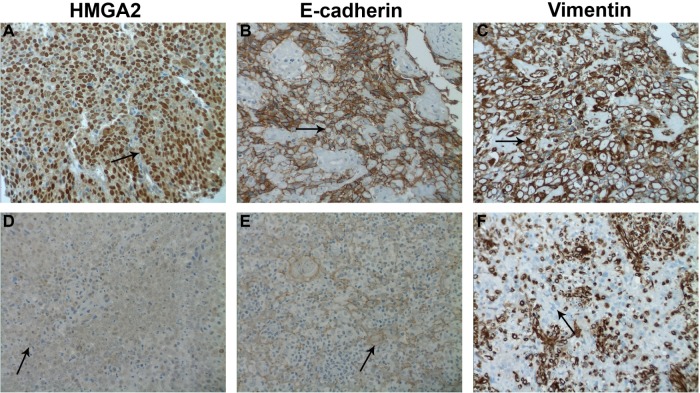
Using immunohistochemistry, HMGA2, E-cadherin, and vimentin expression levels were evaluated in NPC (n=124) and non-tumoral inflammatory nasopharynx (n=20) tissues. The association of HMGA2 and EMT markers with clinicopathological characteristics and relationships between the protein levels and overall survival were analyzed.
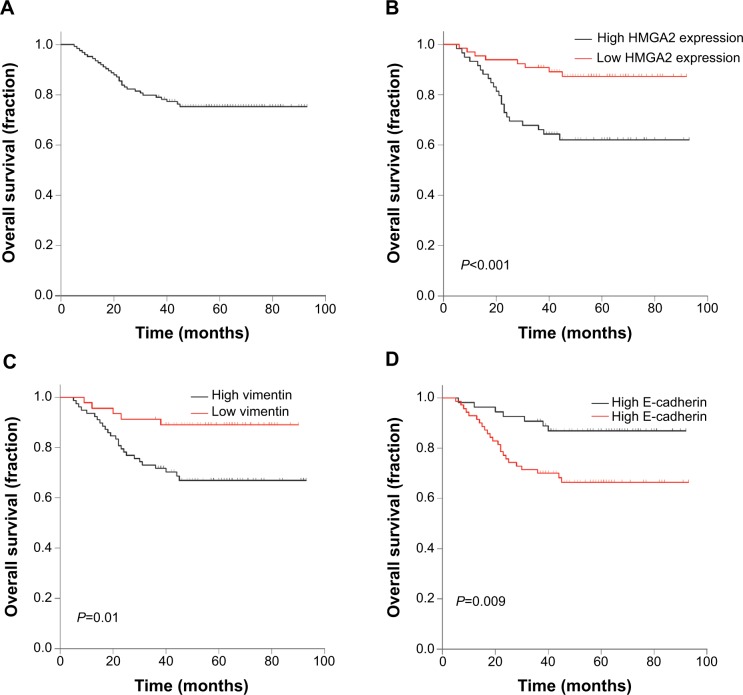
Compared with non-tumorous tissues, HMGA2 and vimentin levels were markedly increased in NPC tissues, whereas decreased E-cadherin levels were observed (P<0.001). Moreover, HMGA2 expression was positively correlated with vimentin levels (r=0.431, P<0.001) and negatively correlated with E-cadherin amounts (r=-0.413, P<0.001) in NPC tissues. The expression of all three proteins correlated significantly with tumor N stage, TNM stage, and 2-year metastasis. Furthermore, significant correlations were found for T stage, N stage, TNM stage, HMGA2, E-cadherin, and vimentin (all P<0.013) with poor prognosis (univariate analysis). However, multivariate analyses showed that only HMGA2 (hazard ratio [HR]: 2.683, 95% confidence interval [CI]: 1.185-6.077, P=0.018) and N stage (HR: 7.892, 95% CI: 2.731-22.807, P<0.001) were independent predictors of poor prognosis.
These results demonstrated that HMGA2, an independent prognostic factor, may promote NPC progression and metastasis, and is significantly associated with EMT proteins. Therefore, HMGA2 may be considered a potential therapeutic target in NPC.
高迁移率族蛋白 2(HMGA2)和上皮-间质转化(EMT)相关蛋白在癌症进展和转移中发挥关键作用。然而,HMGA2 在鼻咽癌(NPC)中的临床意义及其与 EMT 标志物的关系尚不清楚。本研究旨在评估 HMGA2、E-钙黏蛋白和波形蛋白在 NPC 中的临床病理意义和预后价值。
采用免疫组织化学方法,检测 124 例 NPC 组织和 20 例非肿瘤性炎症鼻咽组织中 HMGA2、E-钙黏蛋白和波形蛋白的表达水平。分析 HMGA2 与 EMT 标志物与临床病理特征的关系,以及蛋白水平与总生存期的关系。
与非肿瘤组织相比,HMGA2 和波形蛋白在 NPC 组织中明显升高,而 E-钙黏蛋白水平降低(P<0.001)。此外,HMGA2 表达与 NPC 组织中波形蛋白水平呈正相关(r=0.431,P<0.001),与 E-钙黏蛋白水平呈负相关(r=-0.413,P<0.001)。这三种蛋白的表达均与肿瘤 N 分期、TNM 分期和 2 年转移显著相关。此外,T 分期、N 分期、TNM 分期、HMGA2、E-钙黏蛋白和波形蛋白与预后不良均显著相关(单因素分析,均 P<0.013)。然而,多因素分析显示,仅 HMGA2(风险比[HR]:2.683,95%置信区间[CI]:1.185-6.077,P=0.018)和 N 分期(HR:7.892,95%CI:2.731-22.807,P<0.001)是预后不良的独立预测因素。
这些结果表明,作为一个独立的预后因素,HMGA2 可能促进 NPC 的进展和转移,并与 EMT 蛋白显著相关。因此,HMGA2 可能被视为 NPC 的一个潜在治疗靶点。