Manzardo Ann M, McGuire Austen, Butler Merlin G
Department of Psychiatry & Behavioral Sciences, University of Kansas Medical Center, Kansas City, KS 66160, USA.
Department of Psychiatry & Behavioral Sciences, University of Kansas Medical Center, Kansas City, KS 66160, USA.
Gene. 2015 Apr 15;560(2):184-94. doi: 10.1016/j.gene.2015.01.064. Epub 2015 Feb 2.
Alcoholism arises from combined effects of multiple biological factors including genetic and non-genetic causes with gene/environmental interaction. Intensive research and advanced genetic technology has generated a long list of genes and biomarkers involved in alcoholism neuropathology. These markers reflect complex overlapping and competing effects of possibly hundreds of genes which impact brain structure, function, biochemical alcohol processing, sensitivity and risk for dependence.
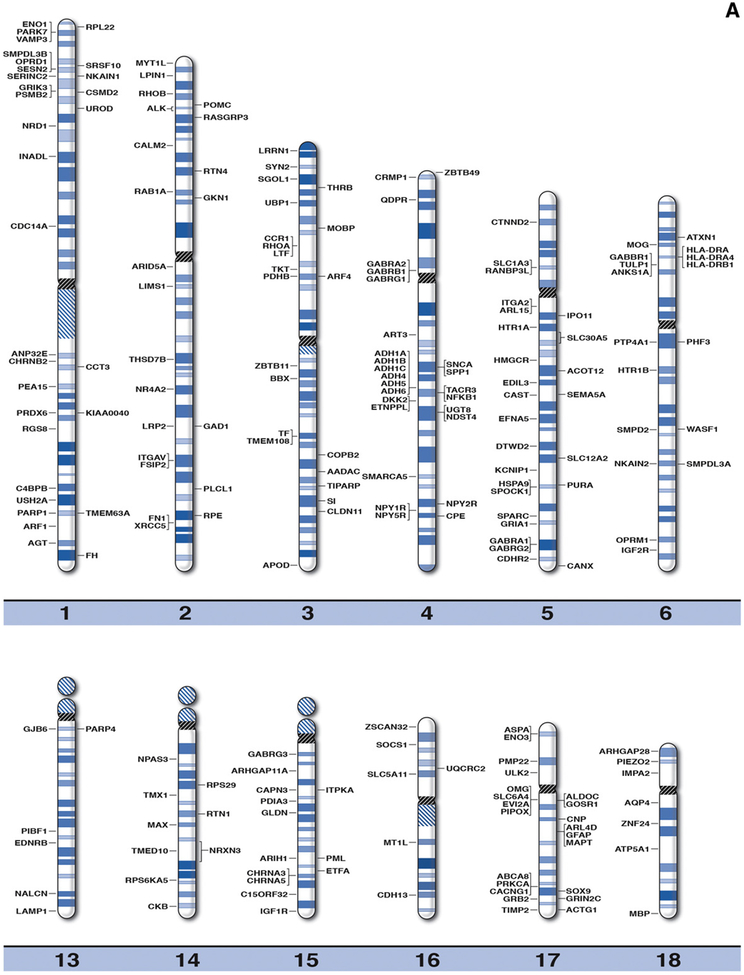
We compiled a tabular list of clinically relevant genetic biomarkers for alcoholism targeting expression disturbances in the human brain through an extensive search of keywords related to alcoholism, alcohol abuse, and genetics from peer reviewed medical research articles and related nationally sponsored websites. Gene symbols were then placed on high resolution human chromosome ideograms with gene descriptions in tabular form.
We identified 337 clinically relevant genetic biomarkers and candidate genes for alcoholism and alcohol-responsiveness from human brain research. Genetic biomarkers included neurotransmitter pathways associated with brain reward processes for dopaminergic (e.g., DRD2, MAOA, and COMT), serotoninergic (e.g., HTR3A, HTR1B, HTR3B, and SLC6A4), GABAergic (e.g., GABRA1, GABRA2, and GABRG1), glutaminergic (GAD1, GRIK3, and GRIN2C) and opioid (e.g., OPRM1, OPRD1, and OPRK1) pathways which presumably impact reinforcing properties of alcohol. Gene level disturbances in cellular and molecular networks impacted by alcohol and alcoholism pathology include transketolase (TKT), transferrin (TF), and myelin (e.g., MBP, MOBP, and MOG).
High resolution chromosome ideograms provide investigators, physicians, geneticists and counselors a convenient visual image of the distribution of alcoholism genetic biomarkers from brain research with alphabetical listing of genes in tabular form allowing comparison between alcoholism-related phenotypes, and clinically-relevant alcoholism gene(s) at the chromosome band level to guide research, diagnosis, and treatment. Chromosome ideograms may facilitate gene-based personalized counseling of alcohol dependent individuals and their families.
酒精中毒是由多种生物学因素共同作用引起的,包括遗传和非遗传因素以及基因/环境相互作用。深入的研究和先进的基因技术已产生了一长串与酒精中毒神经病理学相关的基因和生物标志物。这些标志物反映了可能数百个基因的复杂重叠和竞争效应,这些基因会影响大脑结构、功能、酒精生化处理、敏感性和依赖风险。
我们通过广泛搜索同行评审医学研究文章和相关国家资助网站中与酒精中毒、酒精滥用和遗传学相关的关键词,编制了一份针对人类大脑表达紊乱的酒精中毒临床相关遗传生物标志物表格清单。然后将基因符号置于高分辨率人类染色体 ideogram 上,并以表格形式给出基因描述。
我们从人类大脑研究中确定了 337 个与酒精中毒和酒精反应性相关的临床相关遗传生物标志物和候选基因。遗传生物标志物包括与多巴胺能(如 DRD2、MAOA 和 COMT)、5-羟色胺能(如 HTR3A、HTR1B、HTR3B 和 SLC6A4)、γ-氨基丁酸能(如 GABRA1、GABRA2 和 GABRG1)、谷氨酰胺能(GAD1、GRIK3 和 GRIN2C)和阿片样物质(如 OPRM1、OPRD1 和 OPRK1)途径相关的神经递质途径,这些途径可能影响酒精的强化特性。受酒精和酒精中毒病理学影响的细胞和分子网络中的基因水平紊乱包括转酮醇酶(TKT)、转铁蛋白(TF)和髓磷脂(如 MBP、MOBP 和 MOG)。
高分辨率染色体 ideogram 为研究人员、医生、遗传学家和咨询师提供了一个方便的视觉图像,展示了大脑研究中酒精中毒遗传生物标志物的分布,以表格形式按字母顺序列出基因,便于比较与酒精中毒相关的表型以及染色体带水平上与临床相关的酒精中毒基因,以指导研究、诊断和治疗。染色体 ideogram 可能有助于对酒精依赖个体及其家庭进行基于基因的个性化咨询。