Alam M, Cho C I, Choi T J, Park B, Choi J G, Choy Y H, Lee S S, Cho K H
Asian-Australas J Anim Sci. 2015 Mar;28(3):303-10. doi: 10.5713/ajas.13.0627.
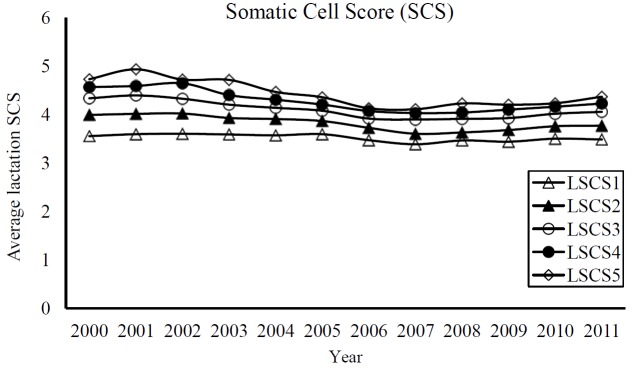
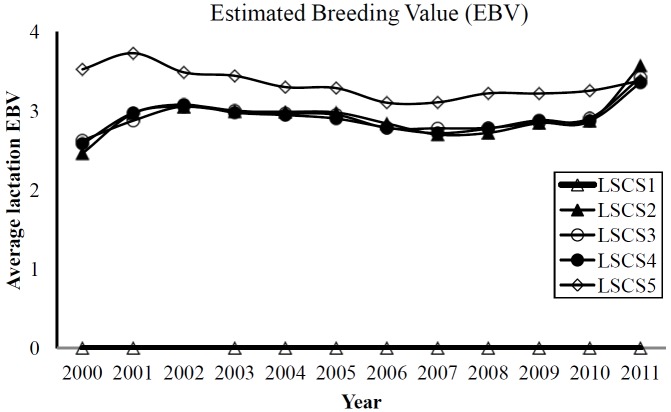
The study was conducted to analyze the genetic parameters of somatic cell score (SCS) of Holstein cows, which is an important indicator to udder health. Test-day records of somatic cell counts (SCC) of 305-day lactation design from first to fifth lactations were collected on Holsteins in Korea during 2000 to 2012. Records of animals within 18 to 42 months, 30 to 54 months, 42 to 66 months, 54 to 78 months, and 66 to 90 months of age at the first, second, third, fourth and fifth parities were analyzed, respectively. Somatic cell scores were calculated, and adjusted for lactation production stages by Wilmink's function. Lactation averages of SCS (LSCS1 through LSCS5) were derived by further adjustments of each test-day SCS for five age groups in particular lactations. Two datasets were prepared through restrictions on number of sires/herd and dams/herd, progenies/sire, and number of parities/cow to reduce data size and attain better relationships among animals. All LSCS traits were treated as individual trait and, analyzed through multiple-trait sire models and single trait animal models via VCE 6.0 software package. Herd-year was fitted as a random effect. Age at calving was regressed as a fixed covariate. The mean LSCS of five lactations were between 3.507 and 4.322 that corresponded to a SCC range between 71,000 and 125,000 cells/mL; with coefficient of variation from 28.2% to 29.9%. Heritability estimates from sire models were within the range of 0.10 to 0.16 for all LSCS. Heritability was the highest at lactation 2 from both datasets (0.14/0.16) and lowest at lactation 5 (0.11/0.10) using sire model. Heritabilities from single trait animal model analyses were slightly higher than sire models. Genetic correlations between LSCS traits were strong (0.62 to 0.99). Very strong associations (0.96 to 0.99) were present between successive records of later lactations. Phenotypic correlations were relatively weaker (<0.55). All correlations became weaker at distant lactations. The estimated breeding values (EBVs) of LSCS traits were somewhat similar over the years for a particular lactation, but increased with lactation number increment. The lowest EBV in first lactation indicated that selection for SCS (mastitis resistance) might be better with later lactation records. It is expected that results obtained from these multi-trait lactation model analyses, being the first large scale SCS data analysis in Korea, would create a good starting step for application of advanced statistical tools for future genomic studies focusing on selection for mastitis resistance in Holsteins of Korea.
本研究旨在分析荷斯坦奶牛体细胞评分(SCS)的遗传参数,SCS是乳房健康的一项重要指标。2000年至2012年期间收集了韩国荷斯坦奶牛从第一胎到第五胎305天泌乳期设计的体细胞计数(SCC)的测定日记录。分别分析了第一胎、第二胎、第三胎、第四胎和第五胎时年龄在18至42月龄、30至54月龄、42至66月龄、54至78月龄以及66至90月龄的动物记录。计算体细胞评分,并通过威尔明克函数对泌乳生产阶段进行校正。通过对特定泌乳期五个年龄组的每个测定日SCS进行进一步调整,得出SCS的泌乳期平均值(LSCS1至LSCS5)。通过限制父系/畜群、母系/畜群、后代/父系以及胎次/奶牛数量来准备两个数据集,以减少数据量并在动物之间获得更好的关系。所有LSCS性状均作为个体性状处理,并通过VCE 6.0软件包的多性状父系模型和单性状动物模型进行分析。将畜群年份作为随机效应。将产犊时的年龄作为固定协变量进行回归分析。五个泌乳期的平均LSCS在3.507至4.322之间,对应的SCC范围在71,000至125,000个细胞/毫升之间;变异系数在28.2%至29.9%之间。父系模型的遗传力估计值在所有LSCS中均在0.10至0.16范围内。使用父系模型时,两个数据集在泌乳期2的遗传力最高(0.14/0.16),在泌乳期5最低(0.11/0.10)。单性状动物模型分析的遗传力略高于父系模型。LSCS性状之间的遗传相关性很强(0.62至0.99)。后期泌乳期连续记录之间存在非常强的关联(0.96至0.99)。表型相关性相对较弱(<0.55)。所有相关性在较远的泌乳期变得更弱。特定泌乳期多年来LSCS性状的估计育种值(EBV)有些相似,但随着泌乳次数的增加而增加。第一泌乳期的最低EBV表明,利用后期泌乳期记录对SCS(抗乳腺炎)进行选择可能更好。预计这些多性状泌乳模型分析的结果,作为韩国首次大规模SCS数据分析,将为未来针对韩国荷斯坦奶牛抗乳腺炎选择的基因组研究应用先进统计工具创造一个良好的开端。