
罗格列酮通过PPARγ依赖性抑制氧化应激减轻同型半胱氨酸硫内酯喂养大鼠的内皮功能障碍。
Rosiglitazone via PPARγ-dependent suppression of oxidative stress attenuates endothelial dysfunction in rats fed homocysteine thiolactone.
作者信息
Yang Xu-Hong, Li Peng, Yin Ya-Ling, Tu Jiang-Hua, Dai Wen, Liu Li-Ying, Wang Shuang-Xi
机构信息
Department of Pharmacology, Pharmaceutical College, Central South University, Changsha, China.
出版信息
J Cell Mol Med. 2015 Apr;19(4):826-35. doi: 10.1111/jcmm.12510. Epub 2015 Feb 5.
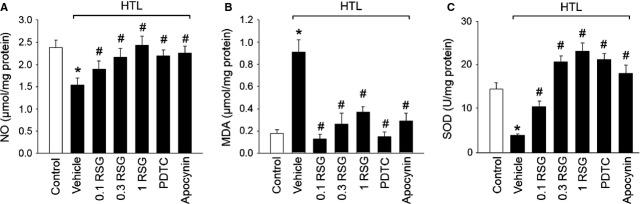
To explore whether rosiglitazone (RSG), a selective peroxisome proliferator-activated receptor γ (PPARγ) agonist, exerts beneficial effects on endothelial dysfunction induced by homocysteine thiolactone (HTL) and to investigate the potential mechanisms. Incubation of cultured human umbilical vein endothelial cells with HTL (1 mM) for 24 hrs significantly reduced cell viabilities assayed by 3-(4,5-dimethyl-2-thiazolyl)-2,5-diphenyl-2-H-tetrazolium bromide, as well as enhanced productions of reactive oxygen species, activation of nuclear factor kappa B, and increased intercellular cell adhesion molecule-1 secretion. Pre-treatment of cells with RSG (0.001-0.1 mM), pyrollidine dithiocarbamate (PDTC, 0.1 mM) or apocynin (0.1 mM) for 1 hr reversed these effects induced by HTL. Furthermore, co-incubation with GW9662 (0.01 mM) abolished the protective effects of RSG on HTL-treated cells. In ex vivo experiments, exposure of isolated aortic rings from. rats to HTL (1 mM) for 1 hr dramatically impaired acetylcholine-induced endothelium-dependent relaxation, reduced release of nitric oxide and activity of superoxide dismutase, and increased malondialdehyde content in aortic tissues. Preincubation of aortic rings with RSG (0.1, 0.3, 1 mM), PDTC or apocynin normalized the disorders induced by HTL. In vivo analysis indicated that administration of RSG (20 mg/kg/d) remarkably suppressed oxidative stress and prevented endothelial dysfunction in rats fed HTL (50 mg/kg/d) for 8 weeks. RSG improves endothelial functions in rats fed HTL, which is related to PPARγ-dependent suppression of oxidative stress.
探讨选择性过氧化物酶体增殖物激活受体γ(PPARγ)激动剂罗格列酮(RSG)是否对同型半胱氨酸硫内酯(HTL)诱导的内皮功能障碍产生有益作用,并研究其潜在机制。用HTL(1 mM)孵育培养的人脐静脉内皮细胞24小时,通过3-(4,5-二甲基-2-噻唑基)-2,5-二苯基-2-H-溴化四氮唑测定,显著降低细胞活力,同时增强活性氧的产生、核因子κB的激活,并增加细胞间细胞黏附分子-1的分泌。用RSG(0.001 - 0.1 mM)、吡咯烷二硫代氨基甲酸盐(PDTC,0.1 mM)或阿朴吗啡(0.1 mM)预处理细胞1小时可逆转HTL诱导的这些效应。此外,与GW9662(0.01 mM)共同孵育可消除RSG对HTL处理细胞的保护作用。在体外实验中,将大鼠离体主动脉环暴露于HTL(1 mM)1小时,显著损害乙酰胆碱诱导的内皮依赖性舒张,降低一氧化氮释放和超氧化物歧化酶活性,并增加主动脉组织中丙二醛含量。用RSG(0.1、0.3、1 mM)、PDTC或阿朴吗啡预孵育主动脉环可使HTL诱导的紊乱恢复正常。体内分析表明,给予RSG(20 mg/kg/d)可显著抑制氧化应激,并预防喂食HTL(50 mg/kg/d)8周的大鼠的内皮功能障碍。RSG改善喂食HTL大鼠的内皮功能,这与PPARγ依赖性抑制氧化应激有关。


 Zotero 插件