Zhu Zhihua, Liu Tao, Li Guangyi, Li Tong, Inoue Yoshio
The State Key Laboratory of Fluid Power Transmission and Control, Department of Mechanical Engeering, Zhejiang University, Hangzhou 310027, China.
School of Systems Engineering, Kochi University of Technology, Kochi 780-8520, Japan.
Sensors (Basel). 2015 Feb 5;15(2):3721-49. doi: 10.3390/s150203721.
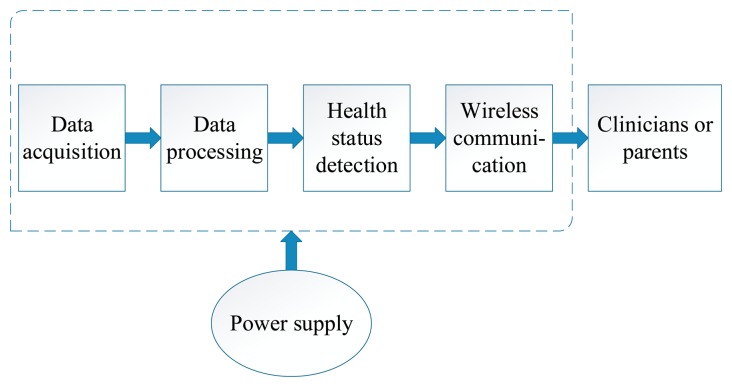
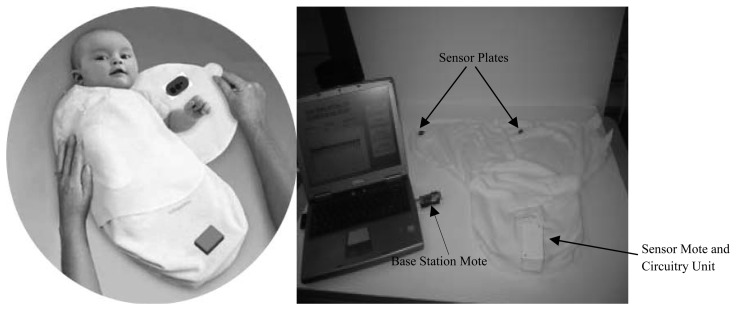
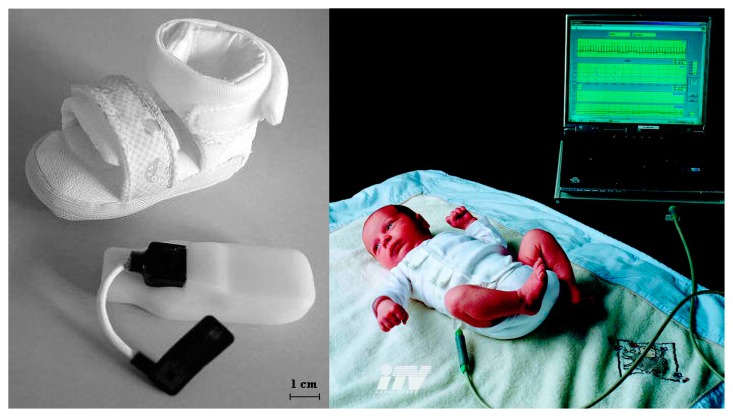
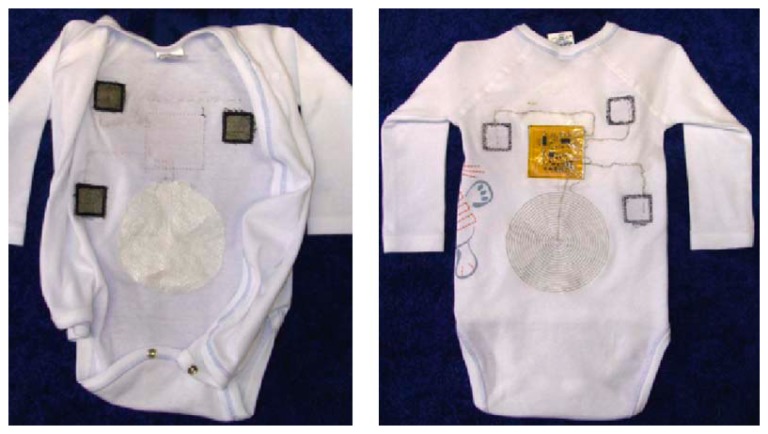
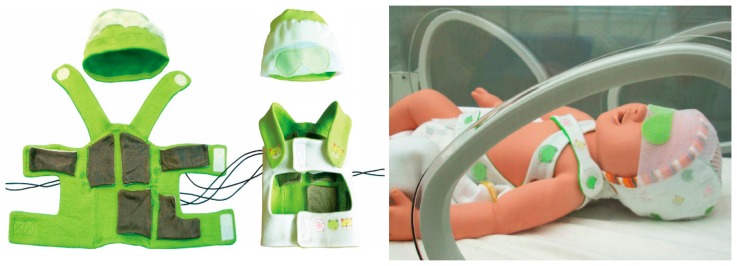
Continuous health status monitoring of infants is achieved with the development and fusion of wearable sensing technologies, wireless communication techniques and a low energy-consumption microprocessor with high performance data processing algorithms. As a clinical tool applied in the constant monitoring of physiological parameters of infants, wearable sensor systems for infants are able to transmit the information obtained inside an infant's body to clinicians or parents. Moreover, such systems with integrated sensors can perceive external threats such as falling or drowning and warn parents immediately. Firstly, the paper reviews some available wearable sensor systems for infants; secondly, we introduce the different modules of the framework in the sensor systems; lastly, the methods and techniques applied in the wearable sensor systems are summarized and discussed. The latest research and achievements have been highlighted in this paper and the meaningful applications in healthcare and behavior analysis are also presented. Moreover, we give a lucid perspective of the development of wearable sensor systems for infants in the future.
随着可穿戴传感技术、无线通信技术以及具有高性能数据处理算法的低能耗微处理器的发展与融合,实现了对婴儿健康状况的持续监测。作为一种应用于持续监测婴儿生理参数的临床工具,婴儿可穿戴传感器系统能够将在婴儿体内获取的信息传输给临床医生或家长。此外,这种集成了传感器的系统能够感知诸如跌倒或溺水等外部威胁,并立即向家长发出警告。首先,本文回顾了一些现有的婴儿可穿戴传感器系统;其次,我们介绍了传感器系统框架中的不同模块;最后,总结并讨论了可穿戴传感器系统中应用的方法和技术。本文突出了最新的研究和成果,并展示了在医疗保健和行为分析方面的有意义应用。此外,我们对未来婴儿可穿戴传感器系统的发展给出了清晰的展望。