Department of Chemistry and Biochemistry, University of Maryland, College Park, Maryland, United States of America; Institute for Physical Science and Technology, University of Maryland, College Park, Maryland, United States of America.
PLoS Comput Biol. 2015 Feb 12;11(2):e1003980. doi: 10.1371/journal.pcbi.1003980. eCollection 2015 Feb.
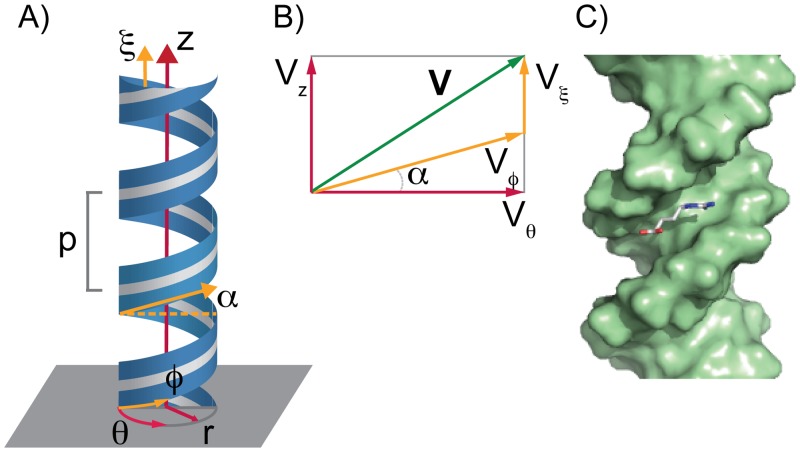
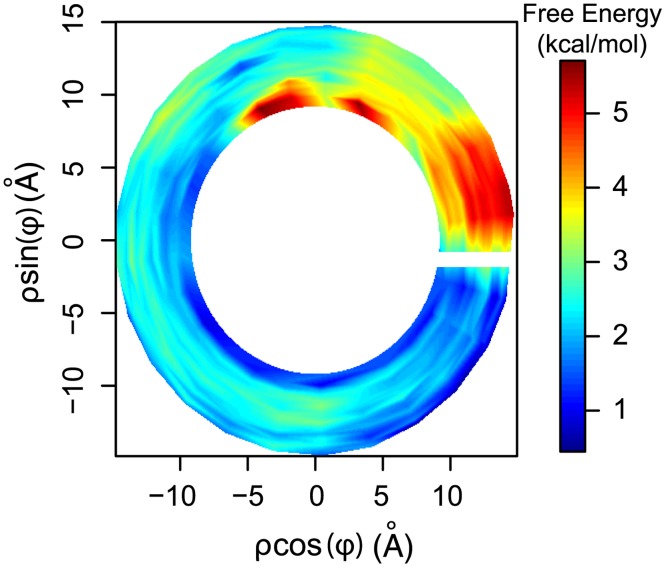
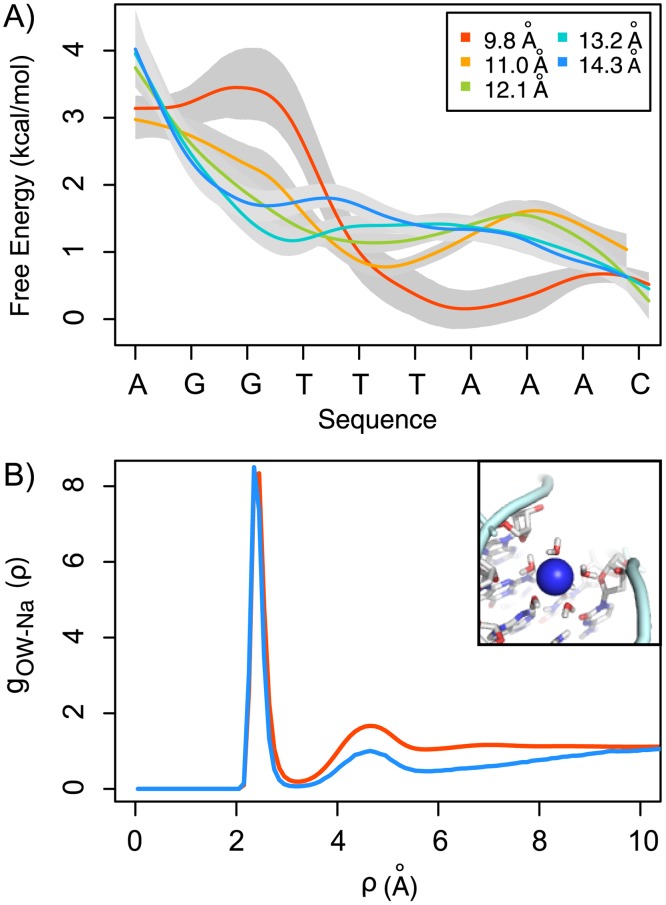
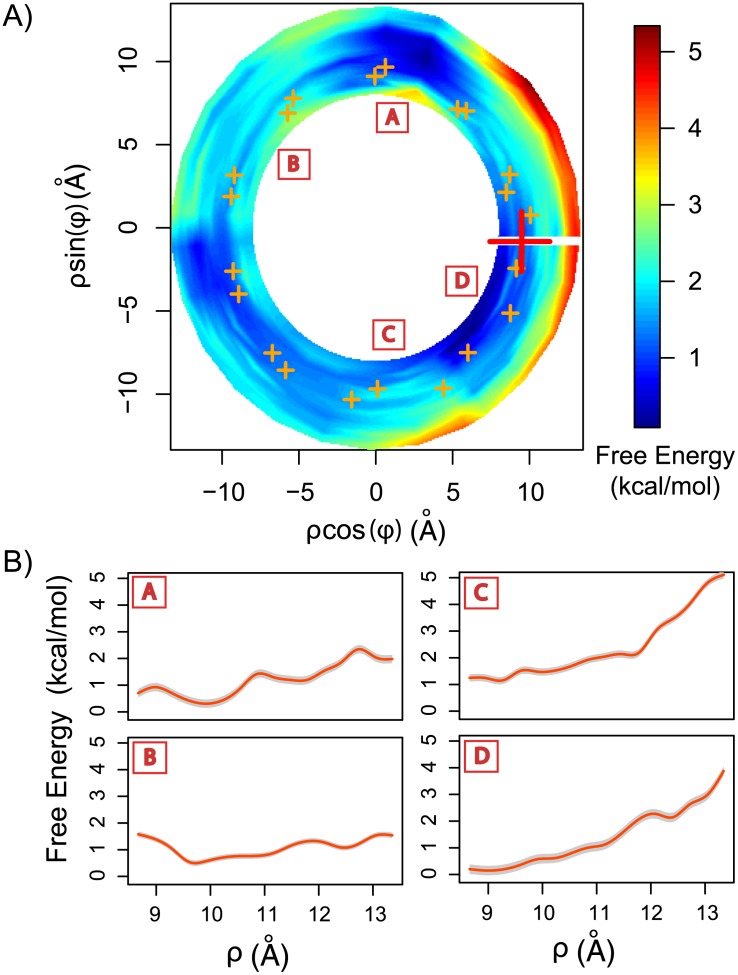
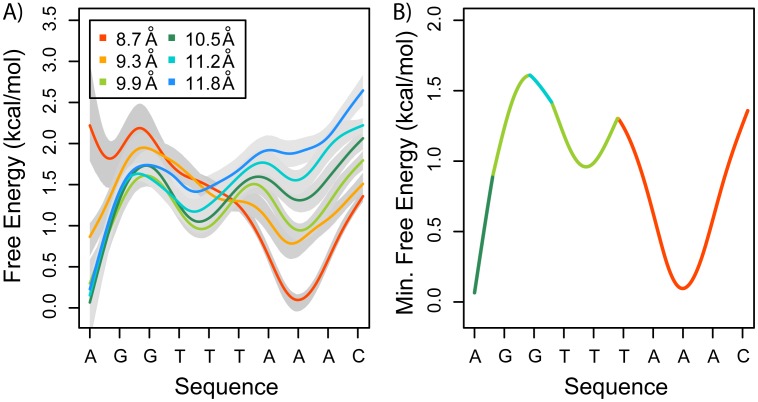
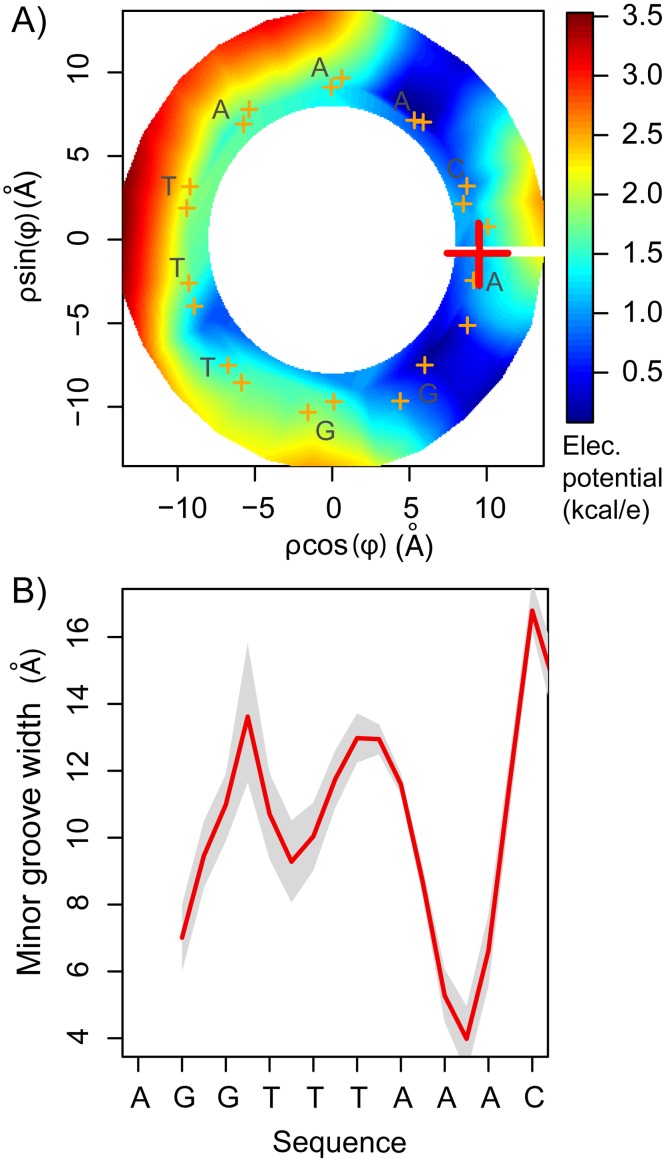
DNA molecules are highly charged semi-flexible polymers that are involved in a wide variety of dynamical processes such as transcription and replication. Characterizing the binding landscapes around DNA molecules is essential to understanding the energetics and kinetics of various biological processes. We present a curvilinear coordinate system that fully takes into account the helical symmetry of a DNA segment. The latter naturally allows to characterize the spatial organization and motions of ligands tracking the minor or major grooves, in a motion reminiscent of sliding. Using this approach, we performed umbrella sampling (US) molecular dynamics (MD) simulations to calculate the three-dimensional potentials of mean force (3D-PMFs) for a Na+ cation and for methyl guanidinium, an arginine analog. The computed PMFs show that, even for small ligands, the free energy landscapes are complex. In general, energy barriers of up to ~5 kcal/mol were measured for removing the ligands from the minor groove, and of ~1.5 kcal/mol for sliding along the minor groove. We shed light on the way the minor groove geometry, defined mainly by the DNA sequence, shapes the binding landscape around DNA, providing heterogeneous environments for recognition by various ligands. For example, we identified the presence of dissociation points or "exit ramps" that naturally would terminate sliding. We discuss how our findings have important implications for understanding how proteins and ligands associate and slide along DNA.
DNA 分子是高度带电的半柔性聚合物,参与了广泛的动力学过程,如转录和复制。描述 DNA 分子周围的结合景观对于理解各种生物过程的能量和动力学至关重要。我们提出了一种曲线坐标系统,充分考虑了 DNA 片段的螺旋对称性。后者自然允许描述配体的空间组织和运动,这些配体跟踪小沟或大沟,运动类似于滑动。使用这种方法,我们进行了伞形采样 (US) 分子动力学 (MD) 模拟,以计算 Na+阳离子和精氨酸类似物甲基胍的三维平均力势 (3D-PMF)。计算出的 PMF 表明,即使对于小配体,自由能景观也是复杂的。通常,从小沟中去除配体的能量壁垒高达5 kcal/mol,沿小沟滑动的能量壁垒约为1.5 kcal/mol。我们揭示了小沟几何形状(主要由 DNA 序列定义)如何塑造 DNA 周围的结合景观,为各种配体的识别提供了异质环境。例如,我们确定了存在解离点或“退出斜坡”,这些点自然会终止滑动。我们讨论了我们的发现如何对理解蛋白质和配体如何与 DNA 结合和滑动具有重要意义。