Clouaire T, Legube G
a Université de Toulouse; UPS; LBCMCP ; Toulouse , France.
Nucleus. 2015;6(2):107-13. doi: 10.1080/19491034.2015.1010946. Epub 2015 Feb 12.
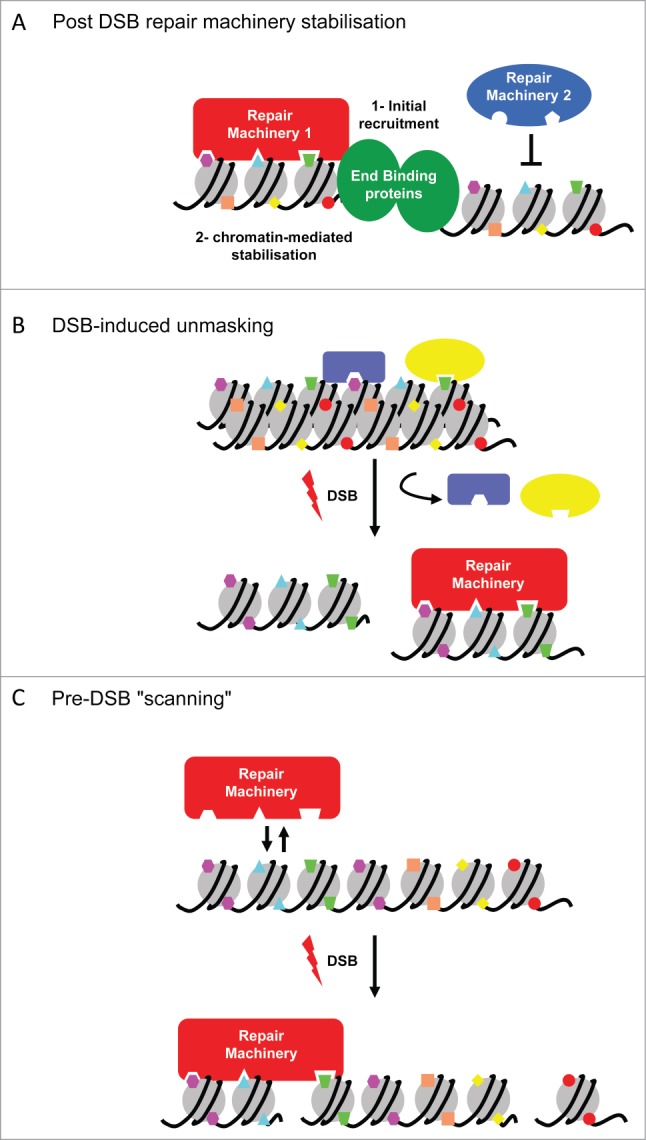
DNA double-strand breaks (DSBs) are highly toxic lesions that can be rapidly repaired by 2 main pathways, namely Homologous Recombination (HR) and Non Homologous End Joining (NHEJ). The choice between these pathways is a critical, yet not completely understood, aspect of DSB repair. We recently found that distinct DSBs induced across the genome are not repaired by the same pathway. Indeed, DSBs induced in active genes, naturally enriched in the trimethyl form of histone H3 lysine 36 (H3K36me3), are channeled to repair by HR, in a manner depending on SETD2, the major H3K36 trimethyltransferase. Here, we propose that these findings may be generalized to other types of histone modifications and repair machineries thus defining a "DSB repair choice histone code". This "decision making" function of preexisting chromatin structure in DSB repair could connect the repair pathway used to the type and function of the damaged region, not only contributing to genome stability but also to its diversity.
DNA双链断裂(DSBs)是具有高度毒性的损伤,可通过两种主要途径迅速修复,即同源重组(HR)和非同源末端连接(NHEJ)。在这些途径之间进行选择是DSB修复的一个关键但尚未完全理解的方面。我们最近发现,全基因组诱导产生的不同DSBs并非由相同途径修复。事实上,活跃基因中诱导产生的DSBs会被导向HR修复,这些活跃基因天然富含组蛋白H3赖氨酸36(H3K36me3)的三甲基化形式,其修复方式依赖于主要的H3K36三甲基转移酶SETD2。在此,我们提出这些发现可能推广到其他类型的组蛋白修饰和修复机制,从而定义一种“DSB修复选择组蛋白密码”。DSB修复中预先存在的染色质结构的这种“决策”功能可能将所使用的修复途径与受损区域的类型和功能联系起来,不仅有助于基因组稳定性,还有助于其多样性。