Schoormans Dounya, Li Jingmei, Darabi Hatef, Brandberg Yvonne, Sprangers Mirjam A G, Eriksson Mikael, Zwinderman Koos H, Hall Per
Department of Medical Epidemiology and Biostatistics, Karolinska Institutet, Stockholm, Sweden; Department of Medical Psychology, Academic Medical Center, Amsterdam, The Netherlands; Department of Medical and Clinical Psychology, Tilburg University, Tilburg, The Netherlands.
Department of Medical Epidemiology and Biostatistics, Karolinska Institutet, Stockholm, Sweden; Human Genetics, Genome Institute of Singapore, Singapore, Singapore.
PLoS One. 2015 Feb 12;10(2):e0118292. doi: 10.1371/journal.pone.0118292. eCollection 2015.
Quality of life (QoL) is an increasingly important parameter in clinical practice as it predicts mortality and poor health outcomes. It is hypothesized that one may have a genetic predisposition for QoL. We therefore related 139 candidate genes, selected through a literature search, to QoL in healthy females.
In 5,142 healthy females, background characteristics (i.e. demographic, clinical, lifestyle, and psychological factors) were assessed. QoL was measured by the EORTC QLQ-C30, which consists of 15 domains. For all women genotype information was available. For each candidate gene, single nucleotide polymorphisms (SNPs) were identified based on their functional (n = 2,663) and physical annotation (n = 10,649). SNPs were related to each QoL-domain, while controlling for background characteristics and population stratification. Finally, gene-based analyses were performed relating the combined effect of 10,649 SNPs (selected based on physical annotation) for each gene, to QoL using the statistical software package VEGAS.
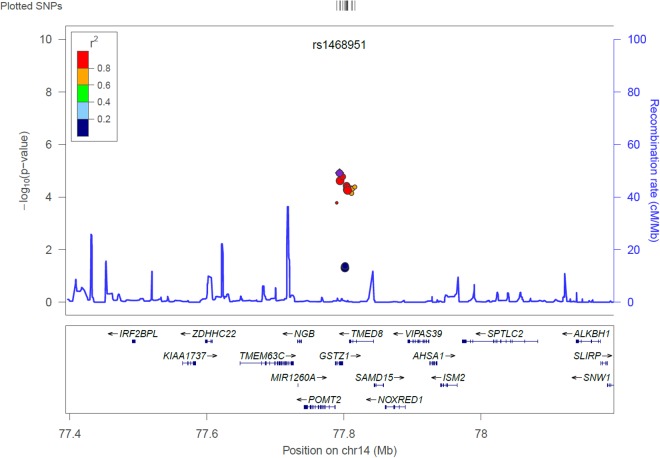
Overall, we found no relation between genetic variations (SNPs and genes) and 14 out of 15 QoL-domains. The strongest association was found between cognitive functioning and the top SNP rs1468951 (p = 1.21E-05) in the GSTZ1 gene. Furthermore, results of the gene-based test showed that the combined effect of 11 SNPs within the GSTZ1 gene is significantly associated with cognitive functioning (p = 2.60E-05).
If validated, the involvement of GSTZ1 in cognitive functioning underscores its heritability which is likely the result of differences in the dopamine pathway, as GSTZ1 contributes to the equilibrium between dopamine and its neurotoxic metabolites via the glutathione redox cycle.
生活质量(QoL)在临床实践中是一个日益重要的参数,因为它可预测死亡率和不良健康结局。据推测,个体可能存在生活质量的遗传易感性。因此,我们将通过文献检索选出的139个候选基因与健康女性的生活质量进行关联研究。
对5142名健康女性评估其背景特征(即人口统计学、临床、生活方式和心理因素)。生活质量通过欧洲癌症研究与治疗组织核心生活质量问卷(EORTC QLQ-C30)进行测量,该问卷包含15个领域。所有女性均有基因分型信息。对于每个候选基因,根据其功能注释(n = 2663)和物理注释(n = 10649)确定单核苷酸多态性(SNP)。在控制背景特征和群体分层的情况下,将SNP与每个生活质量领域进行关联。最后,使用统计软件包VEGAS进行基于基因的分析,将每个基因的10649个SNP(基于物理注释选择)的联合效应与生活质量进行关联。
总体而言,我们发现15个生活质量领域中的14个与遗传变异(SNP和基因)之间无关联。在认知功能与谷胱甘肽硫转移酶Z1(GSTZ1)基因的顶级SNP rs1468951(p = 1.21E-05)之间发现了最强的关联。此外,基于基因的测试结果表明,GSTZ1基因内11个SNP的联合效应与认知功能显著相关(p = 2.60E-05)。
如果得到验证,GSTZ1参与认知功能强调了其遗传性,这可能是多巴胺途径差异的结果,因为GSTZ1通过谷胱甘肽氧化还原循环有助于多巴胺与其神经毒性代谢产物之间的平衡。