Dhakal Radhika, Park Euiho, Lee Se-Weon, Baek Kwang-Hyun
School of Biotechnology, Yeungnam University, Gyeongsan, Gyeongbuk, Republic of Korea.
International Technology Cooperation Center, Rural Development Administration, Jeonju, Republic of Korea.
PLoS One. 2015 Feb 13;10(2):e0117712. doi: 10.1371/journal.pone.0117712. eCollection 2015.
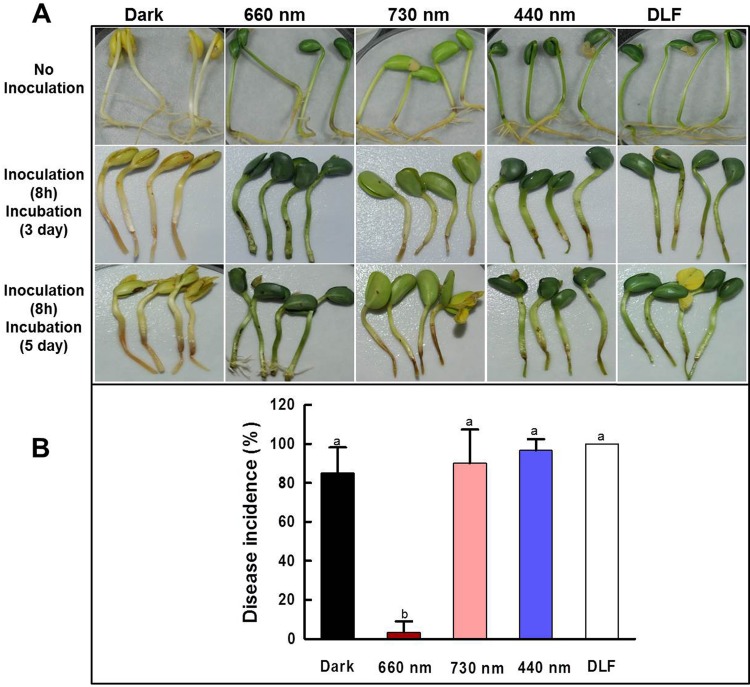
Specific wavelengths of light can exert various physiological changes in plants, including effects on responses to disease incidence. To determine whether specific light wavelength had effects on rotting disease caused by Pseudomonas putida 229, soybean sprouts were germinated under a narrow range of wavelengths from light emitting diodes (LEDs), including red (650-660), far red (720-730) and blue (440-450 nm) or broad range of wavelength from daylight fluorescence bulbs. The controls were composed of soybean sprouts germinated in darkness. After germination under different conditions for 5 days, the soybean sprouts were inoculated with P. putida 229 and the disease incidence was observed for 5 days. The sprouts exposed to red light showed increased resistance against P. putida 229 relative to those grown under other conditions. Soybean sprouts germinated under red light accumulated high levels of salicylic acid (SA) accompanied with up-regulation of the biosynthetic gene ICS and the pathogenesis- related (PR) gene PR-1, indicating that the resistance was induced by the action of SA via de novo synthesis of SA in the soybean sprouts by red light irradiation. Taken together, these data suggest that only the narrow range of red light can induce disease resistance in soybean sprouts, regulated by the SA-dependent pathway via the de novo synthesis of SA and up-regulation of PR genes.
特定波长的光可使植物发生各种生理变化,包括对疾病发生率的反应产生影响。为了确定特定光波长是否对恶臭假单胞菌229引起的腐烂病有影响,将大豆芽在发光二极管(LED)发出的窄波长范围内发芽,包括红色(650 - 660)、远红色(720 - 730)和蓝色(440 - 450纳米),或在日光荧光灯泡发出的宽波长范围内发芽。对照组由在黑暗中发芽的大豆芽组成。在不同条件下发芽5天后,将大豆芽接种恶臭假单胞菌229,并观察5天的发病率。与在其他条件下生长的大豆芽相比,暴露于红光下的大豆芽对恶臭假单胞菌229的抗性增强。在红光下发芽的大豆芽积累了高水平的水杨酸(SA),同时生物合成基因ICS和病程相关(PR)基因PR - 1上调,这表明抗性是由红光照射大豆芽中SA的从头合成通过SA的作用诱导的。综上所述,这些数据表明只有窄范围的红光能诱导大豆芽产生抗病性,通过SA的从头合成和PR基因的上调由SA依赖性途径调节。