Qin Qi-Long, Li Yi, Sun Mei-Ling, Rong Jin-Cheng, Liu Sheng-Bo, Chen Xiu-Lan, Su Hai-Nan, Zhou Bai-Cheng, Xie Bin-Bin, Zhang Yu-Zhong, Zhang Xi-Ying
State Key Laboratory of Microbial Technology, Shandong University, Jinan 250100, China; Marine Biotechnology Research Center, Shandong University, Jinan 250100, China.
Marine Biotechnology Research Center, Shandong University, Jinan 250100, China.
PLoS One. 2015 Feb 13;10(2):e0115998. doi: 10.1371/journal.pone.0115998. eCollection 2015.
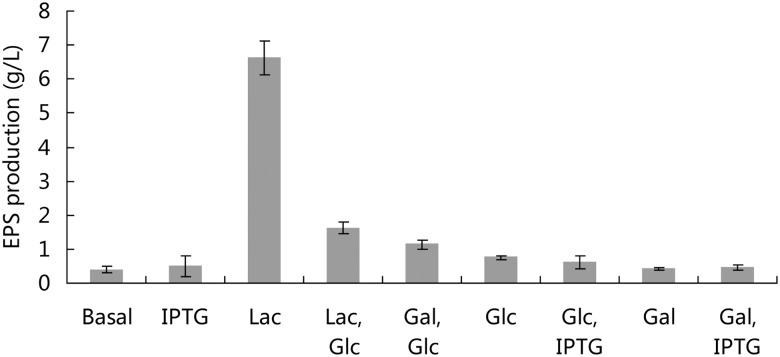
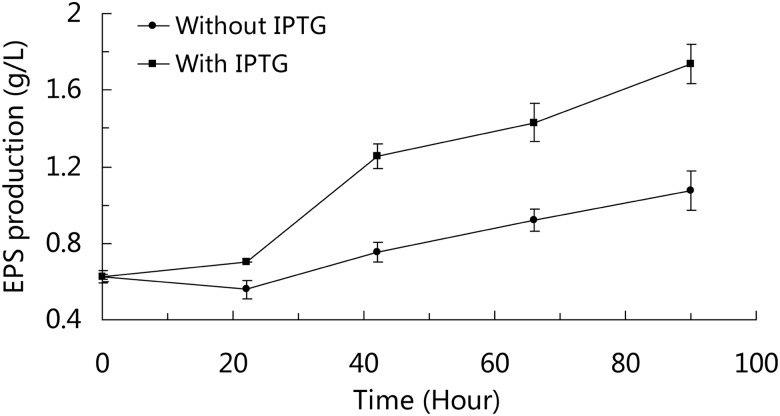
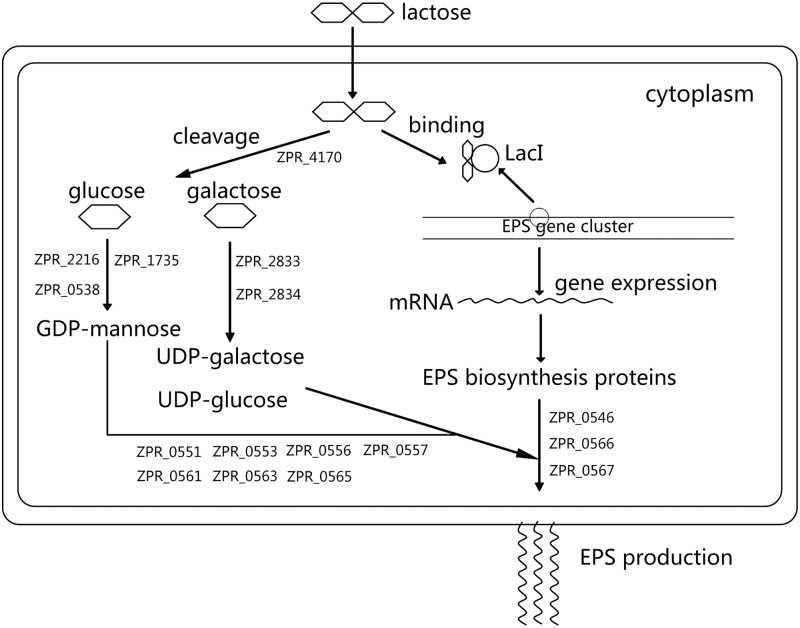
Many marine bacteria secrete exopolysaccharides (EPSs) that have important ecological and physiological functions. Numerous nutritional and environmental factors influence bacterial EPS production. However, the regulatory mechanisms of EPS production are poorly understood. The deep-sea Bacteroidetes bacterium Zunongwangia profunda SM-A87 can produce high quantities of EPS, and its EPS production is enhanced significantly by lactose. Here, we studied the reasons behind the significant advantage that lactose has over other carbon sources in EPS production in SM-A87. RNA-seq technologies were used to study lactose-regulated genes in SM-A87. The expression level of genes within the EPS gene cluster was up-regulated when lactose was added. Supplement of lactose also influenced the expression of genes located outside the EPS gene cluster that are also involved in EPS biosynthesis. The major glycosyl components of SM-A87 EPS are mannose, glucose and galactose. Genomic metabolic pathway analyses showed that the EPS precursor GDP-mannose can be synthesized from glucose, while the precursor UDP-glucose must be synthesized from galactose. Lactose can provide glucose and galactose simultaneously and prevent glucose inhibition. Lactose can also greatly stimulate the growth of SM-A87. Taken together, lactose acts not only as an inducer but also as a carbohydrate source for EPS production. This research broadens our knowledge of the regulation of EPS production in marine bacteria.
许多海洋细菌会分泌具有重要生态和生理功能的胞外多糖(EPSs)。众多营养和环境因素会影响细菌EPS的产生。然而,EPS产生的调控机制却知之甚少。深海拟杆菌Zunongwangia profunda SM-A87能够产生大量EPS,并且乳糖能显著提高其EPS产量。在此,我们研究了乳糖在SM-A87中EPS产生方面相对于其他碳源具有显著优势的原因。利用RNA测序技术研究了SM-A87中受乳糖调控的基因。添加乳糖时,EPS基因簇内基因的表达水平上调。乳糖的添加还影响了EPS基因簇外但也参与EPS生物合成的基因的表达。SM-A87 EPS的主要糖基成分是甘露糖、葡萄糖和半乳糖。基因组代谢途径分析表明,EPS前体GDP-甘露糖可由葡萄糖合成,而前体UDP-葡萄糖必须由半乳糖合成。乳糖能同时提供葡萄糖和半乳糖并防止葡萄糖抑制。乳糖还能极大地刺激SM-A87的生长。综上所述,乳糖不仅作为诱导剂,还作为EPS产生的碳水化合物来源。这项研究拓宽了我们对海洋细菌中EPS产生调控的认识。