Ito Tomotaka, Tsubahara Akio, Shinkoda Koichi, Yoshimura Yosuke, Kobara Kenichi, Osaka Hiroshi
Department of Rehabilitation, Faculty of Health Science and Technology, Kawasaki University of Medical Welfare, Okayama, Japan.
Department of Biomechanics, Graduate School of Biomedical and Health Sciences, Hiroshima University, Hiroshima, Japan.
PLoS One. 2015 Feb 17;10(2):e0117931. doi: 10.1371/journal.pone.0117931. eCollection 2015.
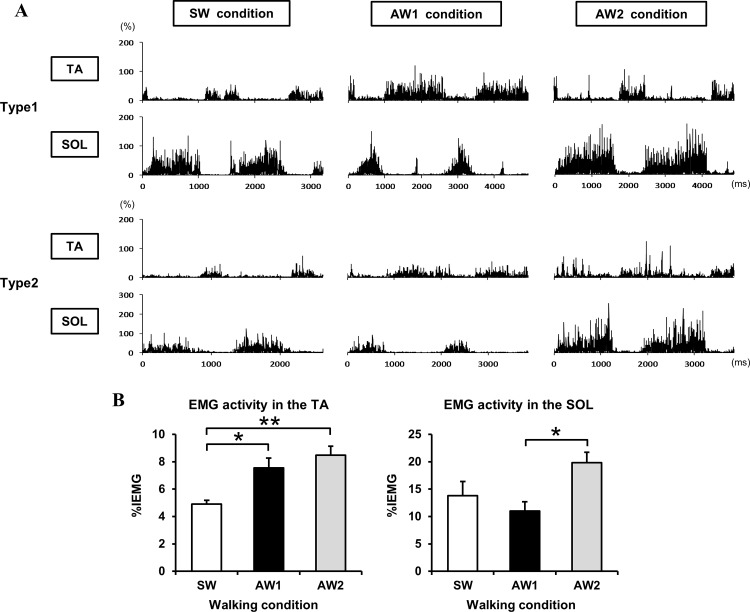
Our previous single-pulse transcranial magnetic stimulation (TMS) study revealed that excitability in the motor cortex can be altered by conscious control of walking relative to less conscious normal walking. However, substantial elements and underlying mechanisms for inducing walking-related cortical plasticity are still unknown. Hence, in this study we aimed to examine the characteristics of electromyographic (EMG) recordings obtained during different walking conditions, namely, symmetrical walking (SW), asymmetrical walking 1 (AW1), and asymmetrical walking 2 (AW2), with left to right stance duration ratios of 1:1, 1:2, and 2:1, respectively. Furthermore, we investigated the influence of three types of walking control on subsequent changes in the intracortical neural circuits. Prior to each type of 7-min walking task, EMG analyses of the left tibialis anterior (TA) and soleus (SOL) muscles during walking were performed following approximately 3 min of preparative walking. Paired-pulse TMS was used to measure short-interval intracortical inhibition (SICI) and intracortical facilitation (ICF) in the left TA and SOL at baseline, immediately after the 7-min walking task, and 30 min post-task. EMG activity in the TA was significantly increased during AW1 and AW2 compared to during SW, whereas a significant difference in EMG activity of the SOL was observed only between AW1 and AW2. As for intracortical excitability, there was a significant alteration in SICI in the TA between SW and AW1, but not between SW and AW2. For the same amount of walking exercise, we found that the different methods used to control walking patterns induced different excitability changes in SICI. Our research shows that activation patterns associated with controlled leg muscles can alter post-exercise excitability in intracortical circuits. Therefore, how leg muscles are activated in a clinical setting could influence the outcome of walking in patients with stroke.
我们之前的单脉冲经颅磁刺激(TMS)研究表明,与意识程度较低的正常行走相比,有意识地控制行走可以改变运动皮层的兴奋性。然而,诱导与行走相关的皮层可塑性的大量要素和潜在机制仍然未知。因此,在本研究中,我们旨在研究在不同行走条件下获得的肌电图(EMG)记录的特征,即对称行走(SW)、不对称行走1(AW1)和不对称行走2(AW2),左右站立持续时间比分别为1:1、1:2和2:1。此外,我们研究了三种行走控制类型对皮质内神经回路后续变化的影响。在每种7分钟的行走任务之前,在大约3分钟的准备性行走后,对行走过程中左胫骨前肌(TA)和比目鱼肌(SOL)进行EMG分析。使用成对脉冲TMS在基线、7分钟行走任务结束后立即以及任务后30分钟测量左TA和SOL中的短间隔皮质内抑制(SICI)和皮质内易化(ICF)。与SW期间相比,TA中的EMG活动在AW1和AW2期间显著增加,而仅在AW1和AW2之间观察到SOL的EMG活动存在显著差异。至于皮质内兴奋性,TA中的SICI在SW和AW1之间有显著变化,但在SW和AW2之间没有。对于相同量的步行运动,我们发现用于控制行走模式的不同方法在SICI中诱导了不同的兴奋性变化。我们的研究表明,与受控腿部肌肉相关的激活模式可以改变运动后皮质内回路的兴奋性。因此,在临床环境中腿部肌肉的激活方式可能会影响中风患者的行走结果。