Bradley W Daniel, Hisey Michael S, Verma-Kurvari Sunita, Ohnmeiss Donna D
Texas Back Institute, Denton, TX.
Texas Back Institute Research Foundation, Plano, TX.
Int J Spine Surg. 2012 Dec 1;6:110-4. doi: 10.1016/j.ijsp.2011.12.005. eCollection 2012.
Lumbar interbody fusion has long been used for the treatment of painful degenerative spinal conditions. The anterior approach is not feasible in some patients, and the posterior approach is associated with a risk of neural complications and possibly muscle injury. A trans-sacral technique was developed that allows access to the L5-S1 disc space. The purposes of this study were to investigate the clinical outcome of trans-sacral interbody fusion in a consecutive series of patients from 1 center and to perform a comprehensive review of the literature on this procedure.
A literature search using PubMed was performed to identify articles published on trans-sacral axial lumbar interbody fusion (AxiaLIF). Articles reviewed included biomechanical testing, feasibility of the technique, and clinical results. The data from our center were collected retrospectively from charts for the consecutive series, beginning with the first case, of all patients undergoing fusion using the AxiaLIF technique. In most cases, posterior instrumentation was also used. A total of 41 patients with at least 6 months' follow-up were included (mean follow-up, 22.2 months). The primary clinical outcome measures were visual analog scales separately assessing back and leg pain and the Oswestry Disability Index. Radiographic assessment of fusion was also performed.
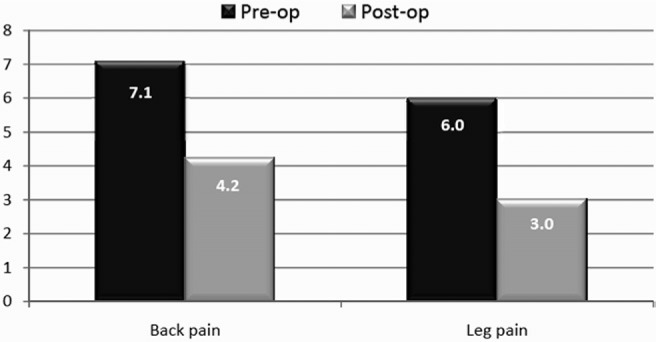
In the group of 28 patients undergoing single-level AxiaLIF combined with posterior fusion, the visual analog scale scores assessing back and leg pain and mean Oswestry Disability Index scores improved significantly (P < .01). In the remaining 13 patients, back pain improved significantly with a trend for improvement in leg pain. Reoperation occurred in 19.5% of patients; in half of these, reoperation was not related to the anterior procedure.
A review of the literature found that the AxiaLIF technique was similar to other fusion techniques with respect to biomechanical properties and produced acceptable clinical outcomes, although results varied among studies.
The AxiaLIF approach allows access to the L5-S1 interspace without violating the annulus or longitudinal ligaments and with minimal risk to dorsal neural elements. It may be a viable alternative to other approaches to interbody fusion at the L5-S1 level. It is important that the patients be selected carefully and surgeons are familiar with the presacral anatomy and the surgical approach.
腰椎椎间融合术长期以来一直用于治疗疼痛性退行性脊柱疾病。前路手术在一些患者中不可行,而后路手术存在神经并发症风险以及可能的肌肉损伤。一种经骶骨技术得以开发,可用于进入L5-S1椎间盘间隙。本研究的目的是调查来自1个中心的一系列连续患者经骶骨椎间融合术的临床结果,并对该手术的文献进行全面综述。
使用PubMed进行文献检索,以识别发表的关于经骶骨轴向腰椎椎间融合术(AxiaLIF)的文章。综述的文章包括生物力学测试、该技术的可行性和临床结果。我们中心的数据是从所有使用AxiaLIF技术进行融合的患者的连续病例图表中回顾性收集的,从第一例开始。在大多数情况下,还使用了后路内固定。共纳入41例至少随访6个月的患者(平均随访22.2个月)。主要临床结果指标是分别评估腰背痛和腿痛的视觉模拟量表以及Oswestry功能障碍指数。还进行了融合的影像学评估。
在28例行单节段AxiaLIF联合后路融合的患者组中,评估腰背痛和腿痛的视觉模拟量表评分以及平均Oswestry功能障碍指数评分显著改善(P <.01)。在其余13例患者中,腰背痛显著改善,腿痛有改善趋势。19.5%的患者进行了再次手术;其中一半患者的再次手术与前路手术无关。
文献综述发现,AxiaLIF技术在生物力学特性方面与其他融合技术相似,并产生了可接受的临床结果,尽管研究结果各不相同。
AxiaLIF方法可进入L5-S1间隙,而不侵犯纤维环或纵韧带,对背侧神经结构的风险最小。它可能是L5-S1水平椎间融合其他方法的可行替代方案。仔细选择患者并让外科医生熟悉骶前解剖结构和手术方法很重要。