
全细胞甲醛交联简化了参与线粒体基因表达的线粒体核仁和相关蛋白的纯化过程。
Whole cell formaldehyde cross-linking simplifies purification of mitochondrial nucleoids and associated proteins involved in mitochondrial gene expression.
作者信息
Rajala Nina, Hensen Fenna, Wessels Hans J C T, Ives Daniel, Gloerich Jolein, Spelbrink Johannes N
机构信息
Mitochondrial DNA Maintenance Group, BioMediTech, FI-33014 University of Tampere, Tampere, Finland.
Department of Pediatrics, Nijmegen Centre for Mitochondrial Disorders, Radboud University Medical Centre, Geert Grooteplein 10, P.O. Box 9101, 6500 HB, Nijmegen, The Netherlands.
出版信息
PLoS One. 2015 Feb 19;10(2):e0116726. doi: 10.1371/journal.pone.0116726. eCollection 2015.
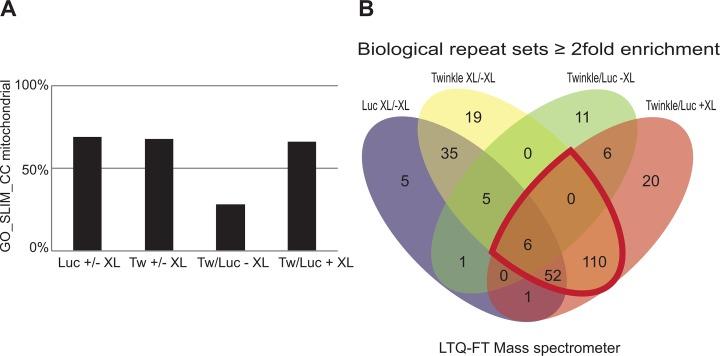
Mitochondrial DNA/protein complexes (nucleoids) appear as discrete entities inside the mitochondrial network when observed by live-cell imaging and immunofluorescence. This somewhat trivial observation in recent years has spurred research towards isolation of these complexes and the identification of nucleoid-associated proteins. Here we show that whole cell formaldehyde crosslinking combined with affinity purification and tandem mass-spectrometry provides a simple and reproducible method to identify potential nucleoid associated proteins. The method avoids spurious mitochondrial isolation and subsequent multifarious nucleoid enrichment protocols and can be implemented to allow for label-free quantification (LFQ) by mass-spectrometry. Using expression of a Flag-tagged Twinkle helicase and appropriate controls we show that this method identifies many previously identified nucleoid associated proteins. Using LFQ to compare HEK293 cells with and without mtDNA, but both expressing Twinkle-FLAG, identifies many proteins that are reduced or absent in the absence of mtDNA. This set not only includes established mtDNA maintenance proteins but also many proteins involved in mitochondrial RNA metabolism and translation and therefore represents what can be considered an mtDNA gene expression proteome. Our data provides a very valuable resource for both basic mitochondrial researchers as well as clinical geneticists working to identify novel disease genes on the basis of exome sequence data.
当通过活细胞成像和免疫荧光观察时,线粒体DNA/蛋白质复合物(类核)在线粒体网络中呈现为离散的实体。近年来这一略显平常的观察结果激发了对这些复合物的分离以及类核相关蛋白鉴定的研究。在这里,我们表明全细胞甲醛交联结合亲和纯化和串联质谱提供了一种简单且可重复的方法来鉴定潜在的类核相关蛋白。该方法避免了虚假的线粒体分离以及随后繁琐的类核富集方案,并且可以实施以允许通过质谱进行无标记定量(LFQ)。使用带有Flag标签的Twinkle解旋酶的表达和适当的对照,我们表明该方法鉴定出许多先前已鉴定的类核相关蛋白。使用LFQ比较有和没有mtDNA但都表达Twinkle-FLAG的HEK293细胞,鉴定出许多在没有mtDNA时减少或缺失的蛋白质。这一组不仅包括已确定的mtDNA维持蛋白,还包括许多参与线粒体RNA代谢和翻译的蛋白质,因此代表了可被视为mtDNA基因表达蛋白质组的内容。我们的数据为基础线粒体研究人员以及致力于根据外显子组序列数据鉴定新疾病基因的临床遗传学家提供了非常有价值的资源。




 Zotero 插件