Brookes Sharon, Gagrica Sladjana, Sanij Elaine, Rowe Janice, Gregory Fiona J, Hara Eiji, Peters Gordon
a Cancer Research-UK London Research Institute ; London , UK.
Cell Cycle. 2015;14(8):1164-73. doi: 10.1080/15384101.2015.1010866.
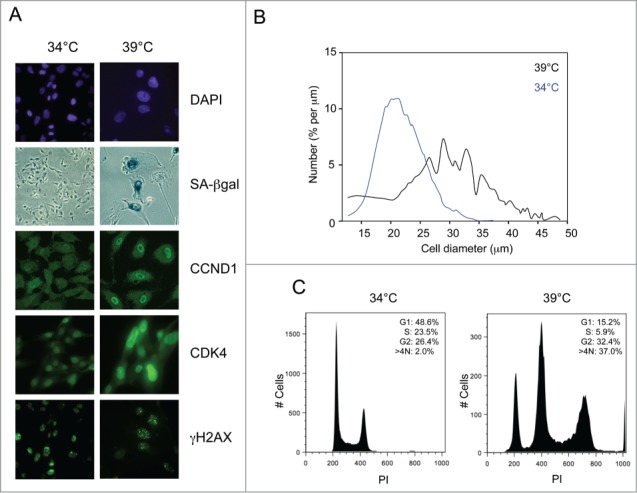
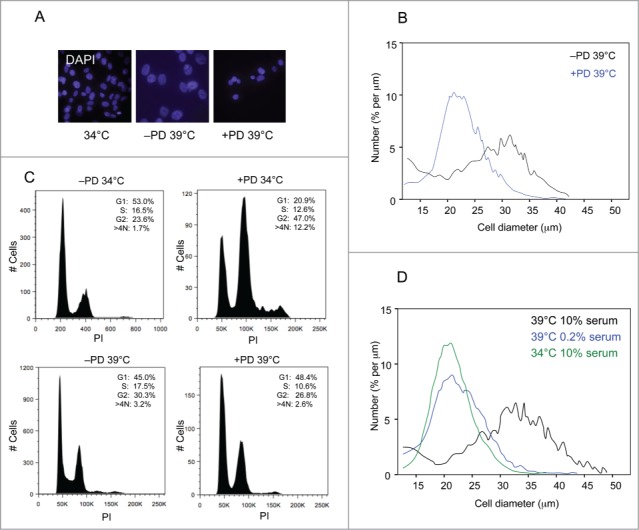
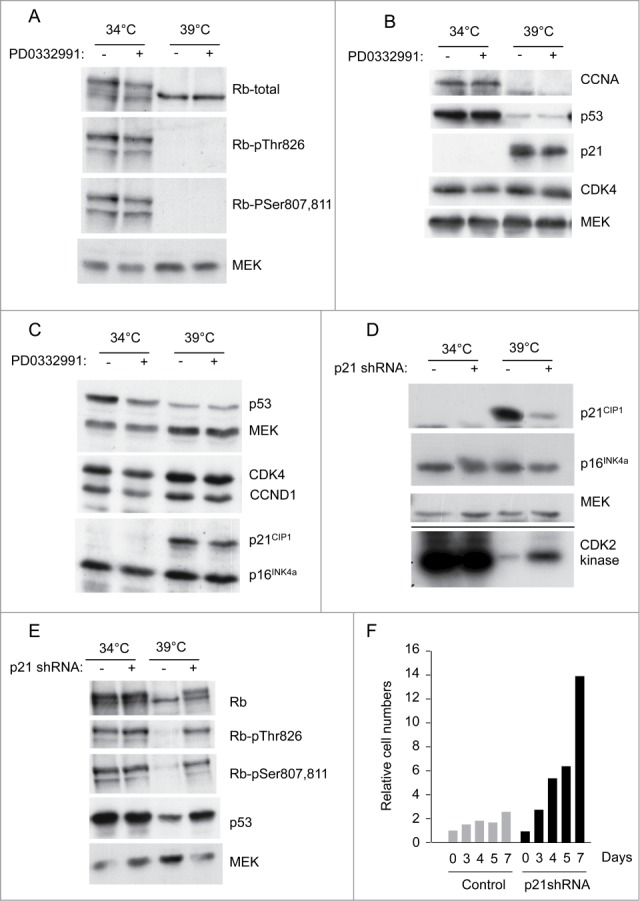
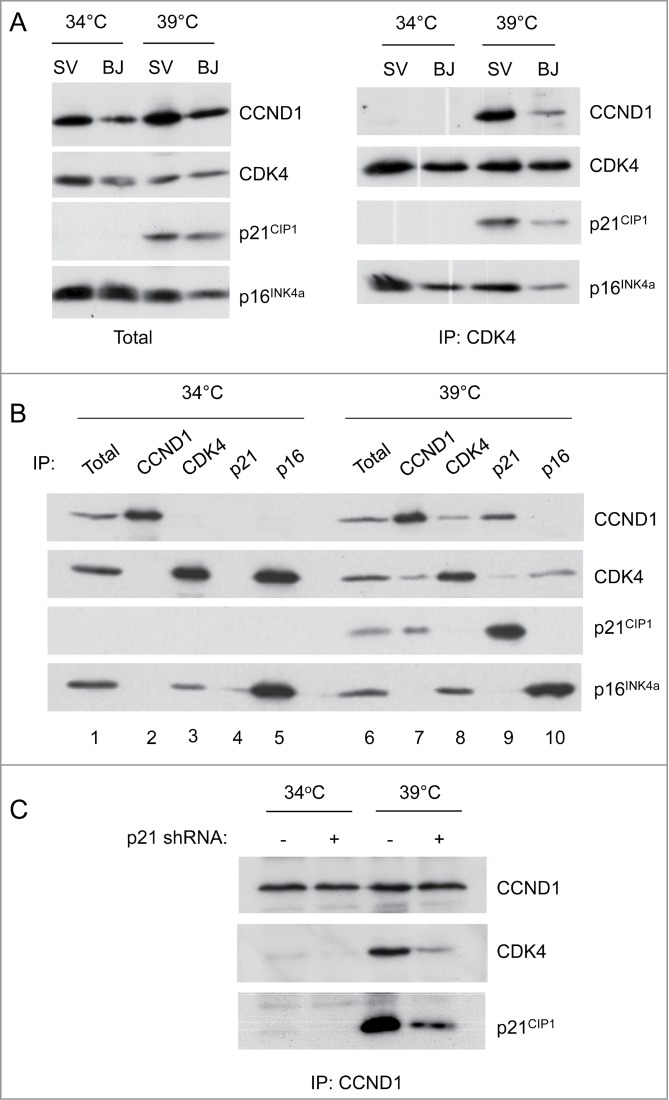
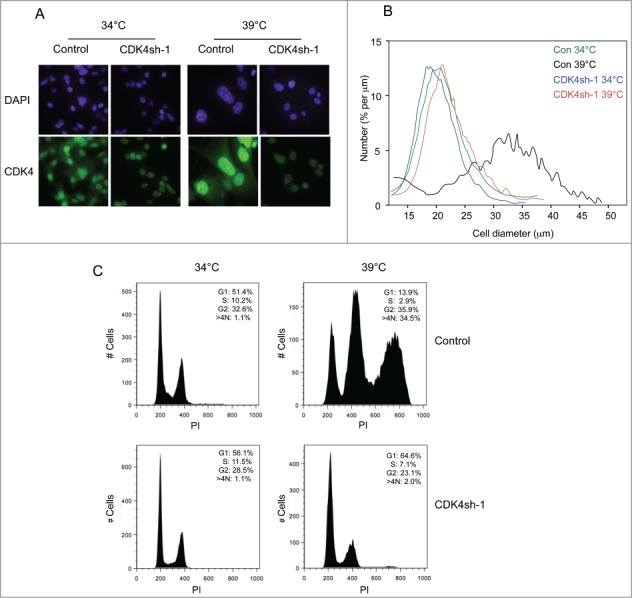
Cellular senescence, the stable cell cycle arrest elicited by various forms of stress, is an important facet of tumor suppression. Although much is known about the key players in the implementation of senescence, including the pRb and p53 axes and the cyclin dependent kinase inhibitors p16(INK4a) and p21(CIP1), many details remain unresolved. In studying conditional senescence in human fibroblasts that express a temperature sensitive SV40 large T-antigen (T-Ag), we uncovered an unexpected role for CDK4. At the permissive temperature, where pRb and p53 are functionally compromised by T-Ag, cyclin D-CDK4 complexes are disrupted by the high p16(INK4a) levels and reduced expression of p21(CIP1). In cells arrested at the non-permissive temperature, p21(CIP1) promotes reassembly of cyclin D-CDK4 yet pRb is in a hypo-phosphorylated state, consistent with cell cycle arrest. In exploring whether the reassembled cyclin D-CDK4-p21 complexes are functional, we found that shRNA-mediated knockdown or chemical inhibition of CDK4 prevented the increase in cell size associated with the senescent phenotype by allowing the cells to arrest in G1 rather than G2/M. The data point to a role for CDK4 kinase activity in a G2 checkpoint that contributes to senescence.
细胞衰老,即由各种形式的应激引发的稳定细胞周期停滞,是肿瘤抑制的一个重要方面。尽管人们对衰老过程中的关键参与者,包括pRb和p53信号轴以及细胞周期蛋白依赖性激酶抑制剂p16(INK4a)和p21(CIP1),已经有了很多了解,但许多细节仍未得到解决。在研究表达温度敏感型SV40大T抗原(T-Ag)的人成纤维细胞中的条件性衰老时,我们发现了CDK4的一个意想不到的作用。在允许温度下,pRb和p53在功能上因T-Ag而受损,细胞周期蛋白D-CDK4复合物因高p16(INK4a)水平和p21(CIP1)表达降低而被破坏。在非允许温度下停滞的细胞中,p21(CIP1)促进细胞周期蛋白D-CDK4的重新组装,但pRb处于低磷酸化状态,这与细胞周期停滞一致。在探索重新组装的细胞周期蛋白D-CDK4-p21复合物是否具有功能时,我们发现shRNA介导的CDK4敲低或化学抑制通过使细胞在G1期而非G2/M期停滞,阻止了与衰老表型相关的细胞大小增加。这些数据表明CDK4激酶活性在一个有助于衰老的G2检查点中发挥作用。