Chien Shang-Tao, Shi Ming-Der, Lee Yi-Chieh, Te Chou-Chia, Shih Yuan-Wei
Department of Pathology, Kaohsiung Armed Forces General Hospital, Kaohsiung, 80284 Taiwan ; Department of Medical Laboratory Sciences and Biotechnology, Fooyin University, Kaohsiung, 83102 Taiwan.
Department of Medical Technology, Kaohsiung Veterans General Hospital Tainan Branch, Tainan, 71051 Taiwan ; Department of Medical Laboratory Science and Biotechnology and Graduate Institute of Biological Technology, Chung Hwa University of Medical Technology, Tainan, 71703 Taiwan.
Cancer Cell Int. 2015 Feb 4;15:15. doi: 10.1186/s12935-015-0168-2. eCollection 2015.
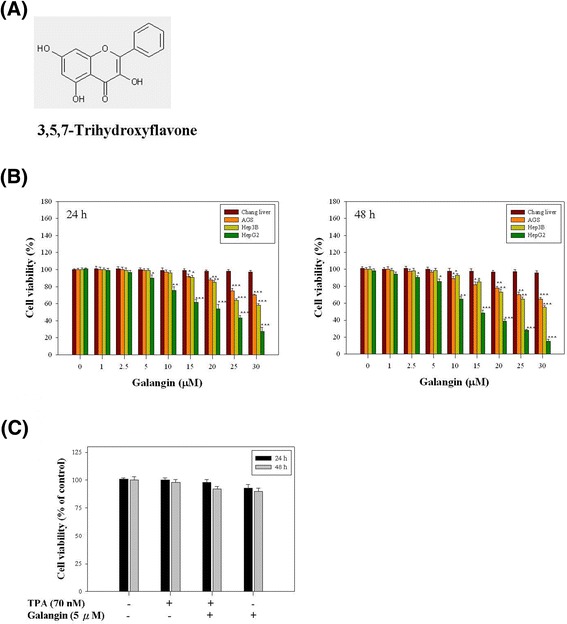
Galangin (3,5,7-trihydroxyflavone) is a flavonoid compound found in high concentration in lesser galangal. The objective of this study was to investigate the ability of galangin to inhibit 12-O-tetradecanoylphorbol-13-acetate (TPA)-induced the invasion and metastasis of HepG2 liver cancer cells.
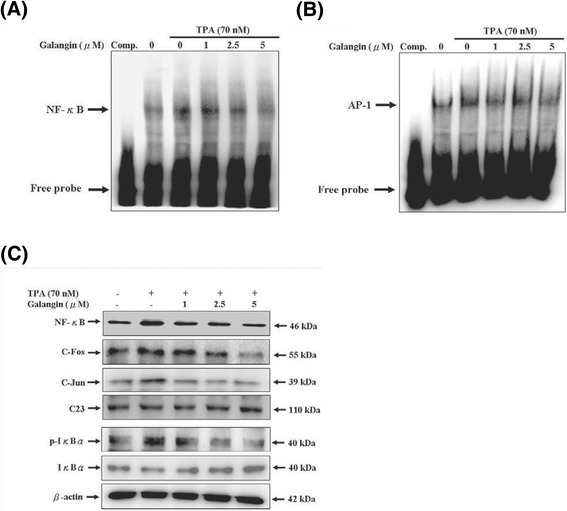
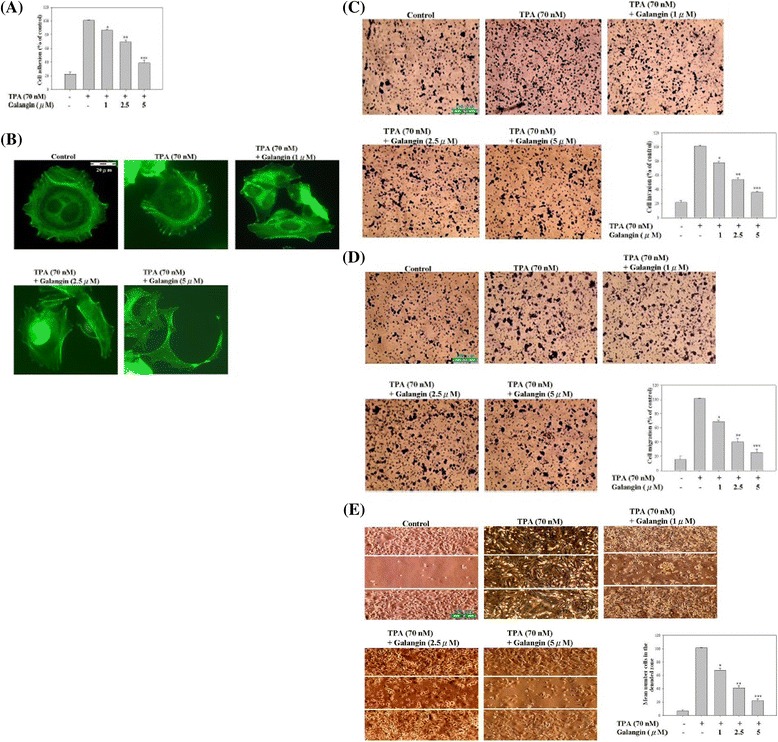
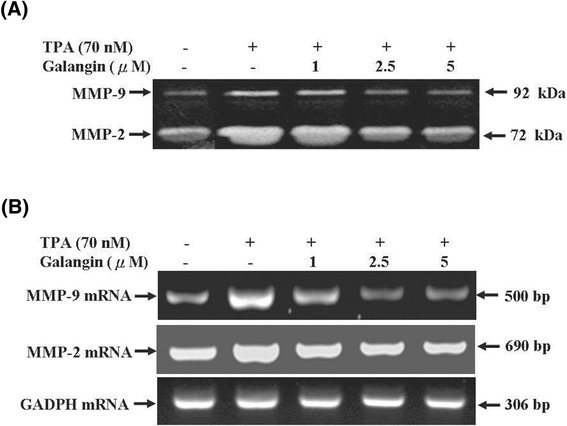
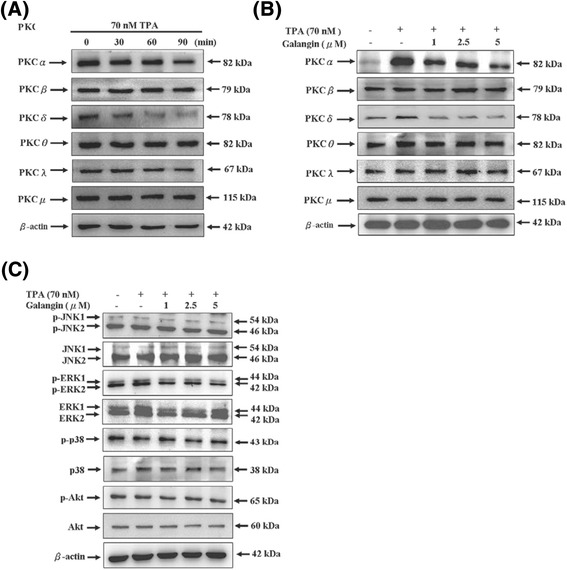
First, using a cell-matrix adhesion assay, immunofluorescence assay, transwell-chamber invasion/migration assay, and wound healing assay, we observed that galangin exerted an inhibitory effect on TPA-induced cell adhesion, morphology/actin cytoskeleton arrangement, invasion and migration. Furthermore, the results of gelatin zymography and reverse transcriptase polymerase chain reaction (RT-PCR) assays showed that galangin reduced the TPA-induced enzyme activity of matrix metalloproteinase-2 (MMP-2) and matrix metalloproteinase-9 (MMP-9) in HepG2 cells; moreover, the messenger RNA level was downregulated. We also observed through a Western blotting assay that galangin strongly inhibited the TPA-induced protein expressions of protein kinase Cα (PKCα), protein kinase Cδ (PKCδ), phosphorylated extracellular signal-regulated kinase 1/2 (ERK1/2), the phospho-inhibitor of kappaBα (phospho-IκBα), c-Fos, c-Jun, and nuclear factor kappa B (NF-κB). Next, galangin dose-dependently inhibited the binding ability of NF-κB and activator protein 1 (AP-1) to MMP-2/MMP-9 promoters, respectively, resulting in the suppression of MMP-2/MMP-9 enzyme activity.
The results revealed that galangin effectively inhibited the TPA-induced invasion and migration of HepG2 cells through a protein kinase C/extracellular signal-regulated kinase (PKC/ERK) pathway. Thus, galangin may have widespread applications in clinical therapy as an anti-metastatic medicament.
高良姜素(3,5,7 - 三羟基黄酮)是一种在小高良姜中高浓度存在的黄酮类化合物。本研究的目的是探究高良姜素抑制12 - O - 十四烷酰佛波醇 - 13 - 乙酸酯(TPA)诱导的肝癌HepG2细胞侵袭和转移的能力。
首先,通过细胞 - 基质黏附试验、免疫荧光试验、Transwell小室侵袭/迁移试验和伤口愈合试验,我们观察到高良姜素对TPA诱导的细胞黏附、形态/肌动蛋白细胞骨架排列、侵袭和迁移具有抑制作用。此外,明胶酶谱分析和逆转录聚合酶链反应(RT - PCR)试验结果表明,高良姜素降低了TPA诱导的HepG2细胞中基质金属蛋白酶 - 2(MMP - 2)和基质金属蛋白酶 - 9(MMP - 9)的酶活性;而且,信使核糖核酸水平下调。我们还通过蛋白质印迹试验观察到,高良姜素强烈抑制TPA诱导的蛋白激酶Cα(PKCα)、蛋白激酶Cδ(PKCδ)、磷酸化细胞外信号调节激酶1/2(ERK1/2)、磷酸化核因子κB抑制蛋白α(磷酸化 - IκBα)、c - Fos、c - Jun和核因子κB(NF - κB)的蛋白表达。接下来,高良姜素分别以剂量依赖的方式抑制NF - κB和激活蛋白1(AP - 1)与MMP - 2/MMP - 9启动子的结合能力,从而导致MMP - 2/MMP - 9酶活性的抑制。
结果表明,高良姜素通过蛋白激酶C/细胞外信号调节激酶(PKC/ERK)途径有效抑制TPA诱导的HepG2细胞侵袭和迁移。因此,高良姜素作为一种抗转移药物可能在临床治疗中具有广泛应用。