Sankowski Roman, Mader Simone, Valdés-Ferrer Sergio Iván
Elmezzi Graduate School of Molecular Medicine , Manhasset, NY , USA ; Feinstein Institute for Medical Research , Manhasset, NY , USA.
Feinstein Institute for Medical Research , Manhasset, NY , USA.
Front Cell Neurosci. 2015 Feb 2;9:28. doi: 10.3389/fncel.2015.00028. eCollection 2015.
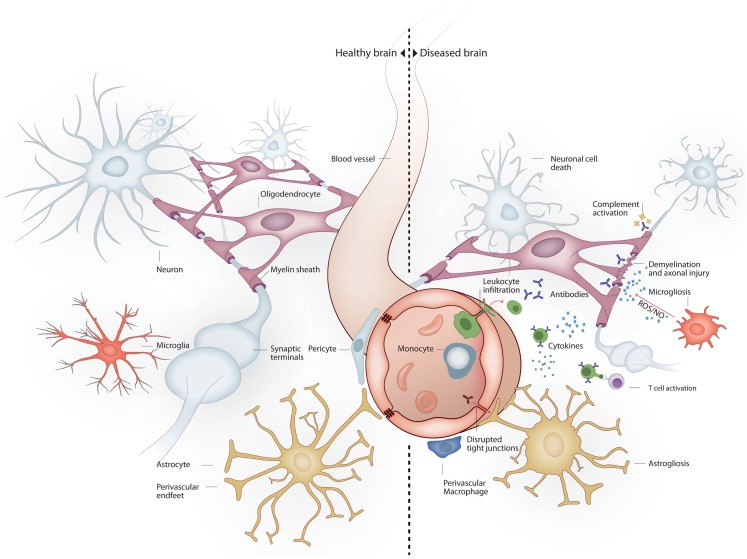
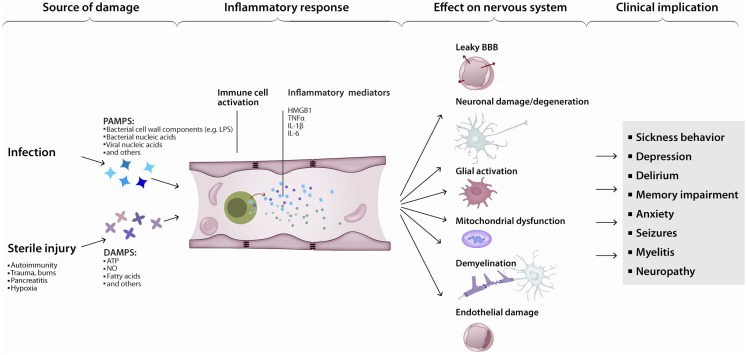
The nervous and immune systems have evolved in parallel from the early bilaterians, in which innate immunity and a central nervous system (CNS) coexisted for the first time, to jawed vertebrates and the appearance of adaptive immunity. The CNS feeds from, and integrates efferent signals in response to, somatic and autonomic sensory information. The CNS receives input also from the periphery about inflammation and infection. Cytokines, chemokines, and damage-associated soluble mediators of systemic inflammation can also gain access to the CNS via blood flow. In response to systemic inflammation, those soluble mediators can access directly through the circumventricular organs, as well as open the blood-brain barrier. The resulting translocation of inflammatory mediators can interfere with neuronal and glial well-being, leading to a break of balance in brain homeostasis. This in turn results in cognitive and behavioral manifestations commonly present during acute infections - including anorexia, malaise, depression, and decreased physical activity - collectively known as the sickness behavior (SB). While SB manifestations are transient and self-limited, under states of persistent systemic inflammatory response the cognitive and behavioral changes can become permanent. For example, cognitive decline is almost universal in sepsis survivors, and a common finding in patients with systemic lupus erythematosus. Here, we review recent genetic evidence suggesting an association between neurodegenerative disorders and persistent immune activation; clinical and experimental evidence indicating previously unidentified immune-mediated pathways of neurodegeneration; and novel immunomodulatory targets and their potential relevance for neurodegenerative disorders.
从早期两侧对称动物开始,神经系统和免疫系统就并行进化,在早期两侧对称动物中,先天免疫和中枢神经系统(CNS)首次共存,一直到有颌脊椎动物以及适应性免疫的出现。中枢神经系统接收躯体和自主感觉信息,并对其做出反应,整合传出信号。中枢神经系统也从外周接收有关炎症和感染的输入信息。细胞因子、趋化因子以及全身炎症的损伤相关可溶性介质也可通过血流进入中枢神经系统。针对全身炎症,这些可溶性介质可直接通过室周器官进入,也可打开血脑屏障。炎症介质的这种易位会干扰神经元和神经胶质细胞的健康,导致脑内稳态失衡。这进而导致急性感染期间常见的认知和行为表现——包括厌食、不适、抑郁和身体活动减少——统称为疾病行为(SB)。虽然疾病行为表现是短暂的且具有自限性,但在持续的全身炎症反应状态下,认知和行为改变可能会变得永久性。例如,认知衰退在脓毒症幸存者中几乎普遍存在,也是系统性红斑狼疮患者的常见表现。在此,我们综述了近期的遗传学证据,这些证据表明神经退行性疾病与持续的免疫激活之间存在关联;临床和实验证据表明存在先前未被识别的神经变性免疫介导途径;以及新型免疫调节靶点及其与神经退行性疾病的潜在相关性。