Chimetto Tonon Luciane A, Silva Bruno Sergio de O, Moreira Ana Paula B, Valle Cecilia, Alves Nelson, Cavalcanti Giselle, Garcia Gizele, Lopes Rubens M, Francini-Filho Ronaldo B, de Moura Rodrigo L, Thompson Cristiane C, Thompson Fabiano L
Laboratory of Microbiology, Institute of Biology, Federal University of Rio de Janeiro (UFRJ) , Rio de Janeiro , Brazil ; Brazilian Biosciences National Laboratory (LNBio), National Research Center Energy and Materials (CNPEM) , Campinas , Brazil.
Laboratory of Microbiology, Institute of Biology, Federal University of Rio de Janeiro (UFRJ) , Rio de Janeiro , Brazil.
PeerJ. 2015 Feb 10;3:e741. doi: 10.7717/peerj.741. eCollection 2015.
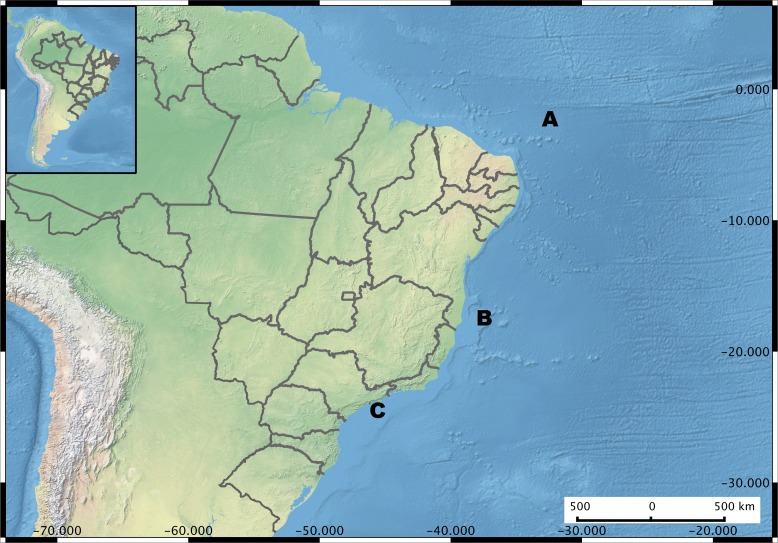
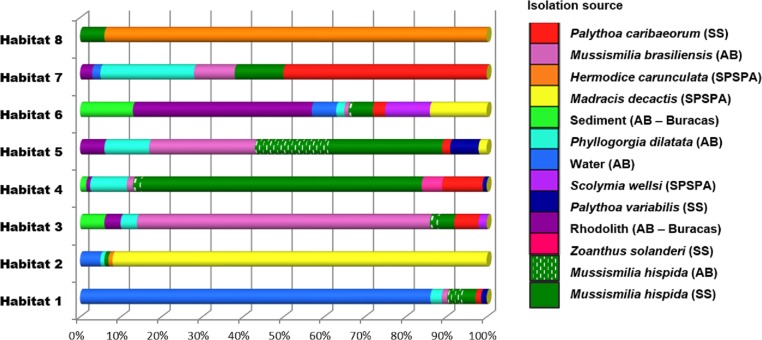
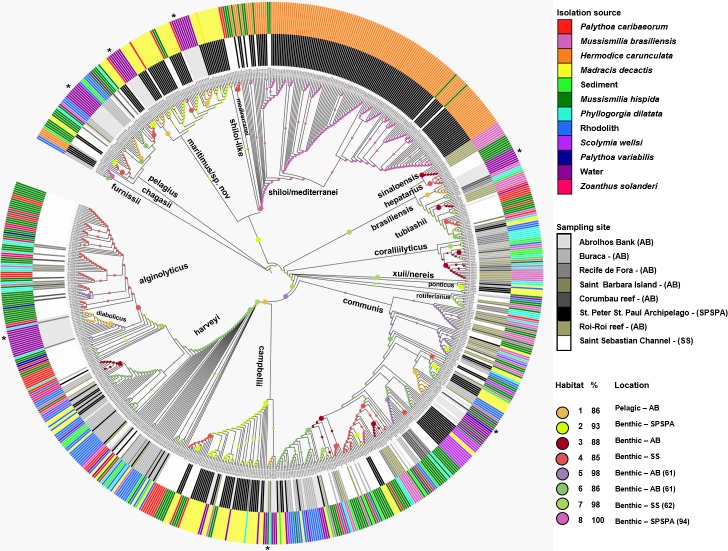
We analyzed the diversity and population structure of the 775 Vibrio isolates from different locations of the southwestern Atlantic Ocean (SAO), including St. Peter and St. Paul Archipelago (SPSPA), Abrolhos Bank (AB) and the St. Sebastian region (SS), between 2005 and 2010. In this study, 195 novel isolates, obtained from seawater and major benthic organisms (rhodoliths and corals), were compared with a collection of 580 isolates previously characterized (available at www.taxvibrio.lncc.br). The isolates were distributed in 8 major habitat spectra according to AdaptML analysis on the basis of pyrH phylogenetic reconstruction and ecological information, such as isolation source (i.e., corals: Madracis decactis, Mussismilia braziliensis, M. hispida, Phyllogorgia dilatata, Scolymia wellsi; zoanthids: Palythoa caribaeorum, P. variabilis and Zoanthus solanderi; fireworm: Hermodice carunculata; rhodolith; water and sediment) and sampling site regions (SPSPA, AB and SS). Ecologically distinct groups were discerned through AdaptML, which finds phylogenetic groups that are significantly different in their spectra of habitat preferences. Some habitat spectra suggested ecological specialization, with habitat spectra 2, 3, and 4 corresponding to specialization on SPSPA, AB, and SS, respectively. This match between habitat and location may reflect a minor exchange of Vibrio populations between geographically isolated benthic systems. Moreover, we found several widespread Vibrio species predominantly from water column, and different populations of a single Vibrio species from H. carunculata in ecologically distinct groups (H-1 and H-8 respectively). On the other hand, AdaptML detected phylogenetic groups that are found in both the benthos and in open water. The ecological grouping observed suggests dispersal and connectivity between the benthic and pelagic systems in AB. This study is a first attempt to characterize the biogeographic distribution of vibrios in both seawater and several benthic hosts in the SAO. The benthopelagic coupling observed here stands out the importance of vibrios in the global ocean health.
我们分析了2005年至2010年间从西南大西洋(SAO)不同地点分离出的775株弧菌的多样性和种群结构,这些地点包括圣彼得和圣保罗群岛(SPSPA)、阿布鲁霍斯浅滩(AB)以及圣塞巴斯蒂安地区(SS)。在本研究中,从海水和主要底栖生物(钙藻和珊瑚)中获得的195株新分离株与先前已鉴定的580株分离株(可在www.taxvibrio.lncc.br获取)进行了比较。根据基于pyrH系统发育重建和生态信息(如分离源,即珊瑚:十角蜂巢珊瑚、巴西缪氏珊瑚、硬叶缪氏珊瑚、扩张叶柳珊瑚、韦氏石芝珊瑚;海葵:加勒比海葵、多变海葵和索氏海葵;多毛纲动物:疣背裂虫;钙藻;水和沉积物)以及采样地点区域(SPSPA、AB和SS)的AdaptML分析,这些分离株分布在8个主要生境谱中。通过AdaptML识别出了生态上不同的群体,该方法能找到在生境偏好谱上有显著差异的系统发育群体。一些生境谱表明存在生态特化现象,生境谱2、3和4分别对应于在SPSPA、AB和SS上的特化。生境与地点之间的这种匹配可能反映了地理隔离的底栖系统之间弧菌种群的少量交换。此外,我们发现了几种主要来自水柱的广泛分布的弧菌物种,以及在生态上不同的群体(分别为H - 1和H - 8)中来自疣背裂虫的单一弧菌物种的不同种群。另一方面,AdaptML检测到了在底栖生物和开阔水域中都存在的系统发育群体。观察到的生态分组表明AB中底栖和浮游系统之间存在扩散和连通性。本研究首次尝试描述SAO海水和几种底栖宿主中弧菌的生物地理分布。这里观察到的底栖 - 浮游耦合突出了弧菌在全球海洋健康中的重要性。