Zhang Zhongheng, Chen Lin
Department of Critical Care Medicine, Jinhua Municipal Central Hospital, Jinhua hospital of Zhejiang University , Zhejiang , PR China.
PeerJ. 2015 Feb 10;3:e752. doi: 10.7717/peerj.752. eCollection 2015.
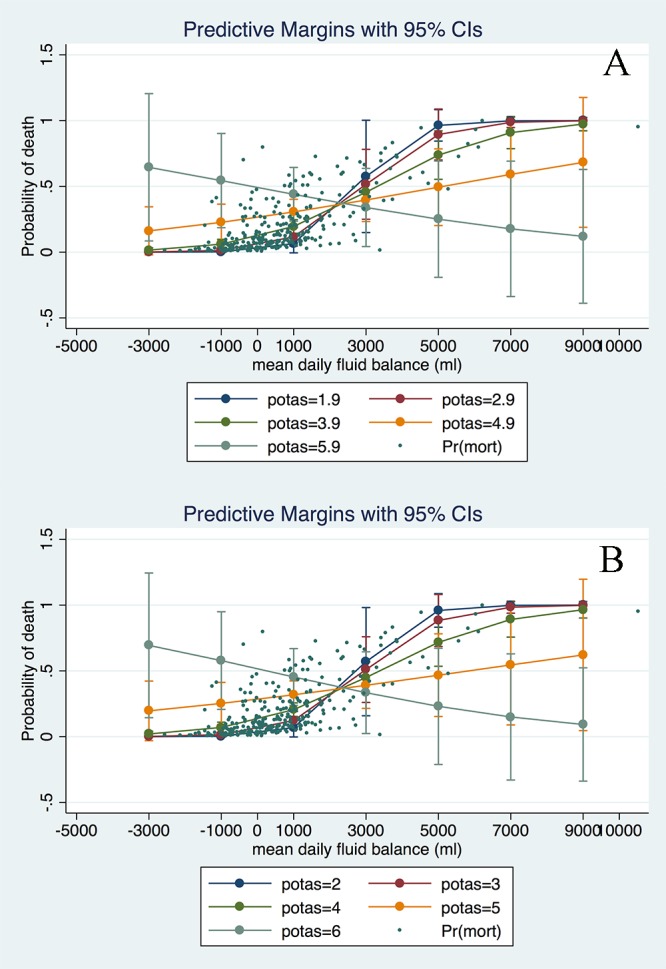
Background and Objective. Acute respiratory distress syndrome (ARDS) is characterized by pulmonary edema and may benefit from conservative fluid management. However, conflicting results exist in the literature. The study aimed to investigate the association between mean fluid balance and mortality outcome in ARDS patients who required invasive mechanical ventilation. Methods. The study was a secondary analysis of a prospectively collected dataset obtained from the NHLBI Biologic Specimen and Data Repository Information Coordinating Center. ARDS patients with invasive mechanical ventilation were eligible. Demographic and laboratory data were extracted from the dataset. Multivariable regression model was built by stepwise selection of covariates. A fractional polynomial approach was used to test the linearity of mean fluid balance in the model. The potential interactions of mean fluid balance with other variables were tested. Main Results. A total of 282 patients were eligible for the analysis, including 61 non-survivors with a mortality rate of 21.6%. After stepwise regression analysis, mean fluid balance remained to be an independent predictor of death (OR: 1.00057; 95% CI [1.00034-1.00080]). The two-term model obtained using fractional polynomial analysis was not superior to the linear model. There was significant interaction between mean fluid balance and serum potassium levels (p = 0.011). While the risk of death increased with increasing mean fluid balance at potassium levels of 1.9, 2.9 , 3.9 and 4.9 mmol/l, the risk decreased at potassium level of 5.9 mmol/l. Conclusion. The present study demonstrates that more positive fluid balance in the first 8 days is significantly associated with increased risk of death. However, the relationship between mean fluid balance and mortality can be modified by serum potassium levels. With hyperkalemia, more positive fluid balance is associated with reduced risk of death.
背景与目的。急性呼吸窘迫综合征(ARDS)以肺水肿为特征,可能受益于保守的液体管理。然而,文献中存在相互矛盾的结果。本研究旨在调查需要有创机械通气的ARDS患者平均液体平衡与死亡率之间的关联。方法。本研究是对从美国国立心肺血液研究所生物标本和数据储存库信息协调中心前瞻性收集的数据集进行的二次分析。符合条件的是接受有创机械通气的ARDS患者。从数据集中提取人口统计学和实验室数据。通过逐步选择协变量建立多变量回归模型。采用分数多项式方法检验模型中平均液体平衡的线性。检验平均液体平衡与其他变量之间的潜在相互作用。主要结果。共有282例患者符合分析条件,其中61例非幸存者,死亡率为21.6%。经过逐步回归分析,平均液体平衡仍然是死亡的独立预测因素(比值比:1.00057;95%置信区间[1.00034 - 1.00080])。使用分数多项式分析得到的二次模型并不优于线性模型。平均液体平衡与血清钾水平之间存在显著相互作用(p = 0.011)。当血清钾水平为1.9、2.9、3.9和4.9 mmol/L时,随着平均液体平衡增加死亡风险升高,而当血清钾水平为5.9 mmol/L时死亡风险降低。结论。本研究表明,前8天液体平衡越正与死亡风险增加显著相关。然而,平均液体平衡与死亡率之间的关系可被血清钾水平改变。在高钾血症情况下,液体平衡越正与死亡风险降低相关。