Frankó Balázs, Galbe Mats, Wallberg Ola
Department of Chemical Engineering, Lund University, PO Box 124, Getingevägen 60, Lund, SE-221 00 Sweden.
Biotechnol Biofuels. 2015 Feb 8;8:15. doi: 10.1186/s13068-015-0199-x. eCollection 2015.
Bark and bark-containing forest residues have the potential for utilization as raw material for lignocellulosic ethanol production due to their abundance and low cost. However, the different physical properties and chemical composition of bark compared to the conventionally used wood chips may influence the spruce-to-ethanol bioconversion process. This study assesses the impact of bark on the overall bioconversion in two process configurations, separate hydrolysis and fermentation (SHF) and simultaneous saccharification and fermentation (SSF), utilizing steam-pretreated spruce bark and wood mixtures.
Mixtures of different proportions of spruce bark and wood chips were subjected to SO2-catalyzed steam pretreatment at 210°C for five minutes, which has been shown to be effective for the pretreatment of spruce wood chips. The final ethanol concentration was the highest without bark and decreased significantly with increasing proportions of bark in both process configurations. However, this decrease cannot be attributed solely to the lower availability of the carbohydrates in mixtures containing bark, as the ethanol yield also decreased, from 85 to 59% in SSF and from 84 to 51% in SHF, as the mass fraction of bark was increased from 0 to 100%.
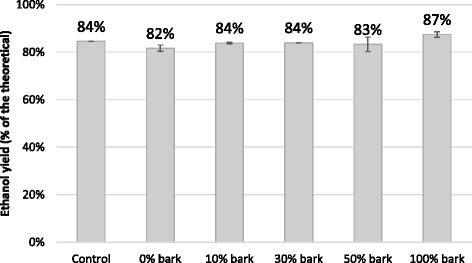
The results show that it was significantly more difficult to hydrolyse spruce bark to monomeric sugars than wood chips. Bark had an adverse effect on the whole bioconversion process due to its lower enzymatic hydrolyzability. On the other hand, bark inclusion had no detrimental effect on the fermentability of steam-pretreated spruce wood and bark mixtures. It was also observed that lower amounts of inhibitory degradation products were formed during the steam pretreatment of spruce bark than during the steam pretreatment of wood chips.
树皮及含树皮的森林残余物因其数量丰富且成本低廉,具有作为木质纤维素乙醇生产原料的利用潜力。然而,与传统使用的木片相比,树皮不同的物理性质和化学成分可能会影响云杉到乙醇的生物转化过程。本研究利用蒸汽预处理的云杉树皮和木材混合物,评估了树皮在两种工艺配置(分别水解和发酵(SHF)以及同步糖化和发酵(SSF))中对整体生物转化的影响。
将不同比例的云杉树皮和木片混合物在210°C下进行SO₂催化的蒸汽预处理5分钟,该预处理已被证明对云杉木片的预处理有效。在两种工艺配置中,最终乙醇浓度在无树皮时最高,且随着树皮比例的增加显著降低。然而,这种降低不能仅归因于含树皮混合物中碳水化合物可用性较低,因为随着树皮质量分数从0增加到100%,乙醇产率也降低,在SSF中从85%降至59%,在SHF中从84%降至51%。
结果表明,将云杉树皮水解为单糖比木片困难得多。由于其较低的酶水解性,树皮对整个生物转化过程有不利影响。另一方面,包含树皮对蒸汽预处理的云杉木材和树皮混合物的发酵性没有不利影响。还观察到,在云杉树皮的蒸汽预处理过程中形成的抑制性降解产物比木片的蒸汽预处理过程中少。