Rigby Rachel E, Rehwinkel Jan
Medical Research Council Human Immunology Unit, Medical Research Council Weatherall Institute of Molecular Medicine, Radcliffe Department of Medicine, University of Oxford, Oxford OX3 9DS, UK.
Medical Research Council Human Immunology Unit, Medical Research Council Weatherall Institute of Molecular Medicine, Radcliffe Department of Medicine, University of Oxford, Oxford OX3 9DS, UK.
Trends Immunol. 2015 Mar;36(3):179-88. doi: 10.1016/j.it.2015.02.001. Epub 2015 Feb 20.
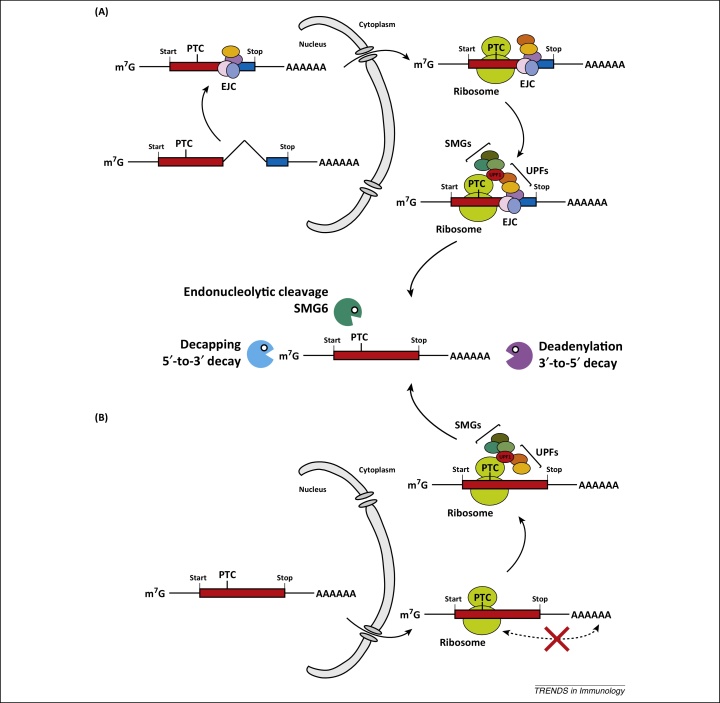
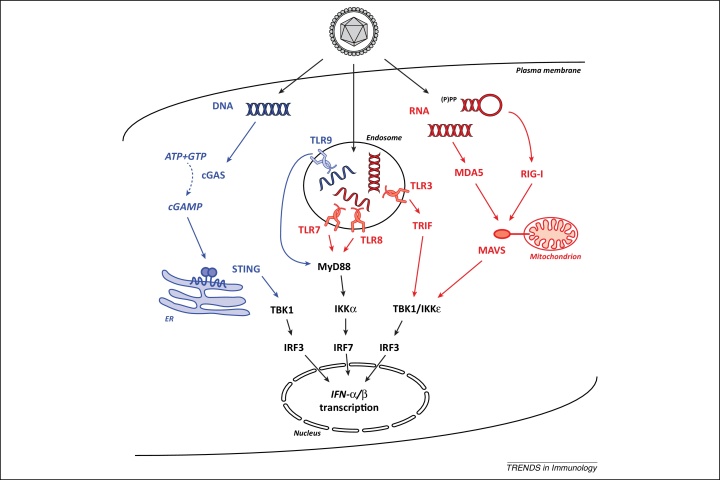
Post-transcriptional control determines the fate of cellular RNA molecules. Nonsense-mediated decay (NMD) provides quality control of mRNA, targeting faulty cellular transcripts for degradation by multiple nucleases including the RNA exosome. Recent findings have revealed a role for NMD in targeting viral RNA molecules, thereby restricting virus infection. Interestingly, NMD is also linked to immune responses at another level: mutations affecting the NMD or RNA exosome machineries cause chronic activation of defence programmes, resulting in autoimmune phenotypes. Here we place these observations in the context of other links between innate antiviral immunity and type I interferon mediated disease and examine two models: one in which expression or function of pathogen sensors is perturbed and one wherein host-derived RNA molecules with a propensity to activate such sensors accumulate.
转录后调控决定细胞RNA分子的命运。无义介导的衰变(NMD)对mRNA进行质量控制,将有缺陷的细胞转录本靶向多种核酸酶(包括RNA外切体)进行降解。最近的研究发现揭示了NMD在靶向病毒RNA分子中的作用,从而限制病毒感染。有趣的是,NMD在另一个层面上也与免疫反应相关:影响NMD或RNA外切体机制的突变会导致防御程序的慢性激活,从而产生自身免疫表型。在这里,我们将这些观察结果置于先天抗病毒免疫与I型干扰素介导的疾病之间的其他联系的背景下,并研究两种模型:一种是病原体传感器的表达或功能受到干扰,另一种是倾向于激活此类传感器的宿主来源RNA分子积累。