Chancey Scott T, Agrawal Sonia, Schroeder Max R, Farley Monica M, Tettelin Hervé, Stephens David S
Division of Infectious Diseases, Department of Medicine, Emory University School of Medicine Atlanta, GA, USA ; Laboratories of Microbial Pathogenesis, Department of Veterans Affairs Medical Center Atlanta, GA, USA.
Institute for Genome Sciences, University of Maryland School of Medicine Baltimore, MD, USA.
Front Microbiol. 2015 Feb 9;6:26. doi: 10.3389/fmicb.2015.00026. eCollection 2015.
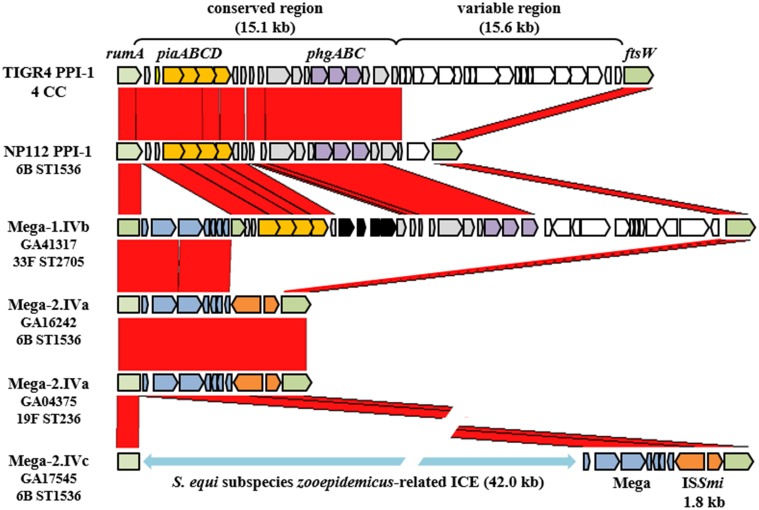
Macrolide resistance in Streptococcus pneumoniae emerged in the U.S. and globally during the early 1990's. The RNA methylase encoded by erm(B) and the macrolide efflux genes mef(E) and mel were identified as the resistance determining factors. These genes are disseminated in the pneumococcus on mobile, often chimeric elements consisting of multiple smaller elements. To better understand the variety of elements encoding macrolide resistance and how they have evolved in the pre- and post-conjugate vaccine eras, the genomes of 121 invasive and ten carriage isolates from Atlanta from 1994 to 2011 were analyzed for mobile elements involved in the dissemination of macrolide resistance. The isolates were selected to provide broad coverage of the genetic variability of antibiotic resistant pneumococci and included 100 invasive isolates resistant to macrolides. Tn916-like elements carrying mef(E) and mel on the Macrolide Genetic Assembly (Mega) and erm(B) on the erm(B) element and Tn917 were integrated into the pneumococcal chromosome backbone and into larger Tn5253-like composite elements. The results reported here include identification of novel insertion sites for Mega and characterization of the insertion sites of Tn916-like elements in the pneumococcal chromosome and in larger composite elements. The data indicate that integration of elements by conjugation was infrequent compared to recombination. Thus, it appears that conjugative mobile elements allow the pneumococcus to acquire DNA from distantly related bacteria, but once integrated into a pneumococcal genome, transformation and recombination is the primary mechanism for transmission of novel DNA throughout the pneumococcal population.
20世纪90年代初,美国及全球范围内均出现了肺炎链球菌对大环内酯类抗生素的耐药性。由erm(B)编码的RNA甲基化酶以及大环内酯类抗生素外排基因mef(E)和mel被确定为耐药决定因素。这些基因通过移动的、通常由多个较小元件组成的嵌合元件在肺炎链球菌中传播。为了更好地了解编码大环内酯类抗生素耐药性的元件种类以及它们在结合疫苗前后时代的演变情况,对1994年至2011年从亚特兰大分离出的121株侵袭性菌株和10株携带菌株的基因组进行了分析,以寻找与大环内酯类抗生素耐药性传播相关的移动元件。选择这些菌株是为了广泛覆盖抗生素耐药肺炎链球菌的遗传变异性,其中包括100株对大环内酯类抗生素耐药的侵袭性菌株。携带mef(E)和mel的Tn916样元件位于大环内酯遗传组装体(Mega)上,携带erm(B)的erm(B)元件和Tn917上的erm(B)被整合到肺炎链球菌染色体主干以及更大的Tn5253样复合元件中。此处报告的结果包括确定Mega的新插入位点以及Tn916样元件在肺炎链球菌染色体和更大复合元件中的插入位点特征。数据表明,与重组相比,通过接合进行元件整合的情况较少。因此,接合性移动元件似乎使肺炎链球菌能够从远缘相关细菌获取DNA,但一旦整合到肺炎链球菌基因组中,转化和重组就是新DNA在整个肺炎链球菌群体中传播的主要机制。