Cutter David J, Schaapveld Michael, Darby Sarah C, Hauptmann Michael, van Nimwegen Frederika A, Krol Augustinus D G, Janus Cecile P M, van Leeuwen Flora E, Aleman Berthe M P
Clinical Trial Service Unit, University of Oxford, Oxford, UK (DJC, SCD); Department of Psychosocial Research, Epidemiology and Biostatistics, the Netherlands Cancer Institute, Amsterdam, the Netherlands (MS, MH, FAvN, FEvL); Department of Radiation Oncology, Leiden University Medical Center, Leiden, the Netherlands (ADGK); Department of Radiation Oncology, Erasmus Medical Center/Daniel den Hoed Clinic, Rotterdam, the Netherlands (CPMJ); Department of Radiation Oncology, the Netherlands Cancer Institute, Plesmanlaan 121, 1066 CX Amsterdam, the Netherlands (BMPA).
J Natl Cancer Inst. 2015 Feb 23;107(4). doi: 10.1093/jnci/djv008. Print 2015 Apr.
Hodgkin lymphoma (HL) survivors are at increased risk of developing valvular heart disease (VHD). We evaluated the determinants of the risk and the radiation dose-response.
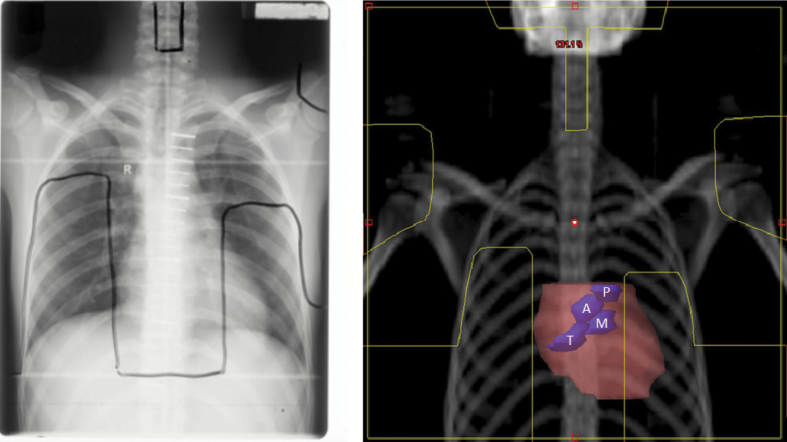
A case-control study was nested in a cohort of 1852 five-year HL survivors diagnosed at ages 15 to 41 years and treated between 1965 and 1995. Case patients had VHD of at least moderate severity as their first cardiovascular diagnosis following HL treatment. Control patients were matched to case patients for age, gender, and HL diagnosis date. Treatment and follow-up data were abstracted from medical records. Radiation doses to heart valves were estimated by reconstruction of individual treatments on representative computed tomography datasets. All statistical tests were two-sided.
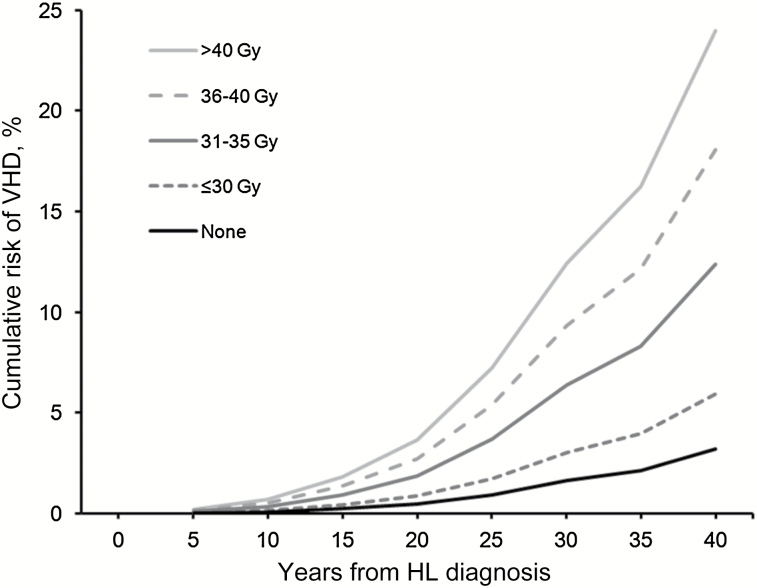
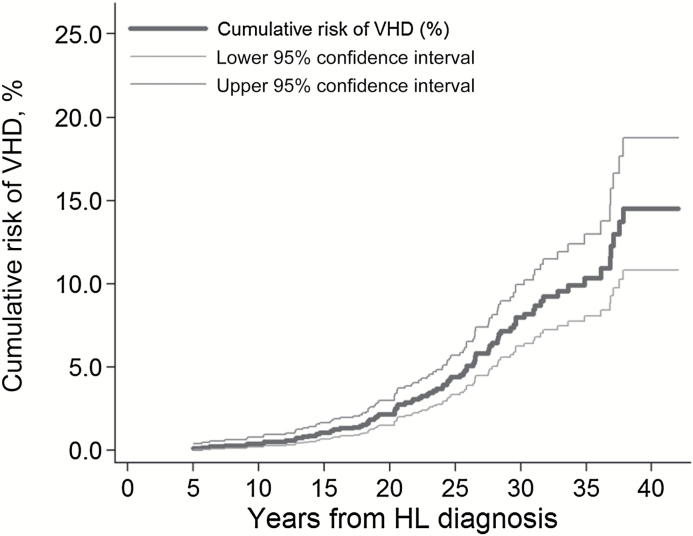
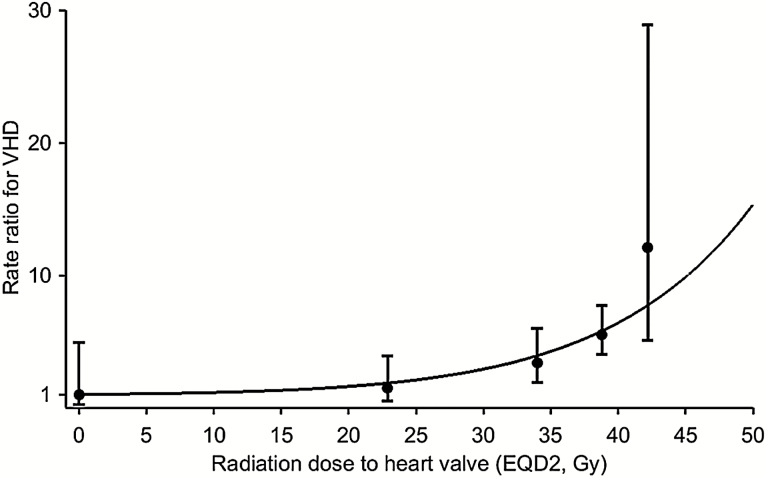
Eighty-nine case patients with VHD were identified (66 severe or life-threatening) and 200 control patients. Aortic (n = 63) and mitral valves (n = 42) were most frequently affected. Risks increased more than linearly with radiation dose. For doses to the affected valve(s) of less than or equal to 30, 31-35, 36-40, and more than 40 Gy, VHD rates increased by factors of 1.4, 3.1, 5.4, and 11.8, respectively (P trend < .001). Approximate 30-year cumulative risks were 3.0%, 6.4%, 9.3%, and 12.4% for the same dose categories. VHD rate increased with splenectomy by a factor of 2.3 (P = .02).
Radiation dose to the heart valves can increase the risk of clinically significant VHD, especially at doses above 30 Gy. However, for patients with mediastinal involvement treated today with 20 or 30 Gy, the 30-year risk will be increased by only about 1.4%. These findings may be useful for patients and doctors both before treatment and during follow-up.
霍奇金淋巴瘤(HL)幸存者患心脏瓣膜病(VHD)的风险增加。我们评估了该风险的决定因素及放射剂量反应。
一项病例对照研究纳入了1852名15至41岁、在1965年至1995年间接受治疗的HL五年幸存者队列。病例患者在HL治疗后首次心血管诊断为至少中度严重程度的VHD。对照患者按年龄、性别和HL诊断日期与病例患者匹配。治疗和随访数据从病历中提取。通过在代表性计算机断层扫描数据集上重建个体治疗来估计心脏瓣膜的放射剂量。所有统计检验均为双侧检验。
确定了89例VHD病例患者(66例严重或危及生命)和200例对照患者。主动脉瓣(n = 63)和二尖瓣(n = 42)最常受累。风险随放射剂量增加的幅度超过线性关系。对于受影响瓣膜的剂量小于或等于30、31 - 35、36 - 40和大于40 Gy,VHD发生率分别增加1.4、3.1、5.4和11.8倍(P趋势 <.001)。相同剂量类别下的近似30年累积风险分别为3.0%、6.4%、9.3%和12.4%。VHD发生率因脾切除术而增加2.3倍(P = 0.02)。
心脏瓣膜的放射剂量可增加临床上显著的VHD风险,尤其是剂量高于30 Gy时。然而,对于如今接受20或30 Gy治疗的纵隔受累患者,30年风险仅增加约1.4%。这些发现可能对治疗前和随访期间的患者及医生都有用。