Neurocognitive Development Lab, Faculty of Psychology, University of Warsaw Warsaw, Poland.
Front Psychol. 2015 Feb 10;6:122. doi: 10.3389/fpsyg.2015.00122. eCollection 2015.
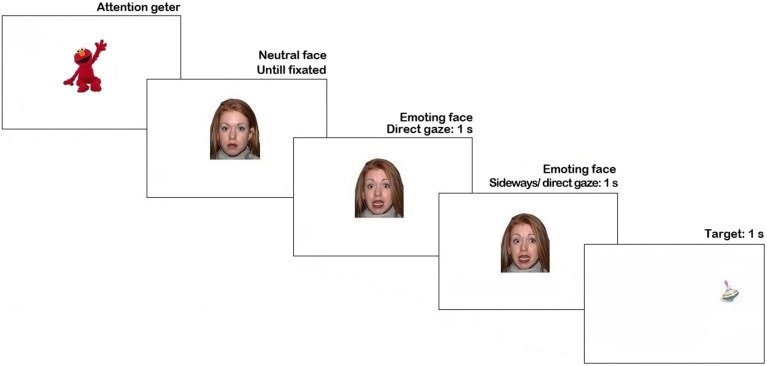
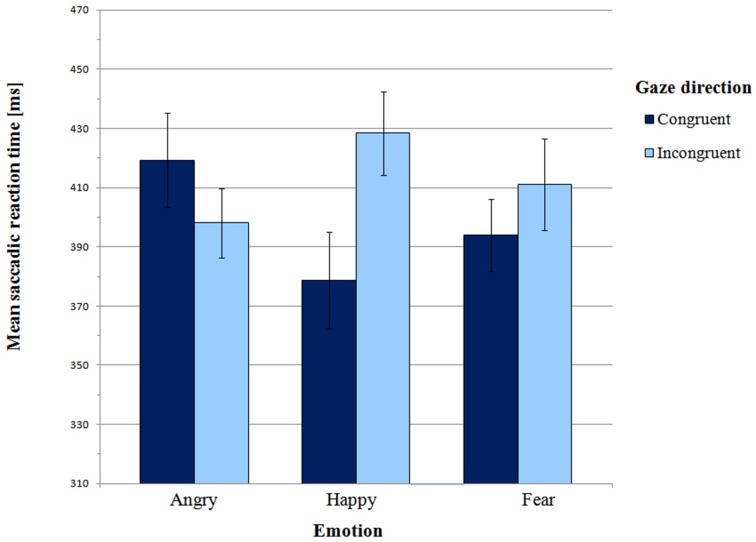
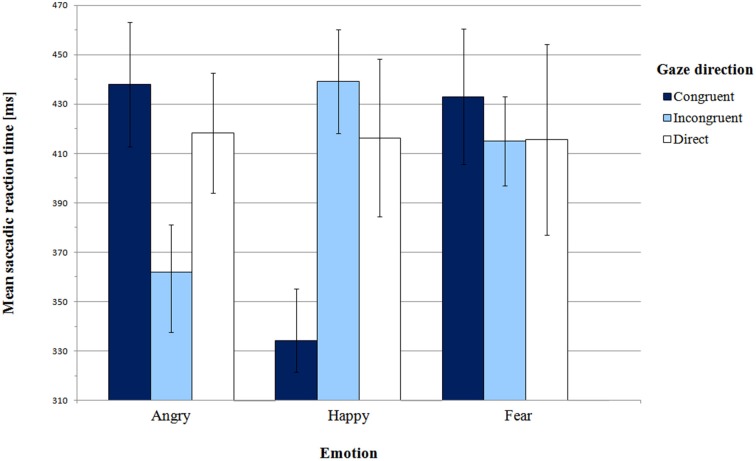
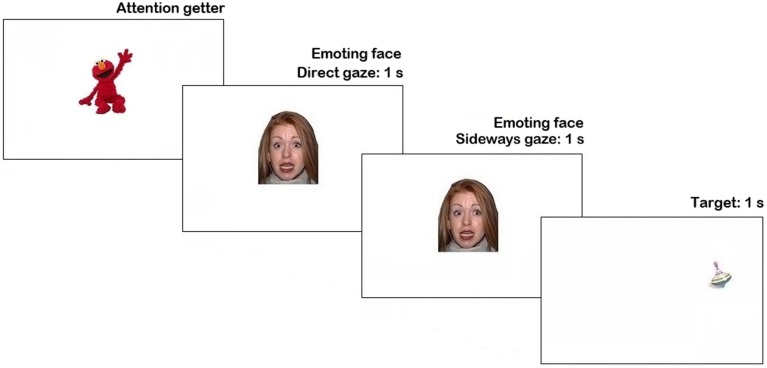
Efficient processing of gaze direction and facial expression of emotion is crucial for early social and emotional development. Toward the end of the first year of life infants begin to pay more attention to negative expressions, but it remains unclear to what extent emotion expression is processed jointly with gaze direction at this age. This study sought to establish the interactions of gaze direction and emotion expression in visual orienting in 9- to 12-month-olds. In particular, we tested whether these interactions can be explained by the negativity bias hypothesis and the shared signal hypothesis. We measured saccadic latencies in response to peripheral targets in a gaze-cueing paradigm with happy, angry, and fearful female faces. In the Pilot Experiment three gaze directions were used (direct, congruent with target location, incongruent with target location). In the Main Experiment we sought to replicate the results of the Pilot experiment using a simpler design without the direct gaze condition. In both experiments we found a robust gaze-cueing effect for happy faces, i.e., facilitation of orienting toward the target in the gaze-cued location, compared with the gaze-incongruent location. We found more rapid orienting to targets cued by happy relative to angry and fearful faces. We did not find any gaze-cueing effect for angry or fearful faces. These results are not consistent with the shared signal hypothesis. While our results show differential processing of positive and negative emotions, they do not support a general negativity bias. On the contrary, they indicate that toward the age of 12 months infants show a positivity bias in gaze-cueing tasks.
注视方向和情绪表情的有效处理对于早期的社会和情感发展至关重要。在生命的第一年结束时,婴儿开始更多地关注负面表情,但在这个年龄段,情绪表达是否与注视方向共同处理尚不清楚。本研究旨在确定 9-12 个月大的婴儿在视觉定向中注视方向和情绪表达的相互作用。特别是,我们测试了这些相互作用是否可以用负性偏差假说和共同信号假说来解释。我们在一个带有快乐、愤怒和恐惧女性面孔的注视引导范式中测量了对周边目标的眼跳潜伏期。在试点实验中,使用了三个注视方向(直接注视、与目标位置一致、与目标位置不一致)。在主要实验中,我们试图使用更简单的设计(不包括直接注视条件)复制试点实验的结果。在两个实验中,我们都发现了快乐面孔的强烈注视引导效应,即与注视不一致的位置相比,定向到注视引导位置的方向更容易。与愤怒和恐惧面孔相比,我们发现对快乐面孔的定向更快。我们没有发现愤怒或恐惧面孔的任何注视引导效应。这些结果与共同信号假说不一致。虽然我们的结果表明对正性和负性情绪的处理不同,但它们并不支持一般的负性偏差。相反,它们表明在 12 个月大时,婴儿在注视引导任务中表现出正性偏差。