Bayless Sarah J, Glover Missy, Taylor Margot J, Itier Roxane J
Department of Psychology, University of Winchester, Winchester, UK.
Psychology Department, University of Waterloo, Waterloo, Canada.
Vis cogn. 2011 Mar 21;19(4):483-510. doi: 10.1080/13506285.2011.552895.
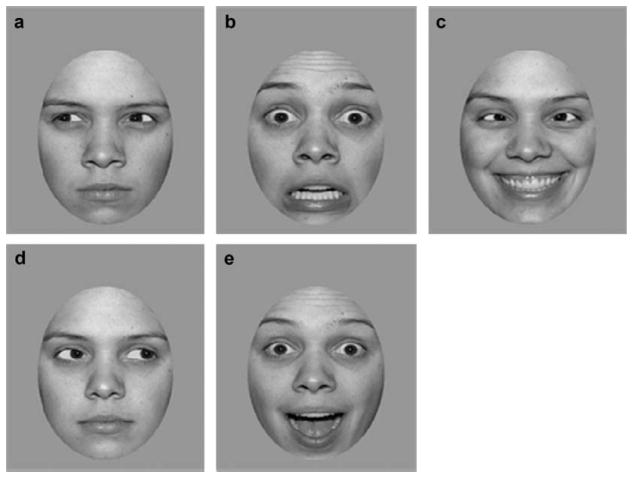
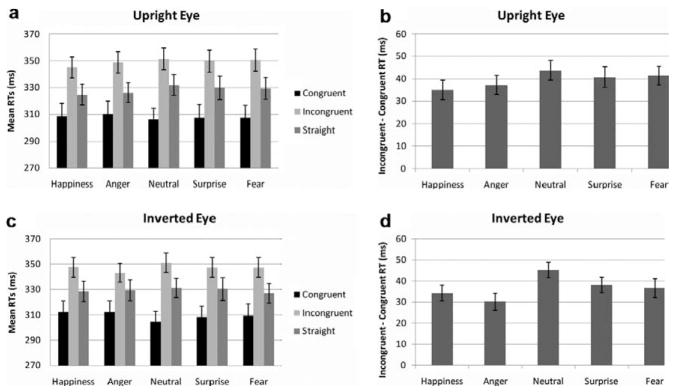
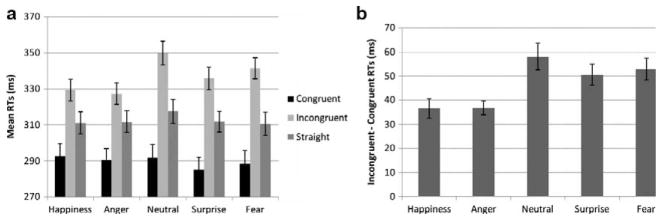
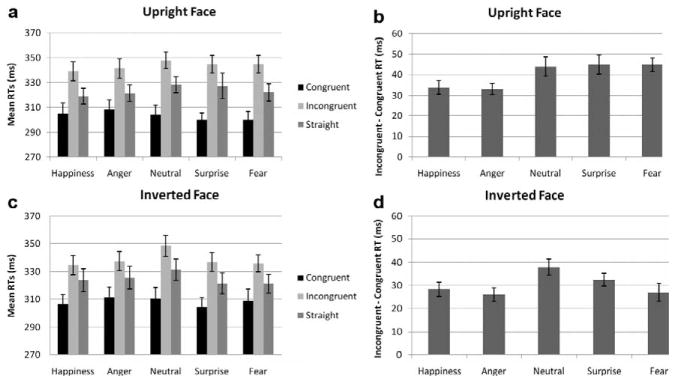
This study investigated the role of the eye region of emotional facial expressions in modulating gaze orienting effects. Eye widening is characteristic of fearful and surprised expressions and may significantly increase the salience of perceived gaze direction. This perceptual bias rather than the emotional valence of certain expressions may drive enhanced gaze orienting effects. In a series of three experiments involving low anxiety participants, different emotional expressions were tested using a gaze-cueing paradigm. Fearful and surprised expressions enhanced the gaze orienting effect compared with happy or angry expressions. Presenting only the eye regions as cueing stimuli eliminated this effect whereas inversion globally reduced it. Both inversion and the use of eyes only attenuated the emotional valence of stimuli without affecting the perceptual salience of the eyes. The findings thus suggest that low-level stimulus features alone are not sufficient to drive gaze orienting modulations by emotion. Rather, they interact with the emotional valence of the expression that appears critical. The study supports the view that rapid processing of fearful and surprised emotional expressions can potentiate orienting to another person's averted gaze in non-anxious people.
本研究调查了情绪化面部表情的眼部区域在调节注视定向效应中的作用。眼睛睁大是恐惧和惊讶表情的特征,可能会显著提高所感知注视方向的显著性。这种感知偏差而非某些表情的情感效价可能会驱动增强的注视定向效应。在一系列涉及低焦虑参与者的三个实验中,使用注视提示范式测试了不同的情绪表情。与快乐或愤怒表情相比,恐惧和惊讶表情增强了注视定向效应。仅呈现眼部区域作为提示刺激消除了这种效应,而倒置则总体上降低了这种效应。倒置和仅使用眼睛都减弱了刺激的情感效价,而不影响眼睛的感知显著性。因此,研究结果表明,仅低层次的刺激特征不足以驱动情绪对注视定向的调节。相反,它们与看起来至关重要的表情的情感效价相互作用。该研究支持这样一种观点,即对恐惧和惊讶情绪表情的快速处理可以增强非焦虑人群对他人回避注视的定向。