Hechtman Jaclyn F, Sadowska Justyna, Huse Jason T, Borsu Laetitia, Yaeger Rona, Shia Jinru, Vakiani Efsevia, Ladanyi Marc, Arcila Maria E
Department of Pathology, Memorial Sloan Kettering Cancer Center, New York, New York.
Department of Medicine, Memorial Sloan Kettering Cancer Center, New York, New York.
Mol Cancer Res. 2015 Jun;13(6):1003-8. doi: 10.1158/1541-7786.MCR-15-0062-T. Epub 2015 Feb 24.
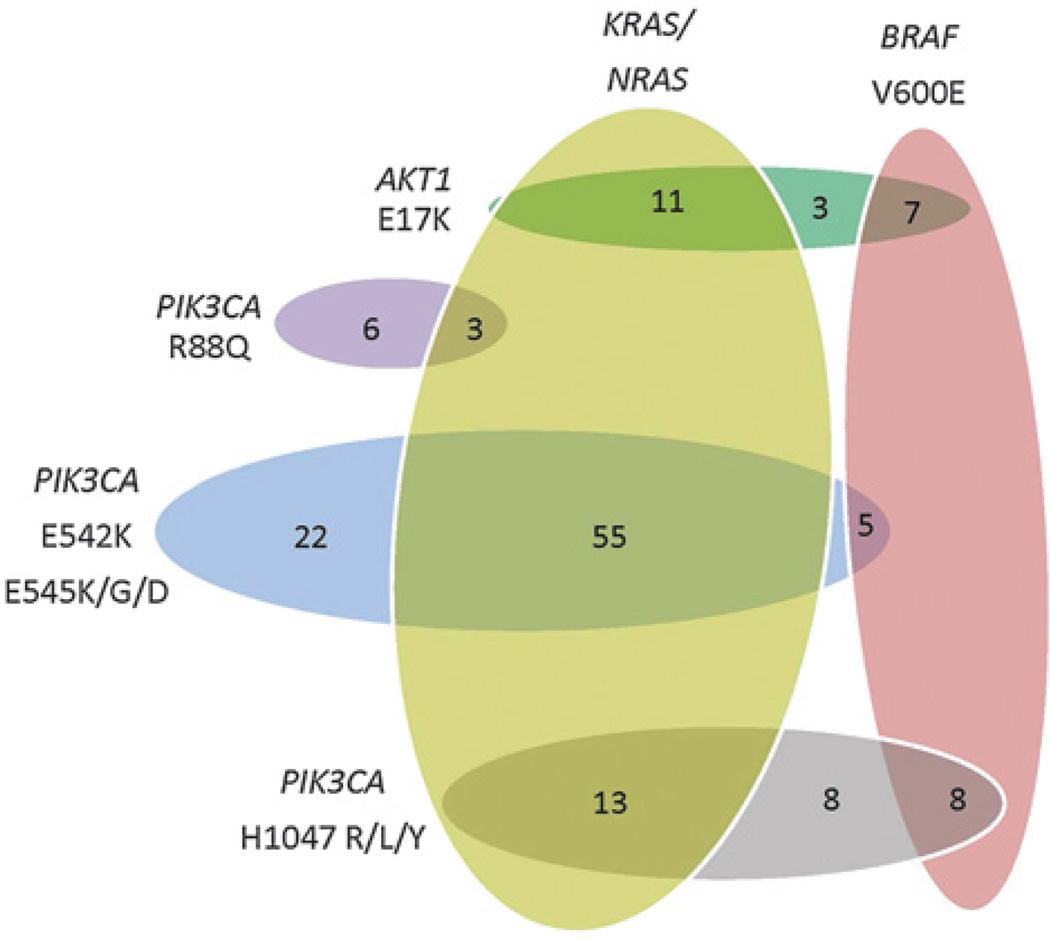
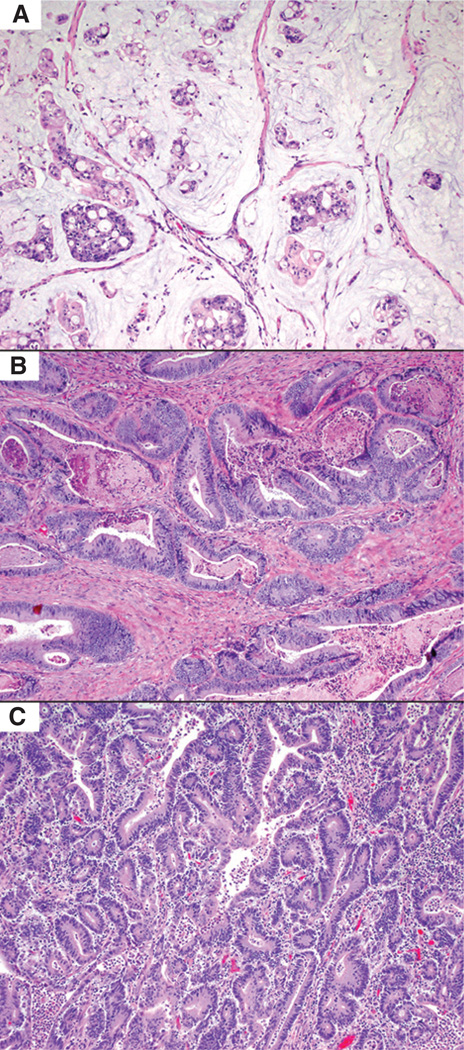
The PI3K/AKT/mTOR pathway is activated through multiple mechanisms in colorectal carcinoma. Here, the clinicopathologic and molecular features of AKT1 E17K-mutated colorectal carcinoma in comparison with PIK3CA-mutated colorectal carcinoma are described in detail. Interestingly, in comparison with PIK3CA mutants, AKT1 E17K was significantly associated with mucinous morphology and concurrent BRAF V600E mutation. Among PIK3CA mutants, exon 21 mutations were significantly associated with BRAF V600E mutation, MSI-H status, and poor differentiation, while exon 10 mutations were associated with KRAS/NRAS mutations. Three of four AKT1 mutants with data from both primary and metastatic lesions had concordant AKT1 mutation status in both. Both AKT1- and PIK3CA-mutant colorectal carcinoma demonstrated frequent loss of PTEN expression (38% and 34%, respectively) and similar rates of p-PRAS 40 expression (63% and 50%, respectively). Both patients with AKT1 E17K alone had primary resistance to cetuximab, whereas 7 of 8 patients with PIK3CA mutation alone experienced tumor shrinkage or stability with anti-EGFR therapy. These results demonstrate that AKT1 E17K mutation in advanced colorectal carcinoma is associated with mucinous morphology, PIK3CA wild-type status, and concurrent RAS/RAF mutations with similar pattern to PIK3CA exon 21 mutants. Thus, AKT1 E17K mutations contribute to primary resistance to cetuximab and serve as an actionable alteration.
This first systematic study of AKT1 and PIK3CA hotspot mutations and their association with cetuximab resistance and BRAF V600E mutation has important ramifications for the development of personalized medicine, particularly in identifying patient candidates for PI3K or AKT inhibitors.
PI3K/AKT/mTOR通路在结直肠癌中通过多种机制被激活。在此,详细描述了AKT1 E17K突变型结直肠癌与PIK3CA突变型结直肠癌相比的临床病理和分子特征。有趣的是,与PIK3CA突变体相比,AKT1 E17K与黏液形态和同时发生的BRAF V600E突变显著相关。在PIK3CA突变体中,外显子21突变与BRAF V600E突变、微卫星高度不稳定(MSI-H)状态和低分化显著相关,而外显子10突变与KRAS/NRAS突变相关。四个AKT1突变体中有三个同时有原发灶和转移灶的数据,两者的AKT1突变状态一致。AKT1和PIK3CA突变型结直肠癌均显示PTEN表达频繁缺失(分别为38%和34%),p-PRAS 40表达率相似(分别为63%和50%)。仅携带AKT1 E17K的两名患者对西妥昔单抗均有原发耐药性,而仅携带PIK3CA突变的8名患者中有7名接受抗表皮生长因子受体(EGFR)治疗后肿瘤缩小或稳定。这些结果表明,晚期结直肠癌中的AKT1 E17K突变与黏液形态、PIK3CA野生型状态以及与PIK3CA外显子21突变体相似模式的同时发生的RAS/RAF突变相关。因此,AKT1 E17K突变导致对西妥昔单抗的原发耐药,并可作为一种可采取行动的改变。
这项对AKT1和PIK3CA热点突变及其与西妥昔单抗耐药性和BRAF V600E突变的关联的首次系统性研究对个性化医疗的发展具有重要意义,特别是在识别PI3K或AKT抑制剂的患者候选者方面。