Johns Hopkins Bloomberg School of Public Health, Baltimore, MD, United States.
JMIR Mhealth Uhealth. 2015 Feb 25;3(1):e24. doi: 10.2196/mhealth.3663.
We had a unique opportunity to examine demographic determinants of household mobile phone ownership in rural Bangladesh using socioeconomic data collected as part of a multiyear longitudinal cohort study of married women of reproductive age.
This paper explores how the demographics of household mobile phone owners have changed over time in a representative population of rural Bangladesh.
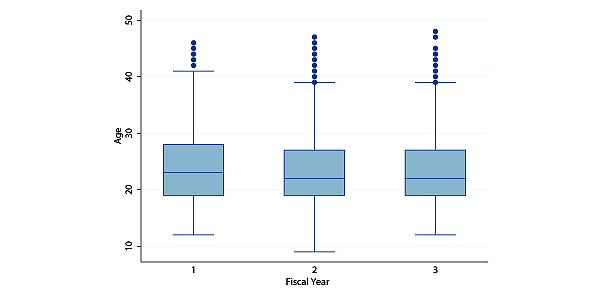
We present data collected between 2008 and 2011 on household mobile phone ownership and related characteristics including age, literacy, education, employment, electricity access, and household wealth among 35,306 individuals. Respondents were enrolled when found to be newly pregnant and contributed socioeconomic information once over the course of the time period serving as a "sample" of families within the population at that time. Univariate and multiple logistic regressions analyses were performed to identify the socioeconomic determinants of household phone ownership.
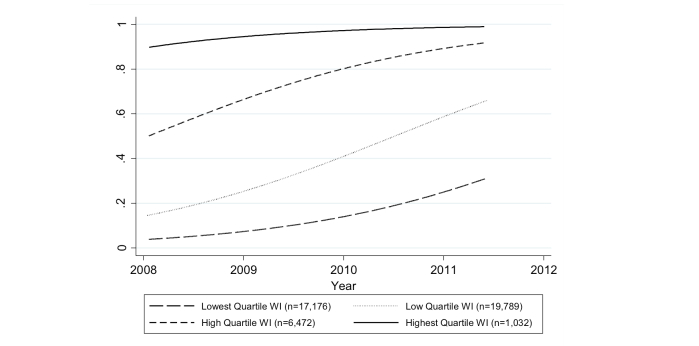
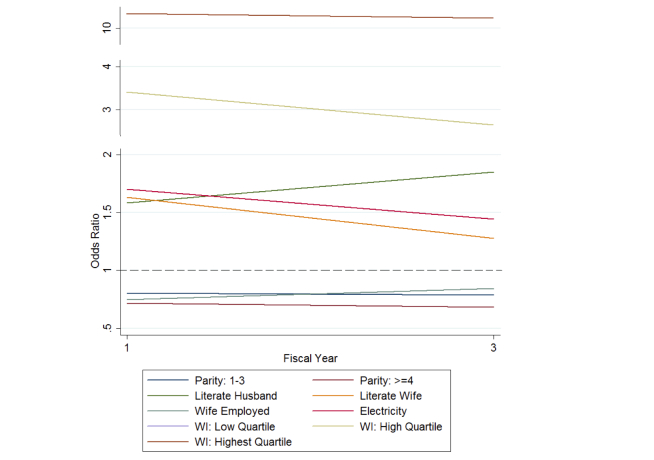
Across 3 fiscal years, we found that reported household ownership of at least 1 working mobile phone grew from 29.85% in the first fiscal year to 56.07% in the third fiscal year. Illiteracy, unavailability of electricity, and low quartiles of wealth were identified as overall demographic constraints to mobile phone ownership. However, over time, these barriers became less evident and equity gaps among demographic status began to dissipate as access to mobile technology became more democratized. We saw a high growth rate in ownership among households in lower economic standing (illiterate, without electricity, low and lowest wealth index), likely a result of competitive pricing and innovative service packages that improve access to mobile phones as the mobile phone market matures. In contrast, as market saturation is rapidly attained in the most privileged demographics (literate, secondary schooling, electricity, high wealth index), members of the lower wealth quartiles seem to be following suit, with more of an exponential growth.
Upward trends in household mobile phone ownership in vulnerable populations over time underline the potential to leverage this increasingly ubiquitous infrastructure to extend health and finance services across social and economic strata.
我们有一个独特的机会,利用在孟加拉国农村进行的一项多年纵向队列研究中收集的社会经济数据,来研究家庭拥有移动电话的人口决定因素。
本文探讨了在孟加拉国农村具有代表性的人群中,家庭移动电话拥有者的人口统计特征随时间的变化情况。
我们展示了 2008 年至 2011 年期间收集的关于家庭移动电话拥有情况以及相关特征的数据,包括年龄、文化程度、教育、就业、电力供应和家庭财富,涉及 35306 个人。当发现新怀孕的女性时,她们被招募为研究对象,并在这段时间内定期提供社会经济信息,作为当时该人群中家庭的“样本”。我们进行了单变量和多变量逻辑回归分析,以确定家庭拥有电话的社会经济决定因素。
在 3 个财政年度中,我们发现至少拥有 1 部工作移动电话的家庭报告拥有率从第一个财政年度的 29.85%增长到第三个财政年度的 56.07%。我们发现,不识字、无法获得电力以及财富水平较低的前四分之一是拥有移动电话的总体人口限制因素。然而,随着时间的推移,这些障碍变得不那么明显,随着移动技术变得更加民主化,人口地位之间的公平差距开始缩小。我们看到处于较低经济地位(不识字、无电、低和最低财富指数)的家庭的拥有率增长迅速,这可能是由于竞争定价和创新的服务套餐使移动电话的获取更加便捷,推动了移动电话市场的成熟。相比之下,随着最具特权的人口在手机市场达到饱和,较低财富阶层的成员似乎也在效仿,拥有率呈指数增长。
随着时间的推移,弱势群体家庭拥有移动电话的上升趋势表明,有可能利用这种日益普及的基础设施,将卫生和金融服务扩展到社会和经济各个阶层。