Xiao Jingfa, Zhang Zhewen, Wu Jiayan, Yu Jun
CAS Key Laboratory of Genome Sciences and Information, Beijing Institute of Genomics, Chinese Academy of Sciences, Beijing 100101, China.
CAS Key Laboratory of Genome Sciences and Information, Beijing Institute of Genomics, Chinese Academy of Sciences, Beijing 100101, China.
Genomics Proteomics Bioinformatics. 2015 Feb;13(1):73-6. doi: 10.1016/j.gpb.2015.01.007. Epub 2015 Feb 23.
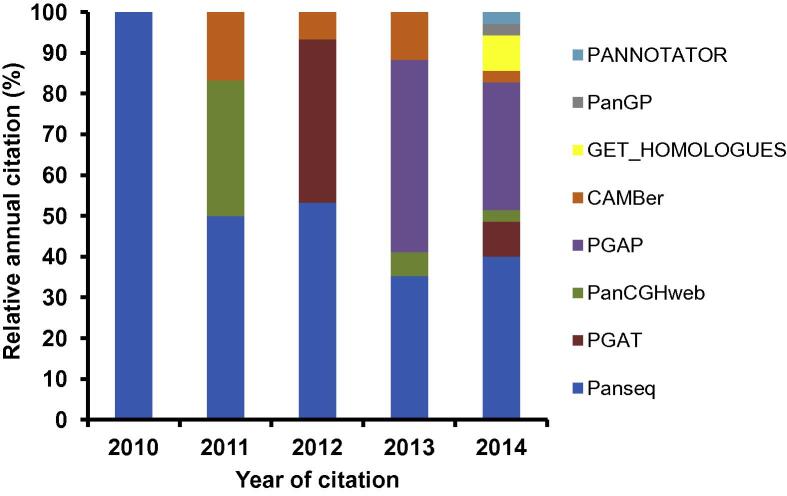
Since the proposal for pangenomic study, there have been a dozen software tools actively in use for pangenomic analysis. By the end of 2014, Panseq and the pan-genomes analysis pipeline (PGAP) ranked as the top two most popular packages according to cumulative citations of peer-reviewed scientific publications. The functions of the software packages and tools, albeit variable among them, include categorizing orthologous genes, calculating pangenomic profiles, integrating gene annotations, and constructing phylogenies. As epigenomic elements are being gradually revealed in prokaryotes, it is expected that pangenomic databases and toolkits have to be extended to handle information of detailed functional annotations for genes and non-protein-coding sequences including non-coding RNAs, insertion elements, and conserved structural elements. To develop better bioinformatic tools, user feedback and integration of novel features are both of essence.
自从提出泛基因组研究的提议以来,已经有十几种软件工具被积极用于泛基因组分析。到2014年底,根据同行评审科学出版物的累计引用次数,Panseq和泛基因组分析管道(PGAP)位列最受欢迎的两个软件包。这些软件包和工具的功能虽然各不相同,但包括对直系同源基因进行分类、计算泛基因组图谱、整合基因注释以及构建系统发育树。随着原核生物中的表观基因组元件逐渐被揭示,预计泛基因组数据库和工具包必须进行扩展,以处理包括非编码RNA、插入元件和保守结构元件在内的基因和非蛋白质编码序列的详细功能注释信息。为了开发更好的生物信息学工具,用户反馈和新功能的整合都至关重要。