Holguera Isabel, Muñoz-Espín Daniel, Salas Margarita
Instituto de Biología Molecular 'Eladio Viñuela' (Consejo Superior de Investigaciones Científicas), Centro de Biología Molecular 'Severo Ochoa' (Consejo Superior de Investigaciones Científicas-Universidad Autónoma de Madrid), Universidad Autónoma, Cantoblanco, 28049 Madrid, Spain.
Instituto de Biología Molecular 'Eladio Viñuela' (Consejo Superior de Investigaciones Científicas), Centro de Biología Molecular 'Severo Ochoa' (Consejo Superior de Investigaciones Científicas-Universidad Autónoma de Madrid), Universidad Autónoma, Cantoblanco, 28049 Madrid, Spain
Nucleic Acids Res. 2015 Mar 11;43(5):2790-801. doi: 10.1093/nar/gkv127. Epub 2015 Feb 26.
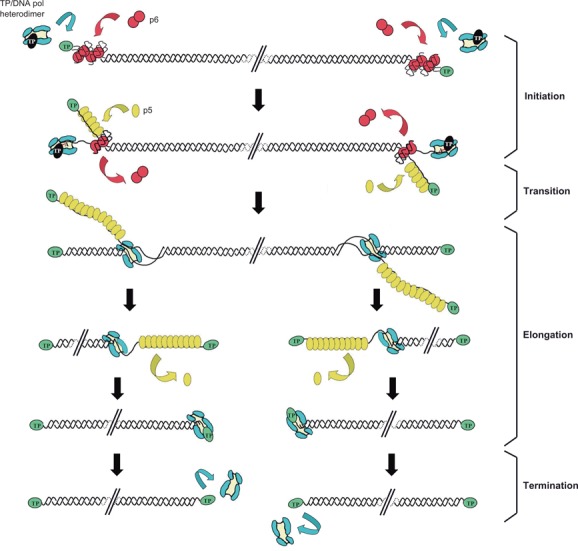
Phage ϕ29 DNA replication takes place by a protein-priming mechanism in which the viral DNA polymerase catalyses the covalent linkage of the initiating nucleotide to a specific serine residue of the terminal protein (TP). The N-terminal domain of the ϕ29 TP has been shown to bind to the host DNA in a sequence-independent manner and this binding is essential for the TP nucleoid localisation and for an efficient viral DNA replication in vivo. In the present work we have studied the involvement of the TP N-terminal domain residues responsible for DNA binding in the different stages of viral DNA replication by assaying the in vitro activity of purified TP N-terminal mutant proteins. The results show that mutation of TP residues involved in DNA binding affects the catalytic activity of the DNA polymerase in initiation, as the Km for the initiating nucleotide is increased when these mutant proteins are used as primers. Importantly, this initiation defect was relieved by using the ϕ29 double-stranded DNA binding protein p6 in the reaction, which decreased the Km of the DNA polymerase for dATP about 130-190 fold. Furthermore, the TP N-terminal domain was shown to be required both for a proper interaction with the DNA polymerase and for an efficient viral DNA amplification.
噬菌体ϕ29的DNA复制通过蛋白质引发机制进行,其中病毒DNA聚合酶催化起始核苷酸与末端蛋白(TP)的特定丝氨酸残基的共价连接。已表明ϕ29 TP的N末端结构域以序列非依赖性方式与宿主DNA结合,这种结合对于TP类核定位以及体内有效的病毒DNA复制至关重要。在本研究中,我们通过检测纯化的TP N末端突变蛋白的体外活性,研究了负责DNA结合的TP N末端结构域残基在病毒DNA复制不同阶段的作用。结果表明,参与DNA结合的TP残基的突变会影响DNA聚合酶在起始过程中的催化活性,因为当使用这些突变蛋白作为引物时,起始核苷酸的Km值会增加。重要的是,在反应中使用ϕ29双链DNA结合蛋白p6可缓解这种起始缺陷,它使DNA聚合酶对dATP的Km值降低了约130 - 190倍。此外,TP N末端结构域被证明对于与DNA聚合酶的适当相互作用以及有效的病毒DNA扩增都是必需的。