Chen Wei-Ju, Arnold John C, Fairchok Mary P, Danaher Patrick J, McDonough Erin A, Blair Patrick J, Garcia Josefina, Halsey Eric S, Schofield Christina, Ottolini Martin, Mor Deepika, Ridoré Michelande, Burgess Timothy H, Millar Eugene V
Infectious Disease Clinical Research Program, Department of Preventive Medicine and Biometrics, Uniformed Services University of the Health Sciences, Bethesda, MD, USA.
Naval Medical Center, San Diego, CA, USA.
J Clin Virol. 2015 Mar;64:74-82. doi: 10.1016/j.jcv.2015.01.007. Epub 2015 Jan 13.
human rhinovirus (HRV) is a major cause of influenza-like illness (ILI) in adults and children. Differences in disease severity by HRV species have been described among hospitalized patients with underlying illness. Less is known about the clinical and virologic characteristics of HRV infection among otherwise healthy populations, particularly adults.
to characterize molecular epidemiology of HRV and association between HRV species and clinical presentation and viral shedding.
observational, prospective, facility-based study of ILI was conducted from February 2010 to April 2012. Collection of nasopharyngeal specimens, patient symptoms, and clinical information occurred on days 0, 3, 7, and 28. Patients recorded symptom severity daily for the first 7 days of illness in a symptom diary. HRV was identified by RT-PCR and genotyped for species determination. Cases who were co-infected with other viral respiratory pathogens were excluded from the analysis. We evaluated the associations between HRV species, clinical severity, and patterns of viral shedding.
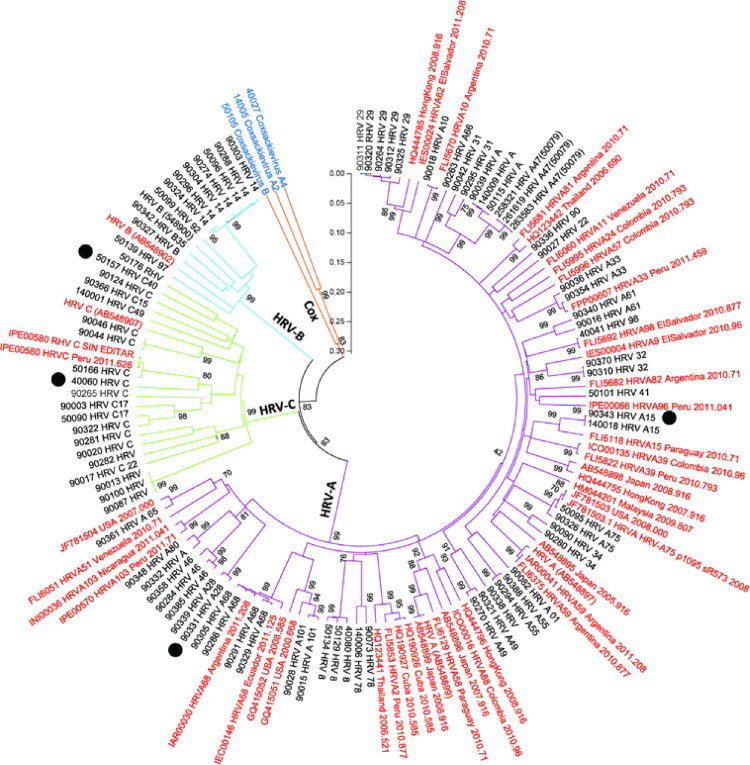
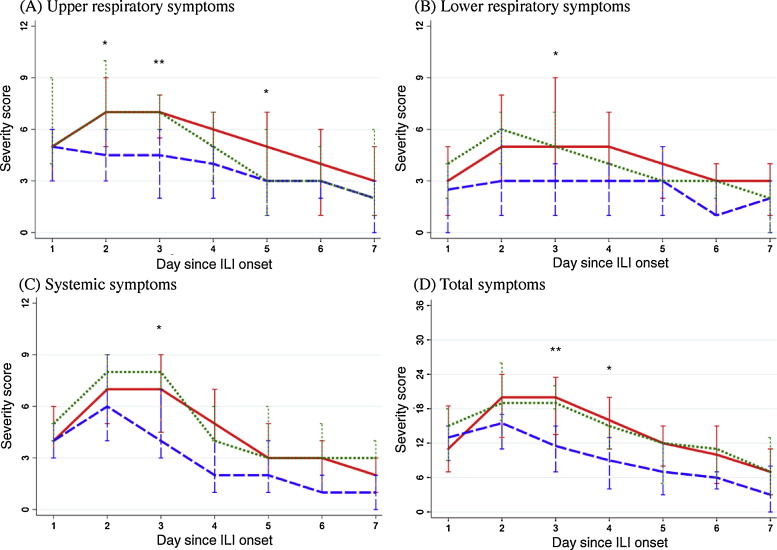
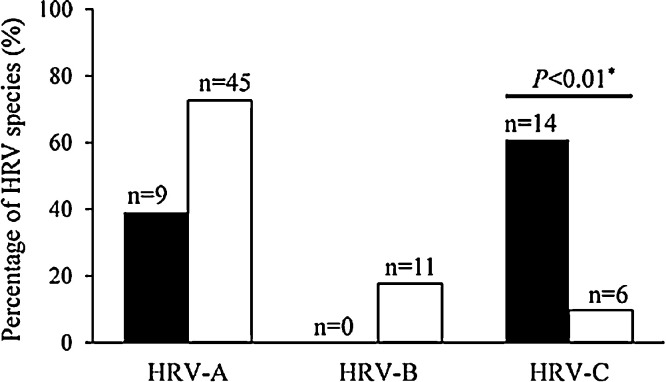
eighty-four HRV cases were identified and their isolates genotyped. Of these, 62 (74%) were >18 years. Fifty-four were HRV-A, 11HRV-B, and 19HRV-C. HRV-C infection was more common among children than adults (59% vs. 10%, P<0.001). Among adults, HRV-A was associated with higher severity of upper respiratory symptoms compared to HRV-B (P=0.02), but no such association was found in children. In addition, adults shed HRV-A significantly longer than HRV-C (P trend=0.01).
among otherwise healthy adults with HRV infection, we observed species-specific differences in respiratory symptom severity and duration of viral shedding.
人鼻病毒(HRV)是成人和儿童流感样疾病(ILI)的主要病因。在患有基础疾病的住院患者中,已描述了不同HRV种类导致的疾病严重程度差异。对于其他健康人群,尤其是成年人中HRV感染的临床和病毒学特征了解较少。
描述HRV的分子流行病学以及HRV种类与临床表现和病毒脱落之间的关联。
2010年2月至2012年4月进行了一项基于机构的ILI观察性前瞻性研究。在第0、3、7和28天采集鼻咽标本、患者症状和临床信息。患者在症状日记中记录疾病前7天的每日症状严重程度。通过逆转录聚合酶链反应(RT-PCR)鉴定HRV并进行基因分型以确定种类。分析中排除了合并感染其他病毒性呼吸道病原体的病例。我们评估了HRV种类、临床严重程度和病毒脱落模式之间的关联。
鉴定出84例HRV病例并对其分离株进行基因分型。其中,62例(74%)年龄大于18岁。54例为HRV-A,11例为HRV-B,19例为HRV-C。HRV-C感染在儿童中比成人更常见(59%对10%,P<0.001)。在成年人中,与HRV-B相比,HRV-A与上呼吸道症状的更高严重程度相关(P=0.02),但在儿童中未发现这种关联。此外,成年人HRV-A的病毒脱落时间明显长于HRV-C(P趋势=0.01)。
在其他健康的HRV感染成年人中,我们观察到呼吸道症状严重程度和病毒脱落持续时间存在种属特异性差异。