Leroy C, Shen Q, Strande V, Meyer R, McLaughlin M E, Lezan E, Bentires-Alj M, Voshol H, Bonenfant D, Alex Gaither L
Novartis Institutes for BioMedical Research, Basel, Switzerland.
Novartis Institutes for BioMedical Research, Cambridge, MA, USA.
Oncogene. 2015 Oct 29;34(44):5593-8. doi: 10.1038/onc.2015.19. Epub 2015 Mar 2.
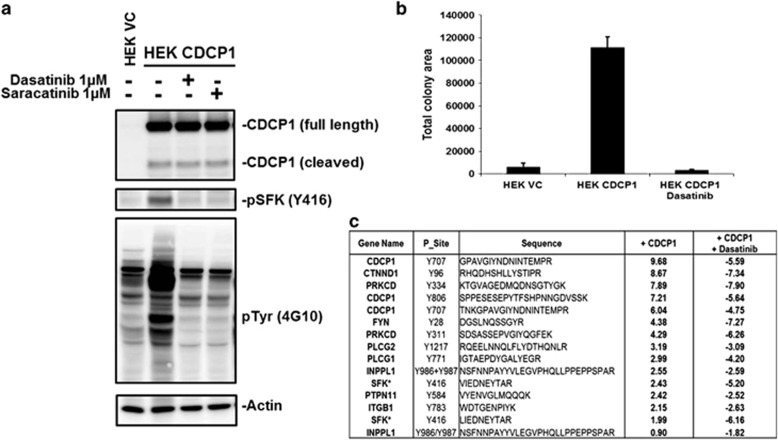
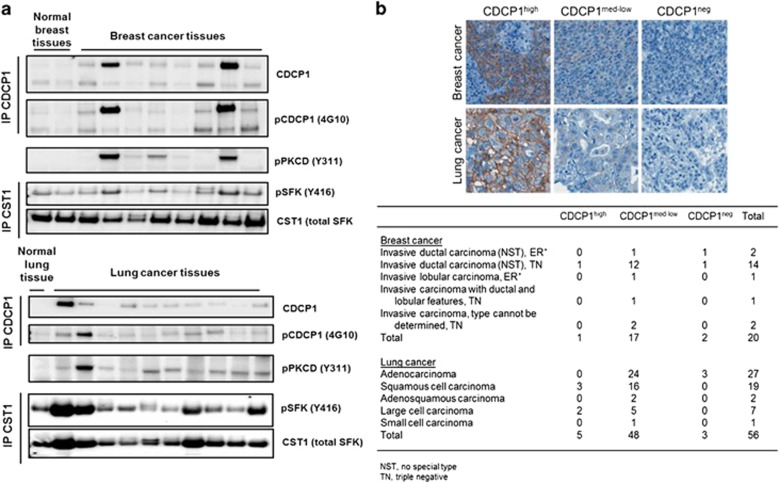
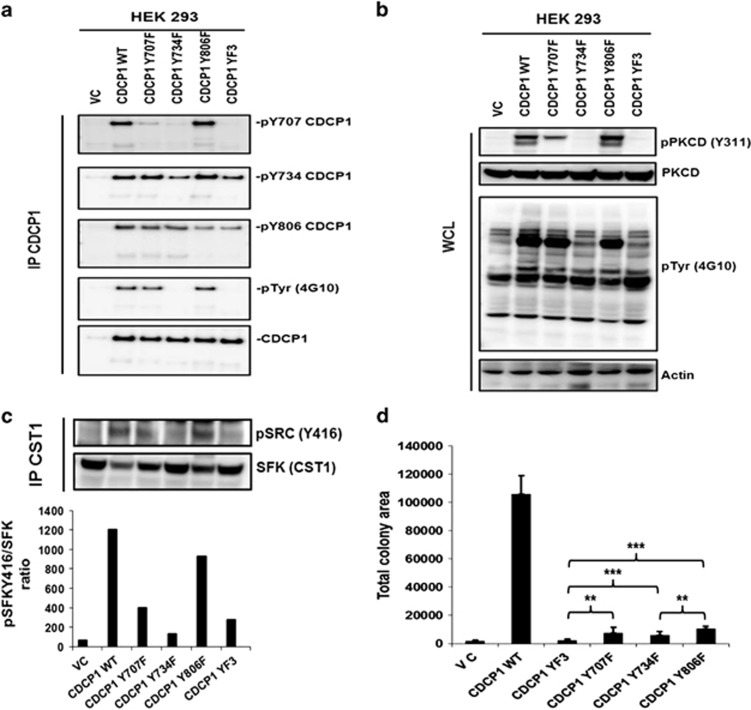
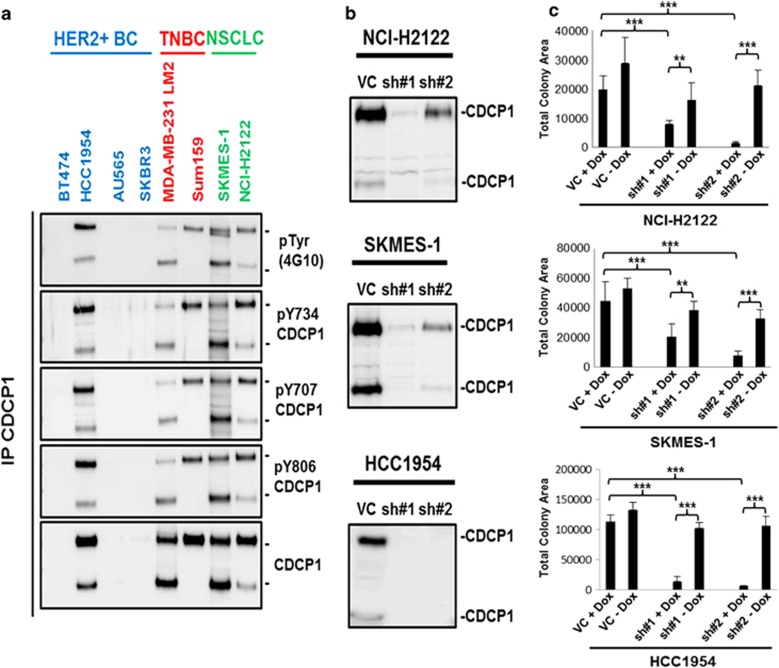
The transmembrane glycoprotein, CUB (complement C1r/C1s, Uegf, Bmp1) domain-containing protein 1 (CDCP1) is overexpressed in several cancer types and is a predictor of poor prognosis for patients on standard of care therapies. Phosphorylation of CDCP1 tyrosine sites is induced upon loss of cell adhesion and is thought to be linked to metastatic potential of tumor cells. Using a tyrosine-phosphoproteomics screening approach, we characterized the phosphorylation state of CDCP1 across a panel of breast cancer cell lines. We focused on two phospho-tyrosine pTyr peptides of CDCP1, containing Tyr707 and Tyr806, which were identified in all six lines, with the human epidermal growth factor 2-positive HCC1954 cells showing a particularly high phosphorylation level. Pharmacological modulation of tyrosine phosphorylation indicated that, the Src family kinases (SFKs) were found to phosphorylate CDCP1 at Tyr707 and Tyr806 and play a critical role in CDCP1 activity. We demonstrated that CDCP1 overexpression in HEK293 cells increases global phosphotyrosine content, promotes anchorage-independent cell growth and activates several SFK members. Conversely, CDCP1 downregulation in multiple solid cancer cell lines decreased both cell growth and SFK activation. Analysis of primary human tumor samples demonstrated a correlation between CDCP1 expression, SFK and protein kinase C (PKC) activity. Taken together, our results suggest that CDCP1 overexpression could be an interesting therapeutic target in multiple solid cancers and a good biomarker to stratify patients who could benefit from an anti-SFK-targeted therapy. Our data also show that multiple tyrosine phosphorylation sites of CDCP1 are important for the functional regulation of SFKs in several tumor types.
跨膜糖蛋白含CUB(补体C1r/C1s、Uegf、Bmp1)结构域蛋白1(CDCP1)在多种癌症类型中过表达,是接受标准护理疗法患者预后不良的一个预测指标。细胞黏附丧失时会诱导CDCP1酪氨酸位点的磷酸化,并且认为这与肿瘤细胞的转移潜能有关。我们采用酪氨酸磷酸化蛋白质组学筛选方法,对一组乳腺癌细胞系中CDCP1的磷酸化状态进行了表征。我们重点研究了CDCP1的两个磷酸化酪氨酸pTyr肽段,其包含Tyr707和Tyr806,在所有六个细胞系中均被鉴定出来,其中人表皮生长因子2阳性的HCC1954细胞显示出特别高的磷酸化水平。酪氨酸磷酸化的药理学调节表明,Src家族激酶(SFK)在Tyr707和Tyr806位点使CDCP1磷酸化,并在CDCP1活性中起关键作用。我们证明,在HEK293细胞中CDCP1过表达会增加整体磷酸酪氨酸含量,促进不依赖贴壁的细胞生长并激活多个SFK成员。相反,在多种实体癌细胞系中CDCP1下调会降低细胞生长和SFK激活。对原发性人类肿瘤样本的分析表明,CDCP1表达、SFK和蛋白激酶C(PKC)活性之间存在相关性。综上所述,我们的结果表明,CDCP1过表达可能是多种实体癌中一个有吸引力的治疗靶点,也是对可能受益于抗SFK靶向治疗的患者进行分层的良好生物标志物。我们的数据还表明,CDCP1的多个酪氨酸磷酸化位点对几种肿瘤类型中SFK的功能调节很重要。