Gawron Andrew J, Feinglass Joseph, Pandolfino John E, Tan Bruce K, Bove Michiel J, Shintani-Smith Stephanie
Division of Gastroenterology & Hepatology, University of Utah, Salt Lake City, UT 84132, USA ; Center for Healthcare Studies, Feinberg School of Medicine, Northwestern University, Chicago, IL 60611, USA.
Division of General Internal Medicine and Geriatrics, Feinberg School of Medicine, Northwestern University, Chicago, IL 60611, USA.
Gastroenterol Res Pract. 2015;2015:689531. doi: 10.1155/2015/689531. Epub 2015 Feb 5.
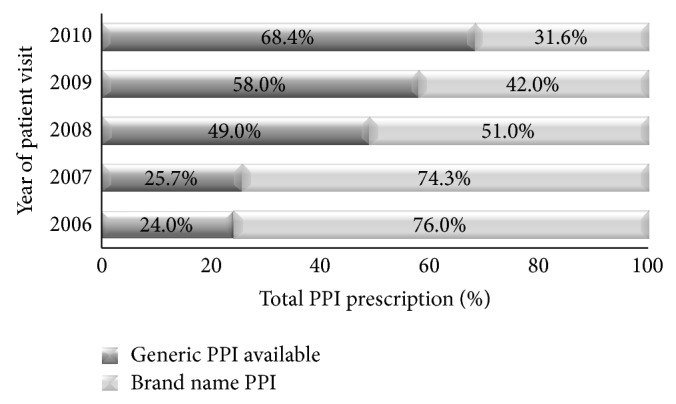
Introduction. Proton pump inhibitors (PPI) are one of the most commonly prescribed medication classes with similar efficacy between brand name and generic PPI formulations. Aims. We determined demographic, clinical, and practice characteristics associated with brand name PPI prescriptions at ambulatory care visits in the United States. Methods. Observational cross sectional analysis using the National Ambulatory Medical Care Survey (NAMCS) of all adult (≥18 yrs of age) ambulatory care visits from 2006 to 2010. PPI prescriptions were identified by using the drug entry code as brand name only or generic available formulations. Descriptive statistics were reported in terms of unweighted patient visits and proportions of encounters with brand name PPI prescriptions. Global chi-square tests were used to compare visits with brand name PPI prescriptions versus generic PPI prescriptions for each measure. Poisson regression was used to determine the incidence rate ratio (IRR) for generic versus brand PPI prescribing. Results. A PPI was prescribed at 269.7 million adult ambulatory visits, based on 9,677 unweighted visits, of which 53% were brand name only prescriptions. In 2006, 76.0% of all PPI prescriptions had a brand name only formulation compared to 31.6% of PPI prescriptions in 2010. Visits by patients aged 25-44 years had the greatest proportion of brand name PPI formulations (57.9%). Academic medical centers and physician-owned practices had the greatest proportion of visits with brand name PPI prescriptions (58.9% and 55.6% of visits with a PPI prescription, resp.). There were no significant differences in terms of median income, patient insurance type, or metropolitan status when comparing the proportion of visits with brand name versus generic PPI prescriptions. Poisson regression results showed that practice ownership type was most strongly associated with the likelihood of receiving a brand name PPI over the entire study period. Compared to HMO visits, patient visits at academic medical centers (IRR 4.2, 95% CI 2.2-8.0), physician-owned practices (IRR 3.9, 95% CI 2.1-7.1), and community health centers (IRR 3.6, 95% CI 1.9-6.6) were all more likely to have brand name PPIs. Conclusion. PPI prescriptions with brand name only formulations are most strongly associated with physician practice type.
引言。质子泵抑制剂(PPI)是最常开具的药物类别之一,品牌名PPI制剂和通用型PPI制剂疗效相似。目的。我们确定了与美国门诊就诊时开具品牌名PPI处方相关的人口统计学、临床和实践特征。方法。使用2006年至2010年全国门诊医疗调查(NAMCS)对所有成年(≥18岁)门诊就诊进行观察性横断面分析。通过仅使用药物录入代码将PPI处方识别为品牌名或通用型可用制剂。描述性统计以未加权的患者就诊次数以及开具品牌名PPI处方的就诊比例来报告。对于各项指标,使用全局卡方检验比较开具品牌名PPI处方的就诊与开具通用型PPI处方的就诊情况。使用泊松回归来确定通用型PPI与品牌名PPI处方开具的发病率比(IRR)。结果。基于9677次未加权就诊,在2.697亿次成年门诊就诊中开具了PPI,其中53%为仅品牌名处方。2006年,所有PPI处方中76.0%为仅品牌名制剂,而2010年这一比例为31.6%。25 - 44岁患者的就诊中品牌名PPI制剂比例最高(57.9%)。学术医疗中心和医生拥有的诊所开具品牌名PPI处方的就诊比例最高(分别为开具PPI处方就诊的58.9%和55.6%)。在比较开具品牌名PPI处方与通用型PPI处方的就诊比例时,在中位数收入、患者保险类型或大都市地位方面没有显著差异。泊松回归结果表明,在整个研究期间,实践所有权类型与开具品牌名PPI的可能性关联最为紧密。与健康维护组织(HMO)就诊相比,学术医疗中心的患者就诊(IRR 4.2,95%置信区间2.2 - 8.0)、医生拥有的诊所(IRR 3.9,95%置信区间2.1 - 7.1)以及社区卫生中心(IRR 3.6,95%置信区间1.9 - 6.6)开具品牌名PPI的可能性都更高。结论。仅品牌名制剂的PPI处方与医生实践类型关联最为紧密。