Slesnick Natasha, Guo Xiamei, Brakenhoff Brittany, Bantchevska Denitza
Department of Human Sciences, The Ohio State University.
Department of Human Sciences, The Ohio State University.
J Subst Abuse Treat. 2015 Jul;54:1-13. doi: 10.1016/j.jsat.2015.02.001. Epub 2015 Feb 18.
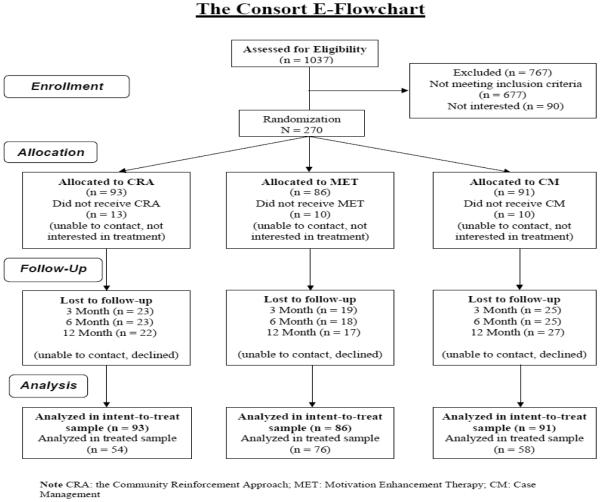
While research on homeless adolescents and young adults evidencing substance use disorder is increasing, there is a dearth of information regarding effective interventions, and more research is needed to guide those who serve this population. The current study builds upon prior research showing promising findings of the community reinforcement approach (CRA) (Slesnick, Prestopnik, Meyers, & Glassman, 2007). Homeless adolescents and young adults between the ages of 14 to 20 years were randomized to one of three theoretically distinct interventions: (1) CRA (n = 93), (2) motivational enhancement therapy (MET, n = 86), or (3) case management (CM, n = 91). The relative effectiveness of these interventions was evaluated at 3, 6, and 12 months post-baseline. Findings indicated that substance use and associated problems were significantly reduced in all three interventions across time. Several moderating effects were found, especially for sex and history of childhood abuse. Findings show little evidence of superiority or inferiority of the three interventions and suggest that drop-in centers have choices for addressing the range of problems that these adolescents and young adults face.
虽然针对有物质使用障碍的无家可归青少年和青年的研究在不断增加,但关于有效干预措施的信息却很匮乏,因此需要更多研究来指导为这一人群提供服务的人员。当前的研究建立在先前研究的基础上,先前研究显示社区强化法(CRA)有一些有前景的研究结果(斯莱斯尼克、普雷斯托普尼克、迈尔斯和格拉斯曼,2007年)。14至20岁的无家可归青少年和青年被随机分配到三种理论上不同的干预措施之一:(1)社区强化法(n = 93),(2)动机增强疗法(MET,n = 86),或(3)个案管理(CM,n = 91)。在基线后的3个月、6个月和12个月评估了这些干预措施的相对有效性。研究结果表明,随着时间的推移,所有三种干预措施中的物质使用及相关问题都显著减少。发现了几种调节效应,尤其是关于性别和童年虐待史的调节效应。研究结果几乎没有显示出这三种干预措施有优劣之分,并表明救助中心在解决这些青少年和青年面临的一系列问题方面有多种选择。