Department of Psychiatry, University of Cambridge, Cambridge, United Kingdom.
Department of Public Health and Primary Care, University of Cambridge, Cambridge, United Kingdom.
PLoS One. 2024 Apr 3;19(4):e0297865. doi: 10.1371/journal.pone.0297865. eCollection 2024.
Homelessness is a growing public health challenge in the United Kingdom and internationally, with major consequences for physical and mental health. Women represent a particularly vulnerable subgroup of the homeless population, with some evidence suggesting that they suffer worse mental health outcomes than their male counterparts. Interventions aimed at improving the lives of homeless women have the potential to enhance mental health and reduce the burden of mental illness in this population. This review synthesised the evidence on the effectiveness and acceptability of interventions which aim to improve mental health outcomes in homeless women.
Five electronic bibliographic databases: MEDLINE, PsycInfo, CINAHL, ASSIA and EMBASE, were searched. Studies were included if they measured the effectiveness or acceptability of any intervention in improving mental health outcomes in homeless women. Study quality was assessed using the Effective Public Health Practice Project (EPHPP) Quality Assessment Tool. A narrative summary of the study findings in relation to the research questions was produced.
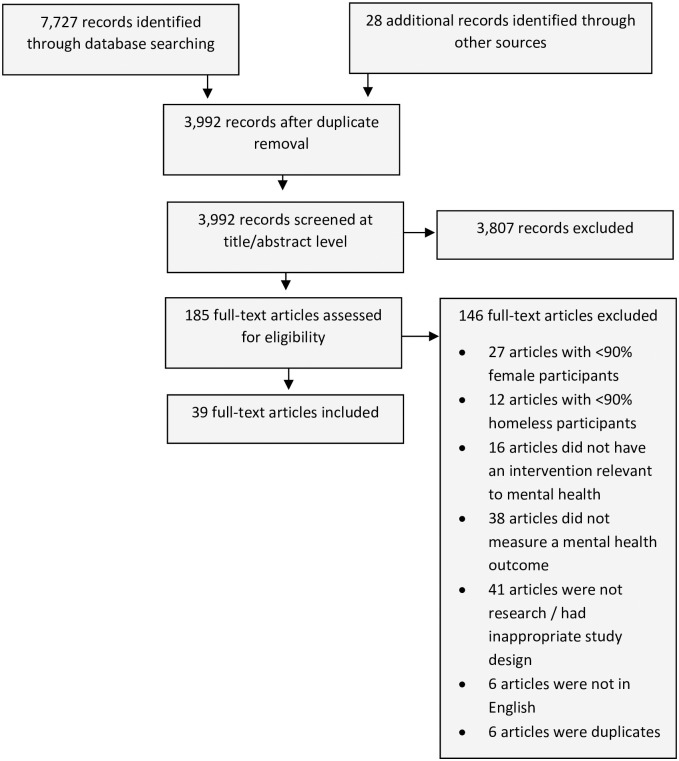
Thirty-nine studies met inclusion criteria. Overall, there was moderate evidence of the effectiveness of interventions in improving mental health outcomes in homeless women, both immediately post-intervention and at later follow-up. The strongest evidence was for the effectiveness of psychotherapy interventions. There was also evidence that homeless women find interventions aimed at improving mental health outcomes acceptable and helpful.
Heterogeneity in intervention and study methodology limits the ability to draw definitive conclusions about the extent to which different categories of intervention improve mental health outcomes in homeless women. Future research should focus on lesser-studied intervention categories, subgroups of homeless women and mental health outcomes. More in-depth qualitative research of factors that enhance or diminish the acceptability of mental health interventions to homeless women is also required.
无家可归是英国和国际上日益严重的公共卫生挑战,对身心健康有重大影响。女性是无家可归人群中特别脆弱的亚组,有证据表明她们的心理健康状况比男性更差。旨在改善无家可归妇女生活的干预措施有可能改善她们的心理健康,并减轻该人群的精神疾病负担。本综述综合了旨在改善无家可归妇女心理健康结果的干预措施的有效性和可接受性的证据。
检索了五个电子文献数据库:MEDLINE、PsycInfo、CINAHL、ASSIA 和 EMBASE。如果研究测量了任何干预措施在改善无家可归妇女心理健康结果方面的有效性或可接受性,则将其纳入研究。使用有效公共卫生实践项目(EPHPP)质量评估工具评估研究质量。根据研究问题,以叙述性摘要的形式总结研究结果。
39 项研究符合纳入标准。总体而言,干预措施在改善无家可归妇女心理健康结果方面具有中等程度的有效性,无论是在干预后即刻还是在后期随访中。心理治疗干预的证据最强。也有证据表明,无家可归妇女认为旨在改善心理健康结果的干预措施是可以接受和有帮助的。
干预措施和研究方法的异质性限制了得出关于不同类别的干预措施在多大程度上改善无家可归妇女心理健康结果的明确结论的能力。未来的研究应侧重于研究较少的干预类别、无家可归妇女的亚组和心理健康结果。还需要对增强或降低无家可归妇女对心理健康干预措施的可接受性的因素进行更深入的定性研究。