Zhang Yi, Wang Yuting, Wang Lei, Bai Mei, Zhang Xiuwu, Zhu Xiongzhao
Medical Psychological Institute, Second Xiangya Hospital, Central South University,Changsha, PR China (Drs Y. Zhang, Y. Wang, L. Wang, Bai, and Zhu); Department of Radiation Oncology, University of Maryland, Baltimore, MD (Drs Y. Zhang and X. Zhang); National Technology Institute of Psychiatry, Central South University, Changsha, PR China (Drs Y. Wang and L. Wang); Key Laboratory of Psychiatry and Mental Health of Hunan Province, Central South University, Changsha, PR China (Drs Bai and Zhu).
Int J Neuropsychopharmacol. 2015 Mar 3;18(8):pyv025. doi: 10.1093/ijnp/pyv025.
Early life stress has been demonstrated to increase the risk of developing depression in adulthood. However, the roles and associated molecular mechanisms of stresses in the onset and relapse of depression have yet to be fully elucidated.
Depression-like behaviors were induced in rats by maternal deprivation and chronic unpredictable stress. Depression- and anxiety-like behaviors of rats, dopamine receptor D2 level, and microRNAs expression in rats' brain tissues were measured.
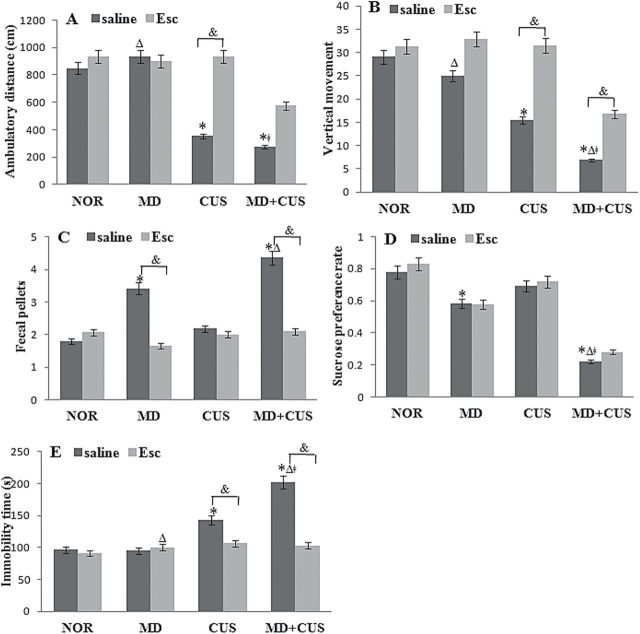
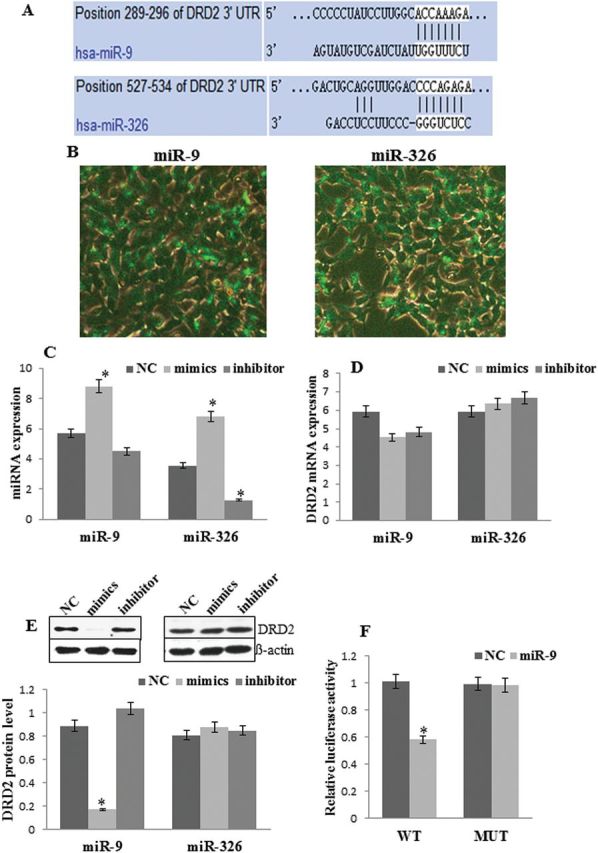
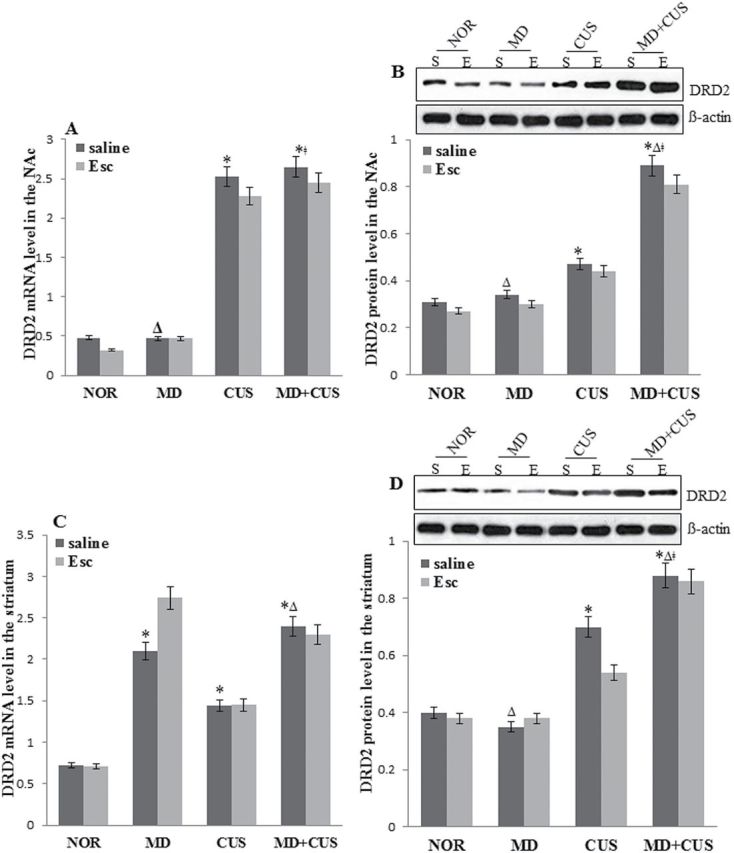
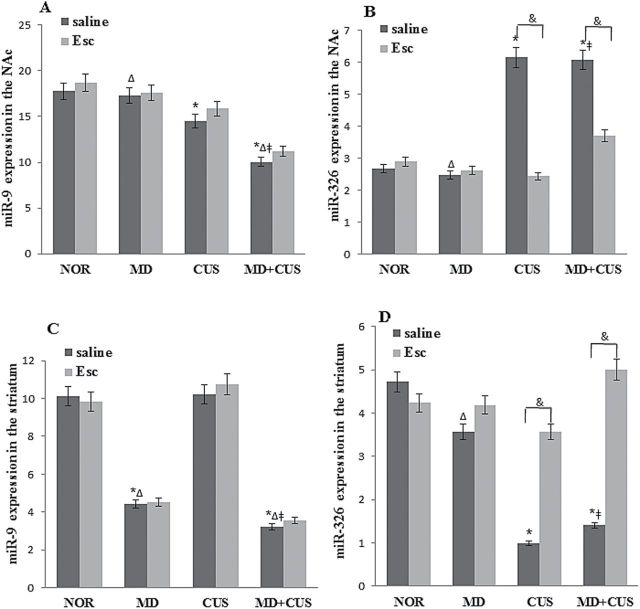
Chronic unpredictable stress alone induced depression-like behaviors in rats, but maternal deprivation enhanced the effect of chronic unpredictable stress. Escitalopram significantly decreased depression-like behaviors in chronic unpredictable stress rats but was less effective in maternal deprivation with chronic unpredictable stress rats. Maternal deprivation increased dopamine receptor D2 messenger RNA expression and decreased microRNA-9 expression in the striatum. Chronic unpredictable stress increased dopamine receptor D2 mRNA and protein levels and decreased microRNA-9 expression in the nucleus accumbens. Furthermore, maternal deprivation enhanced the effect of chronic unpredictable stress on dopamine receptor D2 gene and microRNA-9 expression. Chronic unpredictable stress increased the expression of microRNA-326 in the nucleus accumbens but decreased it in the striatum, whereas maternal deprivation elevated microRNA-326 expression in the striatum. Escitalopram normalized microRNA-326 expression but had no effect on the expression of microRNA-9, dopamine receptor D2 mRNA, and dopamine receptor D2 protein in both the nucleus accumbens and striatum. The in vitro study showed that only microRNA-9 directly targeted the 3' untranslated region of dopamine receptor D2 mRNA and inhibited dopamine receptor D2 protein expression.
Early life stress enhanced the susceptibility to late life stress and resistance to escitalopram treatment through decreasing microRNA-9 expression and subsequently upregulating dopamine receptor D2 expression in the nucleus accumbens. microRNA-326 may be a novel target of escitalopram.
早期生活应激已被证明会增加成年后患抑郁症的风险。然而,应激在抑郁症发作和复发中的作用及相关分子机制尚未完全阐明。
通过母婴分离和慢性不可预测应激诱导大鼠出现抑郁样行为。测量大鼠的抑郁样和焦虑样行为、多巴胺受体D2水平以及大鼠脑组织中的微小RNA表达。
单独的慢性不可预测应激可诱导大鼠出现抑郁样行为,但母婴分离增强了慢性不可预测应激的作用。艾司西酞普兰显著降低了慢性不可预测应激大鼠的抑郁样行为,但对母婴分离合并慢性不可预测应激大鼠的效果较差。母婴分离增加了纹状体中多巴胺受体D2信使核糖核酸的表达并降低了微小RNA-9的表达。慢性不可预测应激增加了伏隔核中多巴胺受体D2信使核糖核酸和蛋白质水平并降低了微小RNA-9的表达。此外,母婴分离增强了慢性不可预测应激对多巴胺受体D2基因和微小RNA-9表达的影响。慢性不可预测应激增加了伏隔核中微小RNA-326的表达,但降低了纹状体中的表达,而母婴分离则提高了纹状体中微小RNA-326的表达。艾司西酞普兰使微小RNA-326表达正常化,但对伏隔核和纹状体中微小RNA-9、多巴胺受体D2信使核糖核酸和多巴胺受体D2蛋白质的表达均无影响。体外研究表明,只有微小RNA-9直接靶向多巴胺受体D2信使核糖核酸的3'非翻译区并抑制多巴胺受体D2蛋白质表达。
早期生活应激通过降低微小RNA-9表达并随后上调伏隔核中多巴胺受体D2表达,增强了对晚年应激的易感性和对艾司西酞普兰治疗的抗性。微小RNA-326可能是艾司西酞普兰的一个新靶点。