Medical Psychological Institute, Second Xiangya Hospital, Central South University, Changsha, Hunan, China.
PLoS One. 2012;7(10):e46921. doi: 10.1371/journal.pone.0046921. Epub 2012 Oct 8.
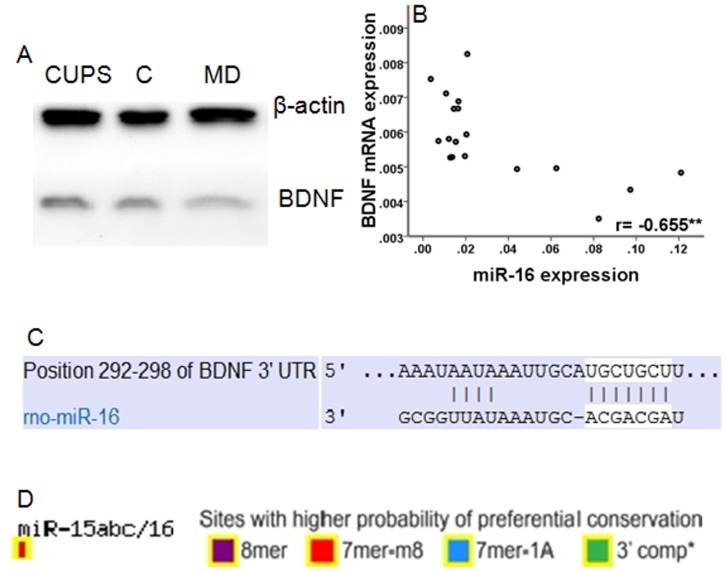
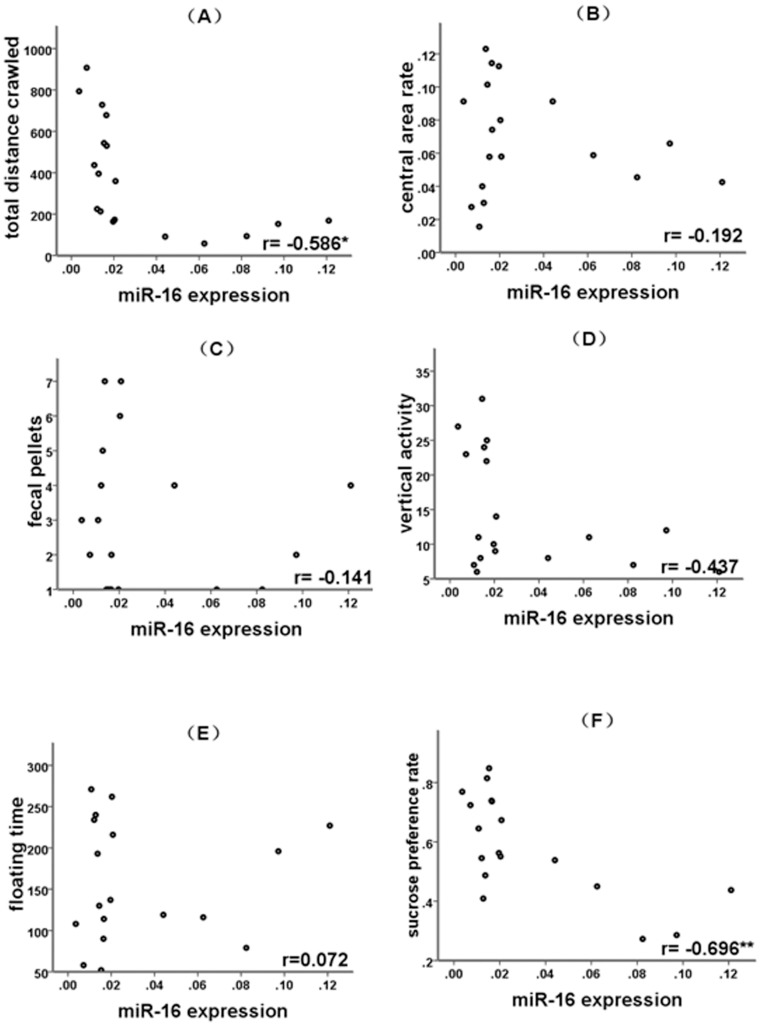
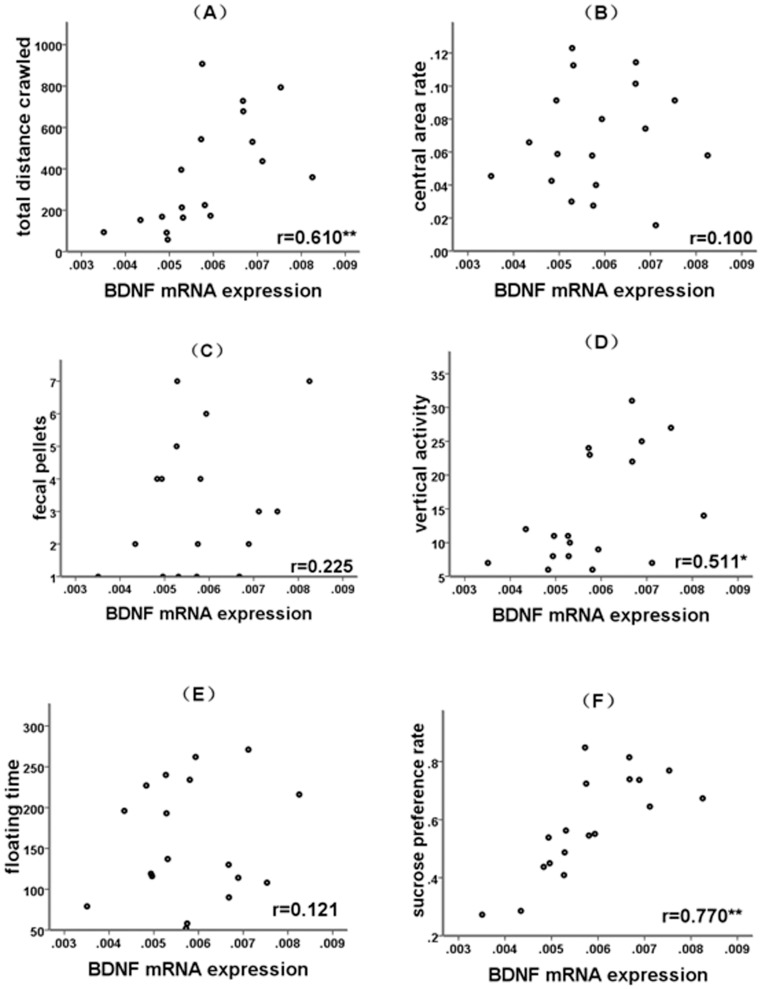
Some environmental stressors lead to the onset of depression via inhibiting hippocampal BDNF expression, but other environmental stressors-induced depression exhibits no change in BDNF expression. The underlying mechanisms behind the divergence remain unknown. In this study, depression-like behaviors were induced in rats by maternal deprivation (MD) and chronic unpredictable stress (CUPS). Depression-like behaviors were tested by open field test, forced swimming test, and sucrose consumption test. BDNF and miR-16 expressions in the hippocampus were examined by real-time PCR. MD and CUPS rats crawled less distance, exhibited decreased vertical activity, and produced more fecal pellets than control rats in the open field test. However, MD rats crawled less distance and produced significantly less fecal pellets than CUPS rats. In the forced swimming and sucrose consumption tests, CUPS and MD rats exhibited longer floating time and consumed less sucrose than control rats, but MD rats exhibited shorter floating time and consumed less sucrose than CUPS rats. MD but not CUPS rats showed lower BDNF mRNA and higher miR-16 expression than control rats. In MD rats, BDNF mRNA expression negatively correlated with the expression of miR-16. BDNF expression positively correlated with the total distance rats crawled and vertical activity in the open field test while miR-16 expression negatively correlated the two behaviors. BDNF positively correlated with sucrose preference rate while miR-16 negatively correlated with sucrose preference rate of the sucrose consumption test. Our study suggests that MD and CUPS induced different depression-like behaviors in rats. Depression induced by MD but not CUPS was significantly associated with upregulation of miR-16 and possibly subsequent downregulation of BDNF in hippocampus.
一些环境应激源通过抑制海马 BDNF 表达导致抑郁的发生,但其他环境应激源诱导的抑郁则没有 BDNF 表达的变化。这种分歧的潜在机制尚不清楚。在这项研究中,通过母婴分离(MD)和慢性不可预测应激(CUPS)诱导大鼠出现抑郁样行为。通过旷场试验、强迫游泳试验和蔗糖消耗试验测试抑郁样行为。通过实时 PCR 检测海马中的 BDNF 和 miR-16 表达。与对照组相比,MD 和 CUPS 大鼠在旷场试验中爬行距离减少,垂直活动减少,粪便颗粒增多。然而,MD 大鼠的爬行距离和粪便颗粒明显少于 CUPS 大鼠。在强迫游泳和蔗糖消耗试验中,CUPS 和 MD 大鼠的漂浮时间较长,蔗糖消耗较少,但 MD 大鼠的漂浮时间较短,蔗糖消耗较少。MD 大鼠而非 CUPS 大鼠的 BDNF mRNA 表达降低,miR-16 表达升高。在 MD 大鼠中,BDNF mRNA 表达与 miR-16 的表达呈负相关。BDNF 表达与大鼠在旷场试验中的爬行总距离和垂直活动呈正相关,而 miR-16 表达与这两种行为呈负相关。BDNF 与蔗糖偏好率呈正相关,而 miR-16 与蔗糖消耗试验中的蔗糖偏好率呈负相关。我们的研究表明,MD 和 CUPS 在大鼠中引起不同的抑郁样行为。MD 诱导的抑郁而非 CUPS 诱导的抑郁与海马中 miR-16 的上调和可能随后的 BDNF 下调显著相关。