Lopes e Souza Thiago Moreno, Fintelman-Rodrigues Natalia, Resende Paola Cristina, Mesquita Milene, Gregianini Tatiana Schaffer, Bozza Fernando A, Pecego Ana Carla, Fernandes Sandra Bianchini, Cury Ana Luisa Furtado, Riediger Irina Nastassja, Siqueira Marilda M
Laboratório de Vírus Respiratórios e do Sarampo.
Fundação Estadual de Produção e Pesquisa em Saúde, Porto Alegre, RS, Brasil.
Mem Inst Oswaldo Cruz. 2015 Feb;110(1):101-5. doi: 10.1590/0074-02760140330. Epub 2015 Feb 27.
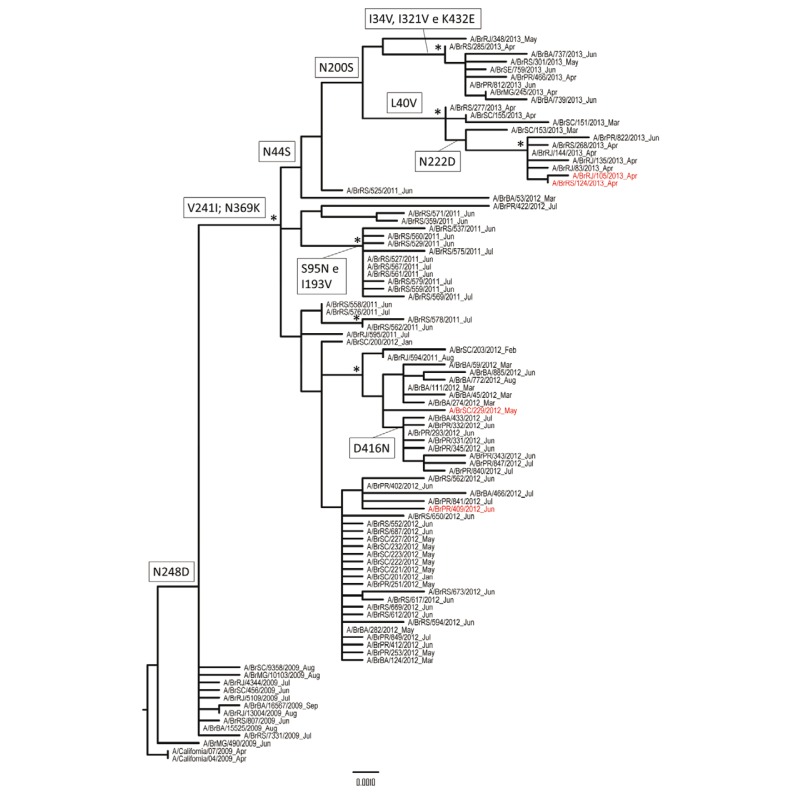
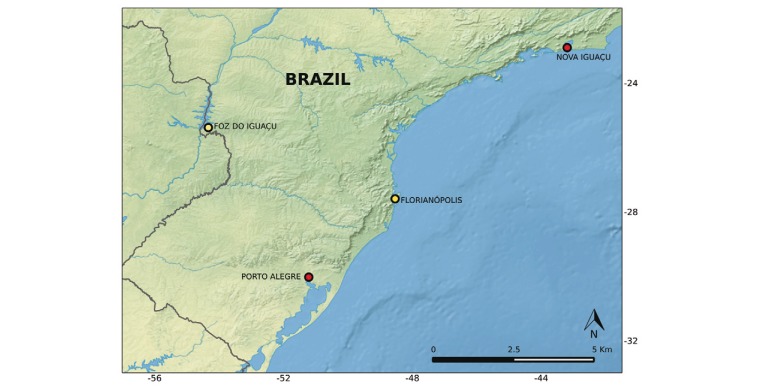
The 2009 pandemic influenza A virus outbreak led to the systematic use of the neuraminidase (NA) inhibitor oseltamivir (OST). Consequently, OST-resistant strains, carrying the mutation H275Y, emerged in the years after the pandemics, with a prevalence of 1-2%. Currently, OST-resistant strains have been found in community settings, in untreated individuals. To spread in community settings, H275Y mutants must contain additional mutations, collectively called permissive mutations. We display the permissive mutations in NA of OST-resistant A(H1N1)pdm09 virus found in Brazilian community settings. The NAs from 2013 are phylogenetically distinct from those of 2012, indicating a tendency of positive selection of NAs with better fitness. Some previously predicted permissive mutations, such as V241I and N369K, found in different countries, were also detected in Brazil. Importantly, the change D344N, also predicted to compensate loss of fitness imposed by H275Y mutation, was found in Brazil, but not in other countries in 2013. Our results reinforce the notion that OST-resistant A(H1N1)pdm09 strains with compensatory mutations may arise in an independent fashion, with samples being identified in different states of Brazil and in different countries. Systematic circulation of these viral strains may jeopardise the use of the first line of anti-influenza drugs in the future.
2009年甲型H1N1流感大流行导致了神经氨酸酶(NA)抑制剂奥司他韦(OST)的广泛使用。结果,携带H275Y突变的奥司他韦耐药菌株在大流行后的几年中出现,流行率为1%-2%。目前,在社区环境中未接受治疗的个体中发现了奥司他韦耐药菌株。为了在社区环境中传播,H275Y突变体必须包含其他突变,统称为许可突变。我们展示了在巴西社区环境中发现的奥司他韦耐药A(H1N1)pdm09病毒NA中的许可突变。2013年的NA在系统发育上与2012年的不同,表明具有更好适应性的NA有正选择趋势。一些先前在不同国家发现的预测许可突变,如V241I和N369K,在巴西也被检测到。重要的是,预计能补偿H275Y突变导致的适应性损失的D344N变化在2013年的巴西被发现,但在其他国家未被发现。我们的结果强化了这样一种观念,即带有补偿性突变的奥司他韦耐药A(H1N1)pdm09菌株可能以独立的方式出现,在巴西的不同州和不同国家都有样本被鉴定出来。这些病毒株的系统性传播可能会危及未来一线抗流感药物的使用。