Ghanbarian Avazeh T, Hurst Laurence D
Department of Biology and Biochemisty, University of Bath, Bath, United Kingdom.
Department of Biology and Biochemisty, University of Bath, Bath, United Kingdom
Mol Biol Evol. 2015 Jul;32(7):1748-66. doi: 10.1093/molbev/msv053. Epub 2015 Mar 4.
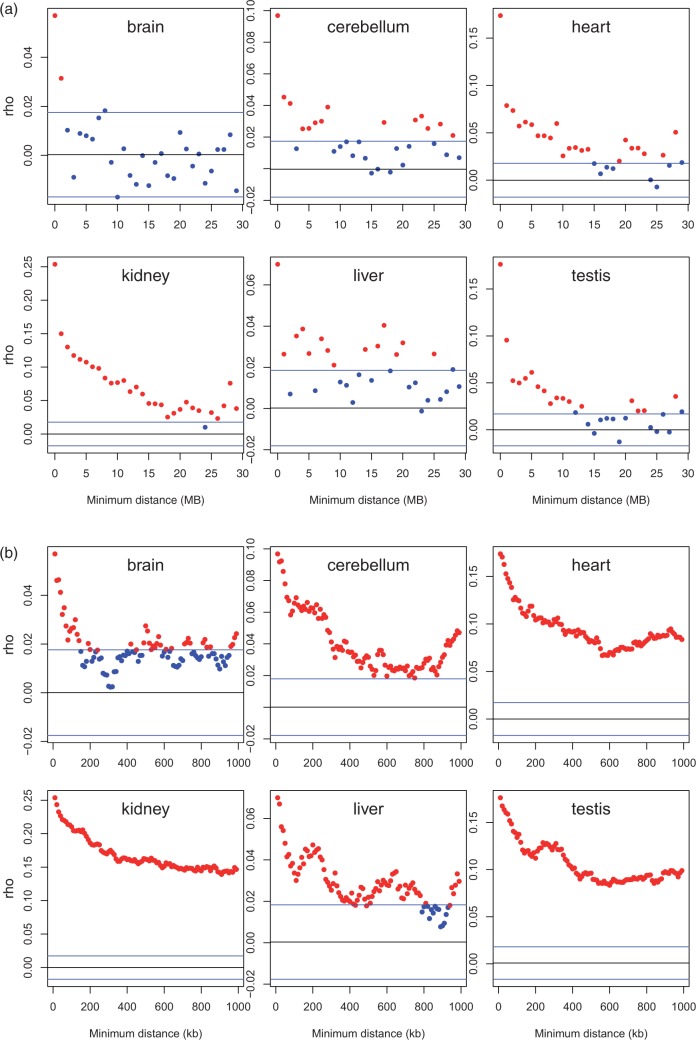
When considering the evolution of a gene's expression profile, we commonly assume that this is unaffected by its genomic neighborhood. This is, however, in contrast to what we know about the lack of autonomy between neighboring genes in gene expression profiles in extant taxa. Indeed, in all eukaryotic genomes genes of similar expression-profile tend to cluster, reflecting chromatin level dynamics. Does it follow that if a gene increases expression in a particular lineage then the genomic neighbors will also increase in their expression or is gene expression evolution autonomous? To address this here we consider evolution of human gene expression since the human-chimp common ancestor, allowing for both variation in estimation of current expression level and error in Bayesian estimation of the ancestral state. We find that in all tissues and both sexes, the change in gene expression of a focal gene on average predicts the change in gene expression of neighbors. The effect is highly pronounced in the immediate vicinity (<100 kb) but extends much further. Sex-specific expression change is also genomically clustered. As genes increasing their expression in humans tend to avoid nuclear lamina domains and be enriched for the gene activator 5-hydroxymethylcytosine, we conclude that, most probably owing to chromatin level control of gene expression, a change in gene expression of one gene likely affects the expression evolution of neighbors, what we term expression piggybacking, an analog of hitchhiking.
在考虑基因表达谱的进化时,我们通常假定这不受其基因组邻域的影响。然而,这与我们所知的现存分类群中基因表达谱中相邻基因之间缺乏自主性的情况形成对比。事实上,在所有真核生物基因组中,具有相似表达谱的基因往往会聚集在一起,这反映了染色质水平的动态变化。那么,如果一个基因在特定谱系中表达增加,其基因组邻居的表达也会增加吗?还是基因表达进化是自主的呢?为了解决这个问题,我们在这里考虑自人类与黑猩猩的共同祖先以来人类基因表达的进化,同时考虑当前表达水平估计的变化以及祖先状态贝叶斯估计中的误差。我们发现,在所有组织和两性中,一个焦点基因的基因表达变化平均可以预测其邻居的基因表达变化。这种效应在紧邻区域(<100 kb)非常明显,但影响范围更广。性别特异性的表达变化在基因组上也是聚集的。由于在人类中表达增加的基因倾向于避开核纤层结构域,并富含基因激活剂5-羟甲基胞嘧啶,我们得出结论,很可能由于基因表达的染色质水平控制,一个基因的表达变化可能会影响其邻居的表达进化,我们将其称为表达搭便车,这是一种类似于搭便车的现象。