Department of Evolution and Development, EBC, Uppsala University, Sweden.
BMC Genomics. 2010 Nov 3;11:614. doi: 10.1186/1471-2164-11-614.
Sexual dimorphism in brain gene expression has been recognized in several animal species. However, the relevant regulatory mechanisms remain poorly understood. To investigate whether sex-biased gene expression in mammalian brain is globally regulated or locally regulated in diverse brain structures, and to study the genomic organisation of brain-expressed sex-biased genes, we performed a large scale gene expression analysis of distinct brain regions in adult male and female mice.
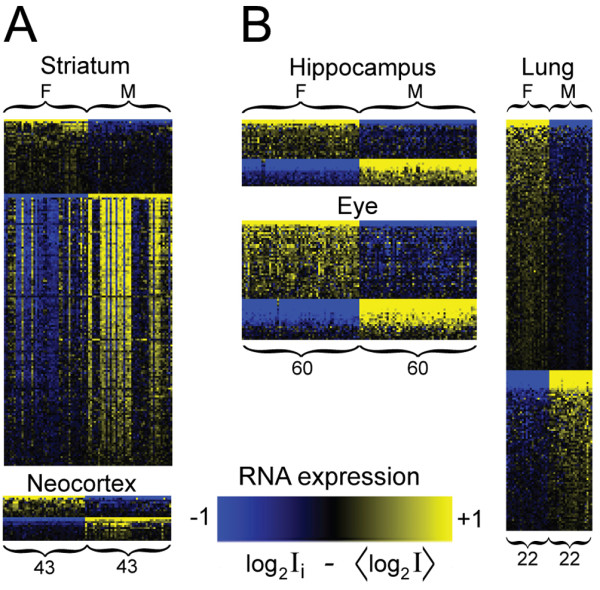
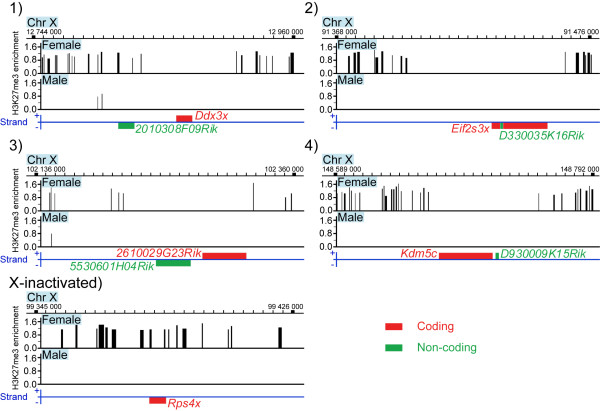
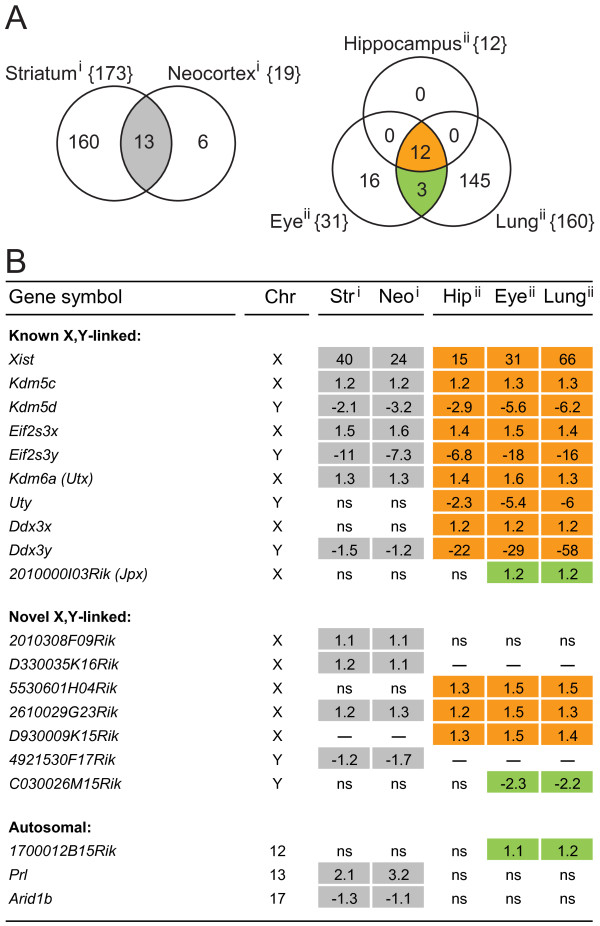
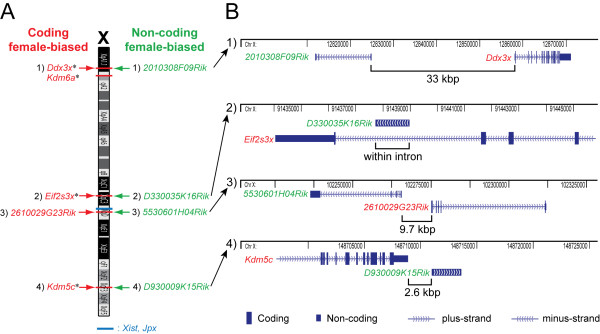
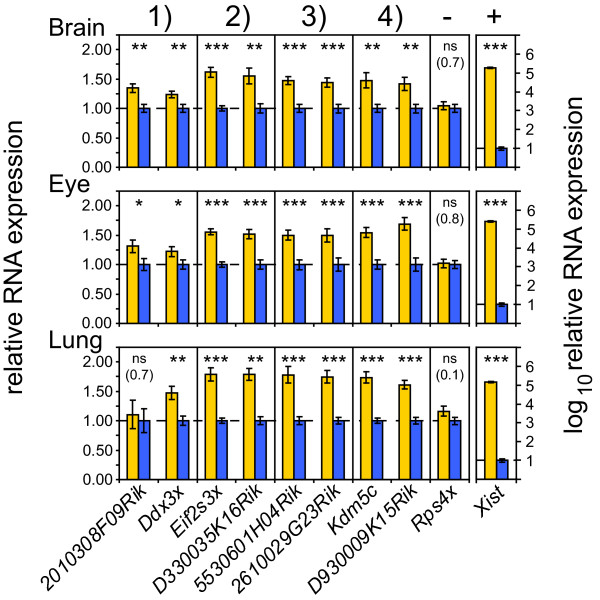
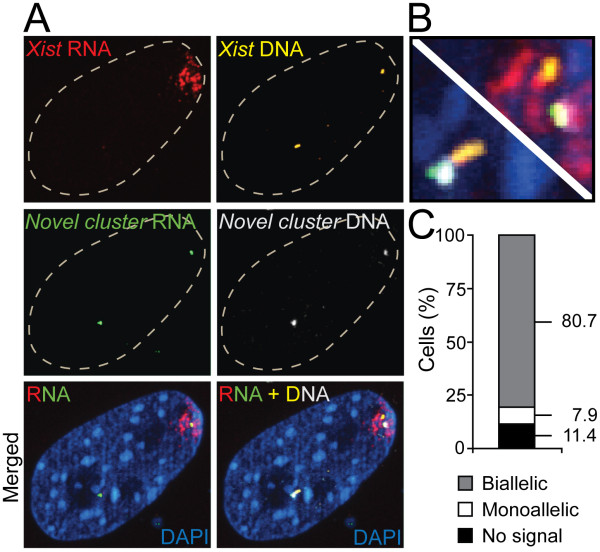
This study revealed spatial specificity in sex-biased transcription in the mouse brain, and identified 173 sex-biased genes in the striatum; 19 in the neocortex; 12 in the hippocampus and 31 in the eye. Genes located on sex chromosomes were consistently over-represented in all brain regions. Analysis on a subset of genes with sex-bias in more than one tissue revealed Y-encoded male-biased transcripts and X-encoded female-biased transcripts known to escape X-inactivation. In addition, we identified novel coding and non-coding X-linked genes with female-biased expression in multiple tissues. Interestingly, the chromosomal positions of all of the female-biased non-coding genes are in close proximity to protein-coding genes that escape X-inactivation. This defines X-chromosome domains each of which contains a coding and a non-coding female-biased gene. Lack of repressive chromatin marks in non-coding transcribed loci supports the possibility that they escape X-inactivation. Moreover, RNA-DNA combined FISH experiments confirmed the biallelic expression of one such novel domain.
This study demonstrated that the amount of genes with sex-biased expression varies between individual brain regions in mouse. The sex-biased genes identified are localized on many chromosomes. At the same time, sexually dimorphic gene expression that is common to several parts of the brain is mostly restricted to the sex chromosomes. Moreover, the study uncovered multiple female-biased non-coding genes that are non-randomly co-localized on the X-chromosome with protein-coding genes that escape X-inactivation. This raises the possibility that expression of long non-coding RNAs may play a role in modulating gene expression in domains that escape X-inactivation in mouse.
在几种动物物种中,大脑基因表达的性别二态性已得到认可。然而,相关的调控机制仍知之甚少。为了研究哺乳动物大脑中的性别偏向性基因表达是在不同的大脑结构中全局调控还是局部调控,以及研究大脑表达性别偏向性基因的基因组组织,我们对成年雄性和雌性小鼠的不同大脑区域进行了大规模的基因表达分析。
本研究揭示了小鼠大脑中性别转录的空间特异性,并在纹状体中鉴定出 173 个性别偏向基因;在新皮质中发现 19 个;在海马体中发现 12 个;在眼睛中发现 31 个。所有大脑区域中,性染色体上的基因都明显过表达。对一组在多个组织中存在性别偏向的基因进行分析,发现了已知逃避 X 染色体失活的 Y 染色体编码的雄性偏向转录本和 X 染色体编码的雌性偏向转录本。此外,我们还鉴定出了新的编码和非编码的 X 连锁基因,这些基因在多种组织中表现出雌性偏向表达。有趣的是,所有雌性偏向非编码基因的染色体位置都与逃避 X 染色体失活的蛋白编码基因非常接近。这定义了 X 染色体的每个区域都包含一个编码和一个非编码的雌性偏向基因。非转录性非编码基因中缺乏抑制性染色质标记,支持了它们逃避 X 染色体失活的可能性。此外,RNA-DNA 联合荧光原位杂交实验证实了一个这样的新区域的双等位基因表达。
本研究表明,在小鼠的不同大脑区域中,具有性别偏向表达的基因数量存在差异。鉴定出的性别偏向基因定位于许多染色体上。同时,大脑多个部位共有的性别二态性基因表达主要局限于性染色体。此外,该研究还发现了多个雌性偏向的非编码基因,它们与逃避 X 染色体失活的蛋白编码基因随机非局部共定位在 X 染色体上。这增加了长非编码 RNA 表达可能在调节逃避 X 染色体失活的小鼠基因表达域中发挥作用的可能性。