Lenz Michael, Goetzke Roman, Schenk Arne, Schubert Claudia, Veeck Jürgen, Hemeda Hatim, Koschmieder Steffen, Zenke Martin, Schuppert Andreas, Wagner Wolfgang
1] Joint Research Center for Computational Biomedicine, RWTH Aachen University, Aachen, Germany [2] Aachen Institute for Advanced Study in Computational Engineering Science (AICES), RWTH Aachen University, Aachen, Germany [3] Institute for Biomedical Engineering - Cell Biology, RWTH Aachen University Medical School, Aachen, Germany.
Helmholtz-Institute for Biomedical Engineering, RWTH Aachen University Medical School, Aachen, Germany.
Sci Rep. 2015 Mar 10;5:8973. doi: 10.1038/srep08973.
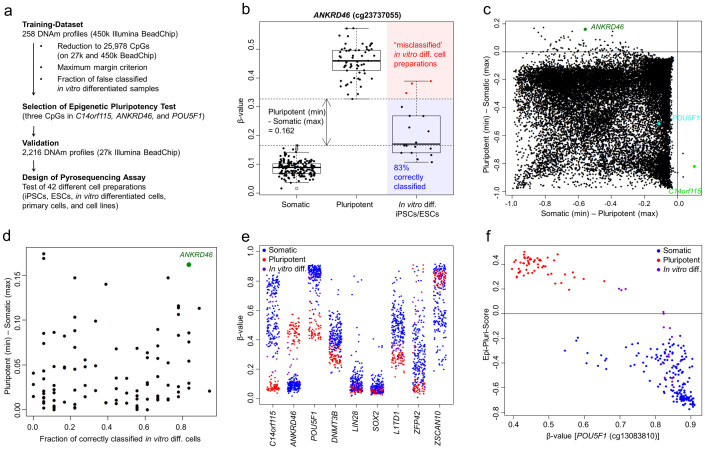
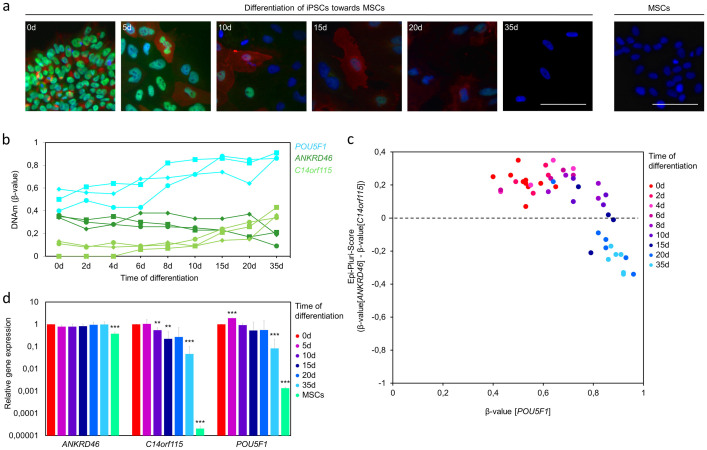
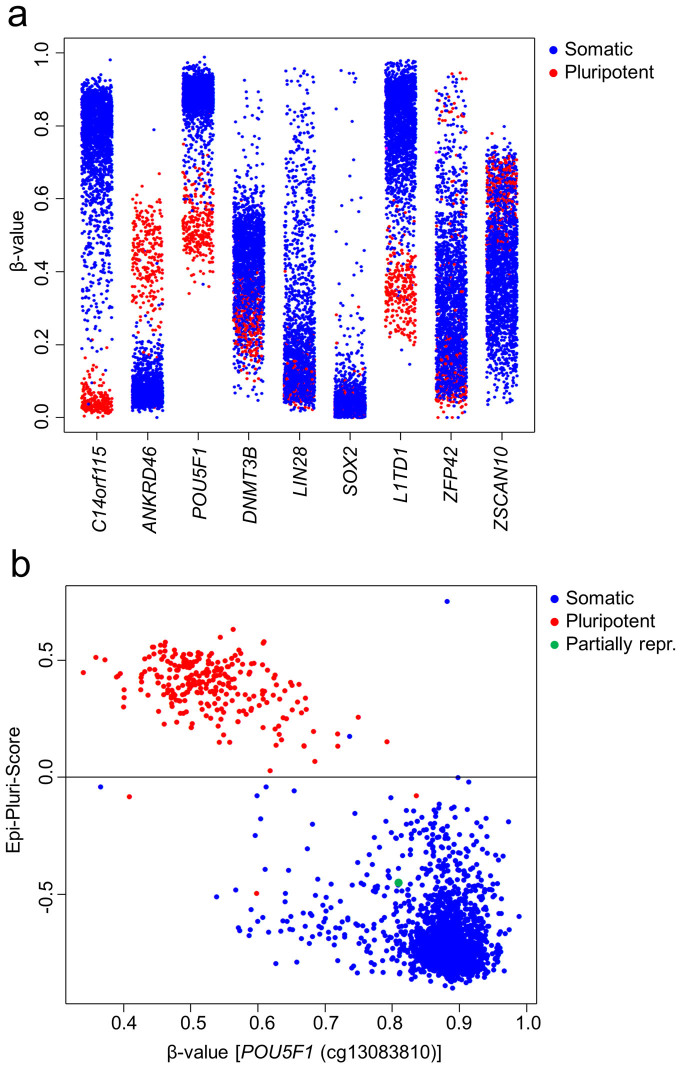
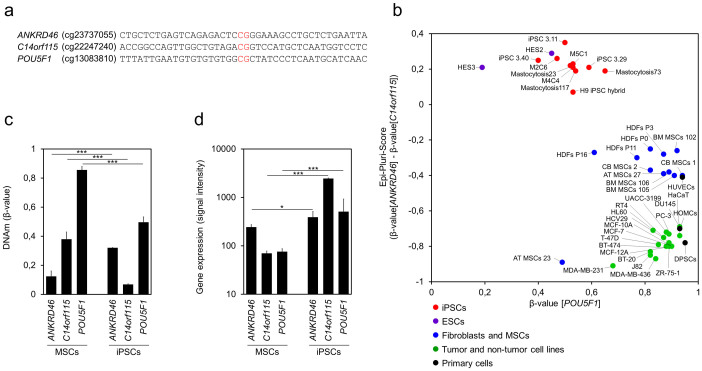
Quality control of human induced pluripotent stem cells (iPSCs) can be performed by several methods. These methods are usually relatively labor-intensive, difficult to standardize, or they do not facilitate reliable quantification. Here, we describe a biomarker to distinguish between pluripotent and non-pluripotent cells based on DNA methylation (DNAm) levels at only three specific CpG sites. Two of these CpG sites were selected by their discriminatory power in 258 DNAm profiles - they were either methylated in pluripotent or non-pluripotent cells. The difference between these two β-values provides an Epi-Pluri-Score that was validated on independent DNAm-datasets (264 pluripotent and 1,951 non-pluripotent samples) with 99.9% specificity and 98.9% sensitivity. This score was complemented by a third CpG within the gene POU5F1 (OCT4), which better demarcates early differentiation events. We established pyrosequencing assays for the three relevant CpG sites and thereby correctly classified DNA of 12 pluripotent cell lines and 31 non-pluripotent cell lines. Furthermore, DNAm changes at these three CpGs were tracked in the course of differentiation of iPSCs towards mesenchymal stromal cells. The Epi-Pluri-Score does not give information on lineage-specific differentiation potential, but it provides a simple, reliable, and robust biomarker to support high-throughput classification into either pluripotent or non-pluripotent cells.
人类诱导多能干细胞(iPSC)的质量控制可通过多种方法进行。这些方法通常相对耗费人力,难以标准化,或者不利于进行可靠的定量分析。在此,我们描述了一种生物标志物,可基于仅三个特定CpG位点的DNA甲基化(DNAm)水平来区分多能细胞和非多能细胞。其中两个CpG位点是根据它们在258个DNAm图谱中的区分能力挑选出来的——它们在多能细胞或非多能细胞中要么发生甲基化。这两个β值之间的差异提供了一个表观多能评分(Epi-Pluri-Score),该评分在独立的DNAm数据集(264个多能样本和1951个非多能样本)上得到验证,特异性为99.9%,灵敏度为98.9%。该评分由POU5F1(OCT4)基因内的第三个CpG位点补充,它能更好地划分早期分化事件。我们针对这三个相关的CpG位点建立了焦磷酸测序分析方法,从而正确地对12个多能细胞系和31个非多能细胞系的DNA进行了分类。此外,在iPSC向间充质基质细胞分化的过程中跟踪了这三个CpG位点的DNAm变化。表观多能评分并未提供关于谱系特异性分化潜能的信息,但它提供了一种简单、可靠且稳健的生物标志物,以支持高通量分类为多能细胞或非多能细胞。